Taxpayer wins Rs 85.3L unexplained cash gift case

Synopsis
Mr Amirtharaj from Thygarayanagar, got Rs 85.03 lakh cash gifts from his sister’s husband, uncle and other relatives, he deposited this cash in his bank account. After this he got an unexplained deposit tax notice. He wins case in ITAT Chennai; Know how.
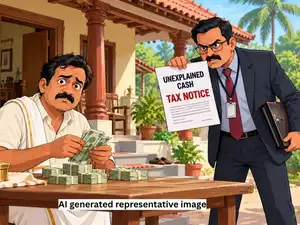
When Mr Amirtharaj from Mylai Ranganathan Street, Thygarayanagar (Chennai), got cash gifts totalling Rs 85.03 lakh from his relatives, he executed gift deeds and then deposited this cash in his bank account. He had no idea at that time that this would result in a tax notice from the income tax department. The gifts were stated to have been received from his wife, paternal uncles, maternal uncle, and sister’s husband, all of whom qualify as “relative” under Income tax law.
As per the Income Tax law, when someone deposits or withdraws a large amount of cash, the bank must file specified financial transaction (SFT) returns. In this case, the concerned bank also reported the transaction made by Amirtharaj to the Income Tax Department.
When the Income Tax Department got to know about this case they started making enquiries about the Rs 85.03 lakh cash deposit. The Income Tax Department also issued tax notices to Amirtharaj’s relatives, who had gifted him that cash. Each of the donors also responded to the tax notices issued to them. The relatives who gifted this cash to Amirtharaj have all verified the gifts, stating that they were given between April and September of 2016.
To further support his argument, Amirtharaj furnished copies of the gift deeds, acknowledgements of ITRs, statements of income, and financial statements of all the donors.
Also read: Medicine shop owner deposits Rs 2.47 crore cash in bank account, gets income tax notice for unexplained cash; wins case in ITAT Delhi for this reason
The Income Tax Assessing Officer (AO) from Chennai was of the opinion that the donors lacked the financial capacity to make such cash gifts. The AO said that the ITR filed by the relatives (donors) and the capital shown in their balance sheets were not commensurate with the quantum of gifts they provided.
So, the income tax department passed its order holding Amirtharaj liable for violation of the income tax law by depositing unexplained cash in his bank account. The Commissioner of Appeals (CIT A) heard his case, and the CIT (A), too, was not convinced with Amirtharaj’s story and hence confirmed the addition of Rs 85.3 lakh on account of gifts received and passed an order on December 29, 2025.
Ultimately on September 18, 2026 Amirtharaj won the case in Income Tax Appellate Tribunal (ITAT) Chennai. Advocate N. Arjun Raj had represented him before ITAT Chennai.
Also read: Grain trader deposited Rs 5.2 crore cash in bank, filed ITR declaring Rs 7.65 lakh income, got unexplained deposit income tax notice; won case in ITAT Delhi for this reason
Why did Amirtharaj win the unexplained cash gift case?
Sarthak Prashar, Director, Global People Solutions at Grant Thornton Bharat, said to ET Wealth Online that Amirtharaj won the case in ITAT Chennai as he submitted sufficient evidence to help establish the identitity of the relatives who had given him this much cash as gifts. The evidence also helped prove the genuineness of the said cash gifts.
Prashar says that Amirtharaj's relatives also confirmed the giving of such gifts and even submitted their ITRs and also furnished gift deeds, financial statements, etc. Thus the ITAT Chennai held that all of these evidence proves that Amirtharaj has discharged his initial burden under Section 68 and now it is upto the Income Tax Department to counter it.
Importantly, Prashar says that ITAT Chennai observed that alone income of a particular donor cannot measure his/her financial capacity to donate as accumulated capital, cash balances, withdrawals, and other available resources also need to be considered.
Prashar says: "Since the Income Tax Department did not bring any positive evidence on record to establish that the money belonged to Amirtharaj, the addition of Rs 85.30 lakh was deleted by ITAT Chennai."
Gifts from relatives are taxed?
Prashar says that gifts from some specified relatives are not taxable even if its value exceeds Rs 50,000. Section 92(5) (g) explains who are these specified relatives: parents, grandparents, spouse, brother, sister, etc
However, as this ITAT Chennai case shows, there is an important distinction between taxability of a gift and substantiation of the transaction. A gift may qualify for exemption because it is received from a specified relative, but the tax authorities can still examine whether the transaction is genuine and supported by appropriate evidence.
In the present case, ITAT Chennai recorded that the wife, paternal uncles, maternal uncle and sister’s husband were relatives for the purposes of the law. However, the dispute was not whether gifts from relatives were exempt from tax, but whether Amirtharaj had adequately established the identity of the donors, genuineness of the gifts and the evidentiary requirements applicable to unexplained credits.
Prashar says that a genuine gift from a specified relative may be exempt from income tax, but the supporting documentation should be as credible as the gift transaction itself like what Amirtharaj did in this ITAT Chennai case. He proved with evidence about the gift, the donors, the financial statements, etc.
For substantial gifts, Prashar says that it is advisable to use banking channels to make the gift, retain the proof of relationship and maintain records supporting the genuineness of the said gift transaction.
Table showing gift taxation:
| Person giving the gift |
Tax treatment |
| Spouse |
Tax-free |
| Brother or sister |
Tax-free |
| Brother or sister of spouse |
Tax-free |
| Brother or sister of either parent |
Tax-free |
| Parents and grandparents |
Tax-free |
| Children and grandchildren |
Tax-free |
| Lineal ascendants or descendants of spouse |
Tax-free |
| Spouse of the specified relatives |
Tax-free |
| Cousin |
Not covered merely by being a cousin |
| Friend or other non-relative |
Rs 50,000 threshold becomes relevant |
Source: Grant Thornton Bharat
Also read: Fruit seller deposited large amount of cash in bank, got income tax notice of unexplained income; won case in ITAT Bangalore for this reason
Also read: Rs 2.42 lakh FD investment and Rs 1.06 lakh cash deposits, no ITR filed, got income tax notice; senior citizen wins case in ITAT Jaipur after 9-year fight
Do we need to file an ITR or execute a gift deed for exempt gifts?
Prashar says that getting an tax exempt gift from a relative does not, by itself, create an obligation to file an income-tax return (ITR). The requirement to file an ITR depends on the recipient’s overall income and other applicable return-filing provisions. In the case of a monetary gift, a gift deed is not mandatorily required under the income-tax law. However, where the amount involved is significant, documenting the gift is advisable.
According to Prashar, the documents, evidence, gif deed, etc should ideally record the identity of the donor and who is getting this gift and what is their relationship and the amount and the date of gift and importantly the fact that the said gift has been made without any consideration in return.
In Amirtharaj's case, he submitted gift deeds and financial records, and the donors independently confirmed the gifts before the income tax authorities, so he won the case.
Also read: Son sells ancestral land for Rs 8 crore, buys 2 more properties; gets income tax notice but wins at ITAT Chandigarh: Know why
ITAT Chennai discussion
The principal issue which ITAT Chennai decided was whether the cash gifts amounting to Rs 85.3 lakh was indeed unexplained cash credits under Section 68 as assumed by the Income Tax Department.
ITAT Chennai said that in their considered opinion, once Amirtharaj had produced the confirmations of the donors, gift deeds, copies of income tax returns (ITR), financial statements and the donors themselves had admitted having made the gifts in response to notices issued under Section 133(6), the initial burden cast upon Amirtharaj under Section 68 stood discharged.
ITAT Chennai said that thereafter, if the AO entertained any doubt regarding the actual source of funds available with the respective donors, it was incumbent upon the Income Tax Department to undertake appropriate enquiry in the assessments of such donors.
ITAT Chennai said: “The addition in the hands of the recipient (Amirtharaj) cannot be sustained merely because the AO entertains suspicion regarding the source available with the donors, particularly when the identity of the donors and the genuineness of the transactions have not been disputed.”
ITAT Chennai said that they find considerable force in the contention of Advocate N. Arjun Raj, who represented Amirtharaj.
ITAT Chennai said that the settled position of law is that, except where the statute specifically mandates otherwise, an assessee cannot ordinarily be called upon to establish the source of funds in the hands of the creditor once the identity of the creditor, genuineness of the transaction and the basic creditworthiness have been established.
Similarly, in the case of the other donors, ITAT Chennai observed that the authorities have merely compared the ITR filed by the relatives with the amount of gift without examining their overall financial position, accumulated capital, withdrawals, cash balances or other available resources.
ITAT Chennai said: “Suspicion, however strong, cannot take the place of legal evidence.”
ITAT Chennai also said that the donors have themselves reflected the gifts in their respective financial statements and the said fact has not been controverted by the Income Tax Department.
The Income Tax Department has also not brought on record any material to demonstrate that the cash deposited in Amirtharaj’s bank account had actually emanated from him.
(Join our ETWealth WhatsApp channel for all the latest updates)
Add 

(Catch all the Personal Finance News, Breaking News, Budget 2025 Events and Latest News Updates on The .)
…more

GST registration may soon need just one form
By Sohail Khan · 5 Oct
‘Democracy in ‘great peril’: Former SC judge on SIR
By Sohail Khan · 5 Oct
Anthropic’s Claude goes local in India
By Sohail Khan · 5 Oct
Leave a Reply