America’s new-age military populism takes shape
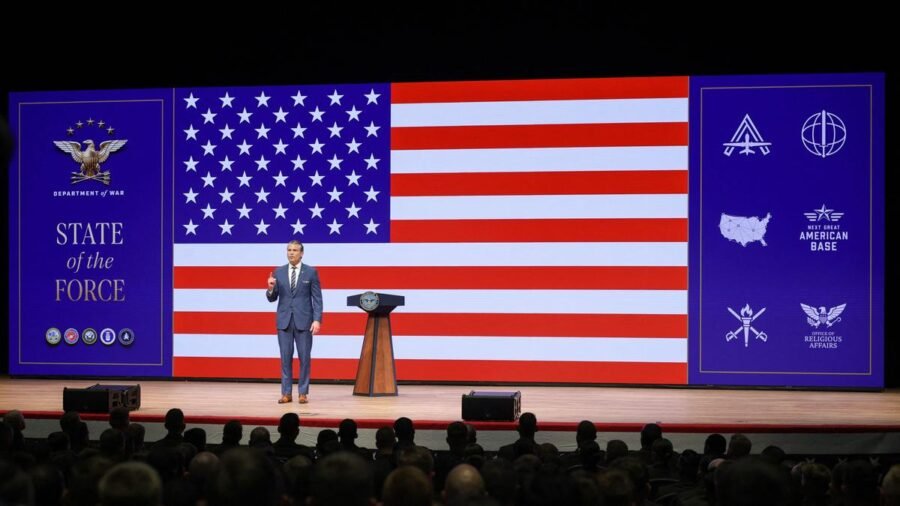
As the second Trump administration nears the midpoint of its term, ‘a rapidly changing America’ appears to be a most apt description. Internal and external repositioning has cast the United States in a new light, forcing recalibrations across countries and regions. While Washington’s foreign policy shifts and their repercussions have been the most palpable external lens, consequential internal changes are beginning to shake the old structures of governance, security and finance. One of the most noticeable, indeed momentous, changes is the renaming of the Department of Defense (DoD) as the Department of War (DoW) — its original historical name. This exercise in rechristening itself may be a microcosm symbolising the Trump administration’s attempts to redraw the arc of America. And Pete Hegseth, the Secretary of War, is at the helm of that endeavour.
The outline from Hegseth’s address
One of the administration’s fiercest attacks on its predecessor was over diversity, equity and inclusion (DEI) across programmes and institutions. On September 30 this year, when Mr. Hegseth delivered his ‘State of the Force’ address at the Marine Corps Base Quantico, he led his administration’s charge against those values, spelling out his own in turn. He doubled down on his 2025 speech to an assembly of admirals and generals, which starkly outlined his motto of “reviving the warrior ethos, rebuilding the military, and re-establishing deterrence”.
A closer look at some of the initiatives and changes that Mr. Hegseth emphasised reflects the fast-changing nature of modern warfare and the need for America, as indeed for any other military, to reform quickly. The unveiling of a four-star combatant command for autonomous warfare (AutoWarCom) is geared towards overhauling the procurement, testing and deployment of drones. This is in sync with the appointment of Elon Musk, Palmer Luckey and Newt Gingrich to jointly lead “Project Meridian” — an initiative to study the future of warfare. That the study must submit its findings within just 120 days underscores both the urgency of, and the challenges to, America’s war-fighting adaptability. A key aim of the Project Meridian initiative will be to place technological superiority vis-à-vis China front and centre. Among the other steps announced to overhaul the U.S. military is the “Fortress America” project, intended to redesign energy and cyber connectivity so that U.S. bases become self-sufficient in both electricity grids and cyber command. Towards realigning the recruitment system, the Pentagon will now work with five select universities to establish a new corps of cadets – Louisiana State University, Liberty University, Tuskegee University, Mississippi State University and Hillsdale College. The absence of any Ivy League institution is telling of the Trump administration’s long war against elite educational institutions and the values that new-age Republicans associate with them.
Perhaps the most consequential move was Mr. Hegseth’s announcement of a 20% cut in general and flag officer positions across the armed forces by January 1, 2027 — double the reduction he announced in 2025. Mr. Hegseth’s broad definition of “redundant force structure”, which he has used as a pretext to trim the military’s senior ranks, now also extends to ending new tenured appointments of civilian academics at military service academies. Besides these measures, the decision to establish an Office of Religious Affairs (ORA), reporting directly to the Secretary of War and providing religious support and spiritual readiness, bears all the hallmarks of Republican evangelical outreach writ large.
Drivers behind the overhaul
Behind the overhaul of the DoW lies a convergence of competing drivers: populism, rapid technological evolution, cultural revivalism, assessments of comparative military might and capability, and a race against time. Americans view the changes differently on each metric. For instance, while most see the decision to set up the Autonomous Warfare Command as a necessity, the removal of senior military ranks has drawn flak — as a decapitation of the military leadership from within. The departure of the Army Secretary, Dan Driscoll, in August was the culmination of the urge to purge that Mr. Hegseth has evinced.
Mr. Hegseth’s measures, taken together, offer a decidedly mixed picture. The U.S. is approaching the end of a military era that began with the Reagan administration’s sweeping military-industrial transformation in the aftermath of Vietnam. The strategic challenge before Washington today is therefore not simply to expand military capacity, but to undertake the next generation of reforms in defence manufacturing, technology and innovation if it is to retain its lead over China and simultaneously contend with multiple adversaries across different theatres.
Reform and strategic necessity
The problem is that the Trump administration’s sense of urgency has too often conflated the politics of populism with the imperatives of military reform. In the process, the distinction between political messaging and strategic necessity-and, at times, between friend and foe-has become blurred.
Mr. Hegseth’s rhetoric about creating forces with “no fatties, no trannies, no beardos, no weirdos”, alongside his proposal for mandatory testosterone-deficiency testing in the annual health screenings of personnel aged 30 years and above, takes the notion of a “warrior ethos” into territory that appears increasingly disconnected from the demands of modern warfare. At a time when technological superiority, automation, artificial intelligence and precision systems are reshaping the character of conflict, military effectiveness cannot be reduced to an increasingly narrow conception of physical warriorhood.
Yet, it would be a mistake to allow the excesses of this rhetoric to obscure the genuine opportunities before the U.S.. President Trump’s two terms have coincided with an extraordinary acceleration in technological change, creating both significant challenges and important possibilities for American military power. The re-establishment of the Space Command in 2019 was one such consequential step, while the more recent announcement of AutoWarCom could, if pursued seriously, have transformative implications for the organisation and the deployment of military power.
The larger task is to ensure that such initiatives are driven by the requirements of future warfare rather than subsumed by the vocabulary of populism. For the world’s most powerful military, the stakes are ultimately too high for political theatre to substitute for strategic clarity.
Harsh V. Pant is Vice President, Observer Research Foundation (ORF), New Delhi. Vivek Mishra is Deputy Director, Strategic Studies Programme at the Observer Research Foundation

Encroachment of land in Mumbai
By Sohail Khan · 6 Oct
Disabled citizens and the future of AI
By Sohail Khan · 6 Oct
The Nobel-winning science of optogenetics: Explained
By Sohail Khan · 5 Oct
Leave a Reply