Why Nothing wants to turn its CMF sub-brand into a standalone Indian company

Smartphone maker Nothing’s co-founder and CEO Carl Pei has said the company will spin off its CMF sub-brand into a standalone Indian company, with the new entity to be majority-owned by Indian shareholders and headquartered in India.
Nothing will retain a stake and continue as a shareholder and partner, while CMF will have its own team and research and development operations in the country.
The move comes after India rolled out a Rs 62,500-crore Mobile Phone Manufacturing Scheme (MPMS) which seeks to encourage Indian-owned mobile phone brands and domestic design and R&D (research and development).
Story continues below.
Subscribe to see fewer ads.
In an open letter, Pei said the move was aimed at building a global consumer electronics brand from India, arguing that the country’s next stage of growth in the sector would have to go beyond manufacturing and focus on product engineering, R&D and intellectual property.
“CMF becomes Indian,” Pei said, adding that the new company would be “majority Indian owned, headquartered in India, with its own team and R&D in the country”. Nothing’s engineering capabilities, operating system, supplier relationships and global brand infrastructure would continue to be part of the partnership.
Why CMF is becoming Indian
Pei said India had already built much of the manufacturing base needed to become a global electronics hub, but lacked a globally competitive consumer electronics brand with substantial in-house engineering capabilities. He pointed to Japan, South Korea and China as examples of countries that developed global brands after building manufacturing ecosystems.
He also contrasted India’s current position with its smartphone market a decade ago. According to Pei, Indian brands accounted for close to half of smartphone sales in 2015 but subsequently lost ground to foreign brands that brought stronger engineering capabilities, including improvements in cameras, design and hardware-software integration. He said Indian brands had fallen to less than 1% of the market by 2025.
Story continues below this ad
For CMF, Pei said the focus would therefore be on developing products in India rather than simply manufacturing them in the country. He identified areas including industrial design, camera systems, operating systems, antennas and the co-engineering of displays, chipsets and camera modules as examples of what he considers “real R&D”.
The Indian phone market
CMF’s India push comes as the affordable and mid-range segments continue to account for a large part of the country’s smartphone market, even as demand at the lower end faces pressure from rising component costs.
Data from market intelligence firm IDC shows smartphones priced between $100 and $200 accounted for 45% of shipments in India in the first quarter of 2026, while the $200-$400 segment accounted for another 27%, making up 72% of the total mobile phone market in the country.
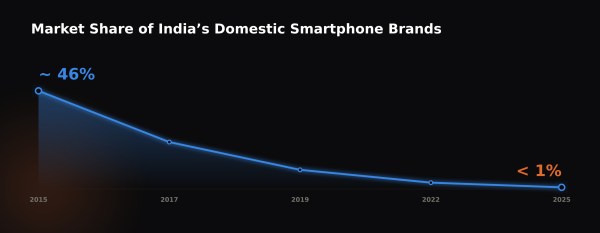 Market share of India’s domestic smartphone brands. This chart was posted by Pei on his X handle.
The $100-$200 segment grew 10% year-on-year, even as the sub-$100 segment declined sharply. CMF, which operates primarily in the affordable segment, has been among the fastest-growing brands in India, though it is still a relatively smaller player compared to Chinese manufacturers like Oppo and Vivo. Estimates peg Nothing’s — CMF’s parent company — India market share to be roughly around 2%.
The quest for India’s own Apple, Samsung, Vivo
Story continues below this ad
The push to build an Indian smartphone brand is rooted in a larger gap in India’s electronics story. The country has succeeded in attracting global companies to manufacture mobile phones at scale, but much of the value generated by the industry, from product design and intellectual property to branding and technology, continues to be owned by companies headquartered elsewhere, though Indian companies like Tata Electronics and Dixon are establishing themselves in the contract manufacturing sector.
The new mobile phone manufacturing scheme seeks to close that gap by explicitly backing an Indian-owned smartphone brand.
To qualify as an Indian brand under the scheme, a company must be incorporated in India; its trademark and intellectual property must be held in India; Indian citizens must exercise management control and hold more than 51% of the entity; and it must have in-house design and R&D capabilities in the country. IT Minister Ashwini Vaishnaw Friday said the government was in conversation with three Indian firms to design a globally competitive phone at different price brackets.
As per the scheme details, eligible Indian brands will receive a 5% incentive on incremental sales. Products designed and developed in India can receive an additional 3% for design and R&D, apart from the domestic-sourcing incentive of up to 1.5%. Companies can also opt for a one-year gestation period, and the scheme leaves room for additional non-fiscal government support, which will be determined by a separate empowered committee.
Story continues below this ad
The higher incentive structure is intended to offset some of the cost disadvantages a new Indian entrant would initially face against established global brands.
The Chinese onslaught
Even though India produces most of the phones it consumes domestically, the market is dominated by foreign players, particularly companies from China, such as Vivo, Oppo, Xiaomi, and Realme, apart from South Korea’s Samsung.
The government’s push to help fund an India-based, and owned, smartphone brand reflects the failure of an earlier generation of Indian mobile brands to capitalise on the country’s rapidly expanding smartphone market. Companies such as Micromax, Karbonn and Lava had established themselves in the feature-phone and low-cost handset segments, but struggled to make the transition to smartphones as the market became more technologically demanding.

India’s high-speed highway push: What NHAI’s new design rules say
By Sohail Khan · 22 Sep

Keeping up with UP| Young minds: A maze every political party is struggling to navigate
By Sohail Khan · 22 Sep
Leave a Reply