Why Noida’s factory unrest is more than just about minimum wages
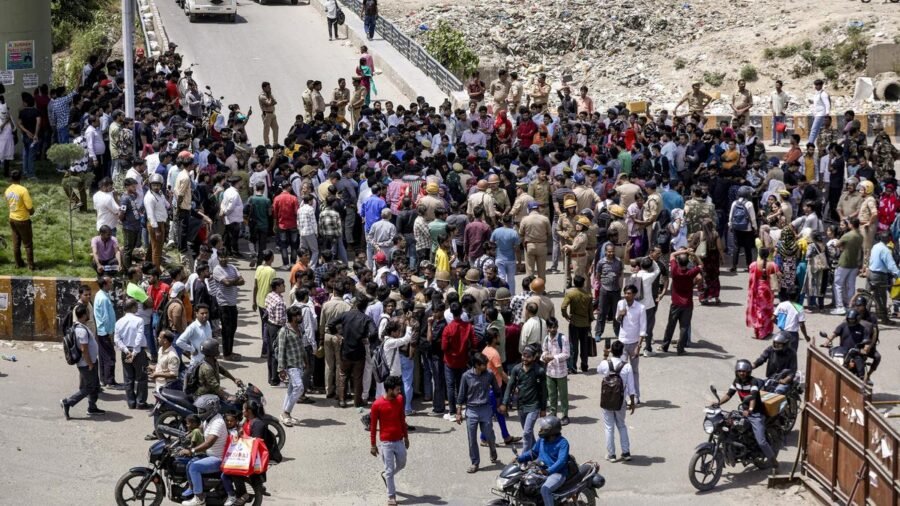
Streets in Noida’s industrial belt saw scenes of unrest on April 13 as protesting factory workers set vehicles ablaze, hurled stones, and clashed with police. Workers from multiple units gathered in large numbers, accusing employers of low wages, irregular payments, and exploitative practices.
The unrest is not just about a single wage revision. The protests point to a deeper structural issue in India’s labour market, where industries may be formally registered, but workers within them often lack basic protections such as written contracts and social security.
Data from the Periodic Labour Force Survey (PLFS) shows that even among regular wage and salaried workers in non-agricultural sectors, informality remains widespread. In 2025, about 58.2% of workers had no written job contract, while 51.7% were not eligible for any social security benefits. In addition, 47.3% were not eligible for paid leave. This means that a significant section of workers employed in formal establishments are, in practice, informally employed.
The extent of this informalisation varies across States. Uttar Pradesh, where the Gautam Buddha Nagar (Noida) protests took place, stands out on multiple indicators. Around 67.8% of regular workers in the State had no written contract, 62.4% were not eligible for paid leave, and 59.2% lacked access to any specified social security benefit. Further, 46.3% of workers in the State were simultaneously without a written contract, paid leave, and social security — among the highest proportions across States. This pattern is not confined to Uttar Pradesh. States such as Bihar, Chhattisgarh and Rajasthan also report high levels of deprivation across these indicators.
One factor underlying this trend is the growing reliance on contract labour. Data from the Annual Survey of Industries (ASI) indicates that the share of contract workers in total industrial employment has risen steadily over the past decade, from about 35% in 2014-15 to 42% in 2023-24. This suggests a structural shift in employment practices, with firms increasingly relying on intermediaries to hire workers.
Such arrangements are typically associated with weaker employment protections. Workers hired through contractors are less likely to have written agreements, paid leave, or access to social security schemes such as ESI. This helps explain the contradiction at the centre of the Noida protests: workers employed within formal factories demanding basic protections typically associated with formal employment.
The Centre of Indian Trade Unions (CITU) president, Sudip Dutta, pointed to broader concerns around workplace conditions, including long hours in difficult environments, lack of basic facilities, and the vulnerability of contract workers to arbitrary dismissal. “If anyone raises an issue, they can be removed from the job,” he said, arguing that the increasing reliance on contract labour has weakened enforcement of labour protections on the ground.
While the increase in minimum wages appears significant, it is because the base wage itself is very low. For instance, in Delhi, monthly wages for unskilled workers rose from ₹9,568 in April 2016 to ₹18,456 in April 2025 which is an increase of about 92.9%.
In Haryana, wages were increased only by about 39% between 2016 and 2025. However, following the recent labour unrest reported from Manesar, Faridabad, and Gurugram, the State announced a revision of around 35% over the previous year. Taking the overall increase since 2016 to about 88.6%.
In Uttar Pradesh, the minimum wage for unskilled workers rose from ₹7,107 in April 2016 to ₹11,313 in April 2026. The wage revision announced by Haryana on April 9 triggered protests in Noida, prompting the Uttar Pradesh government to announce an interim solution late that night.
The State announced an interim increase of up to 21% for unskilled workers in industrial areas such as Noida and Ghaziabad, raising wages from ₹11,313 to ₹13,690 per month.
It is also important to note that minimum wages in Uttar Pradesh vary by location. Workers in industrial districts such as Gautam Buddha Nagar and Ghaziabad receive higher wages than those in municipal areas and other districts.
However, nominal wage increases tell only part of the story. Consumer prices for industrial workers, a key measure of inflation, have also risen significantly over the same period. Data from the Labour Bureau shows that prices in industrial centres across the Delhi-NCR region have increased by roughly 45% to over 52% since 2016.
In Delhi, the increase stands at about 43.7%, while in Gurugram and Ghaziabad, it exceeds 50%. Across Uttar Pradesh’s industrial centres including Kanpur, Lucknow, Varanasi and Agra the increase ranges from about 49.8% to 51.5%.
Even after the post-protest revision, workers argue that the increase in wage is nominal and they are constrained by costs of living.
The pressure has intensified in recent months, as several industrial units have been affected by rising input costs. First due to U.S. tariffs and more recently due to disruptions linked to the Strait of Hormuz. But trade unions argue that the burden is being disproportionately passed on to labour. “Whatever be the pressure over the industries… it cannot be transferred to the workers,” the CITU leader said, noting that minimum wages are meant to ensure subsistence and are not linked to firms’ profitability. He added that wage revisions had been delayed for years across States, contributing to an erosion in workers’ living conditions.
For workers, many of whom are migrants, the impact is immediate and visible in everyday expenses. “Which worker has an LPG connection?… They rely on the retail market,” he said, adding that the cost of cooking fuel has risen around ₹3,000-₹4,000 in the last month.
The data suggests that the issue is not merely about wages, but about the nature of employment itself. As long as a large proportion of workers in formal establishments remain outside the ambit of basic protections, such episodes of unrest are likely to recur across India’s industrial corridors.
(Inputs from Mayank Kumar and Ashok Kumar)




Leave a Reply