Why must a woman always trade curiosity about the world for safety?
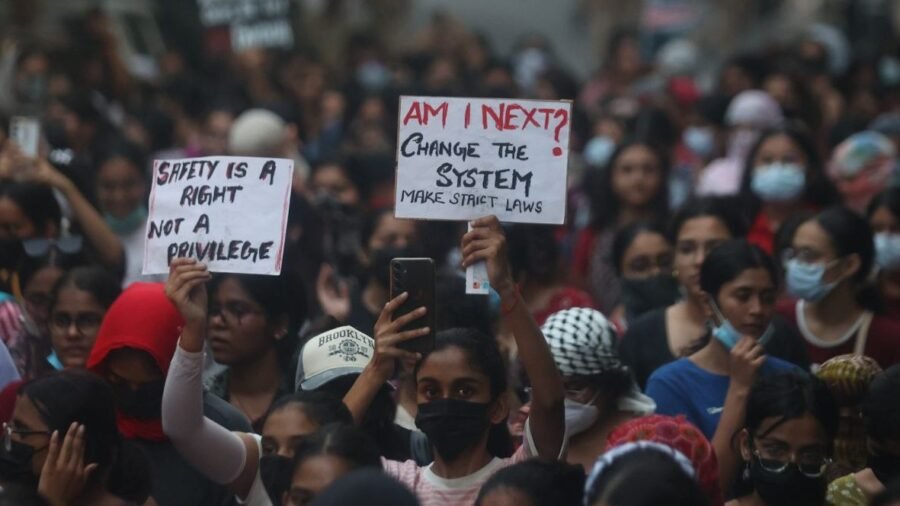
A young woman in Delhi in 2026 and a celebrated mid-20th century American author might not seem to have much in common. But reading a news report about protests organised by college students this week over the alleged gangrape of a minor in a South Delhi park at night immediately reminded me of Sylvia Plath’s words, written almost 75 years ago.
She wrote at the age of 18, “Being born a woman is my awful tragedy… to have my whole circle of action, thought and feeling rigidly circumscribed by my inescapable femininity. Yes, my consuming desire to mingle with road crews, sailors and soldiers, bar room regulars — to be part of a scene, anonymous, listening, recording — all is spoiled by the fact that I am a girl, a female always in danger of assault and battery… Yet, God, I want to talk to everybody I can as deeply as I can. I want to be able to sleep in an open field, to travel west, to walk freely at night…”
Advertisement
One news report, on the other hand, described a poster at the Delhi protests as saying, “It’s not my fault I crave the night air, it’s your fault you crave taking it away from me.”
Protestors highlighted the lack of streetlights and police booths on their way to college. They also spoke of the tactics they adopt to ensure their safety when the state and society cannot be relied upon.
When I first heard about the case that triggered these protests, I thought that the person who told me about it was referring to a similar case from a decade ago, when I had just become a student at a DU college. Such events repeating themselves makes it tempting to curse the concept of womanhood or biology itself, as Plath did.
Advertisement
That, however, would mean we as women should agree to let go of something innate not only to humans but perhaps all living beings — curiosity about the world. When a young woman expresses the desire to venture out into the world, especially at night, patriarchal societies raise suspicion about what she might do with that freedom. Who might she be meeting and for what purpose? And can it be guaranteed that her safety won’t be compromised?
Not all answers to these questions may meet the narrow standards of social acceptance, so it is best, then, to limit her movement. Never mind that women are known to face violence without leaving their homes, in their place of work, at the hands of people they knew well. Or that no one has ever even suggested limiting the movement of an entire class of men as a policy for the sake of safety.
I keep returning to Plath’s words, which lay bare the injustice of it all. What about the basic right to venture here and there, day or night, just to experience and learn what the world actually is? It can mean enjoying the lingering scent of flowers at night in a public park, going to a famous chaat shop in another part of the city, or striking up a conversation with another person — regardless of gender — at a public spot in the evening. Or, it can mean trying those things out and realising that one actually does not care for them. Is experiencing those simple pleasures and disappointments not enough justification to build institutions and processes that can ensure women’s safety?
And what does this social messaging mean for today’s women who are generally being raised to become educated, financially independent, and consider themselves no less than a man in terms of their abilities? For them, there exists a jarring and often unfair double standard, where they are told to harbour all the same ambition and undertake the same responsibilities, all while remaining under the supposedly protective space of home and daylight hours, while unequipped to participate in the world in its totality.
Over the years, movements such as “Take Back the Night” have attempted to mobilise women to hold marches and go out in groups at midnight to make the radical act of a woman venturing out in the dark less so. Of course, these acts must be accompanied by well-functioning law and order to become something routine and, hopefully, unremarkable. But as the women protestors of Delhi showed this week, maybe one of the answers to the problem Sylvia Plath posed is a critical mass of women going out to see the world, not circumscribed by their femininity, but asserting with full force that they are as welcome to be out and about.
The writer is deputy copy editor, . rishika.singh@expressindia.com

A smoke and mirrors summit in which Xi emerged with the upper hand
By Sohail Khan · 28 Sep
Best places in India to see tigers in the wild
By Sohail Khan · 28 Sep
China’s space diplomacy brings Pakistani astronauts closer to orbit
By Sohail Khan · 28 Sep
Leave a Reply