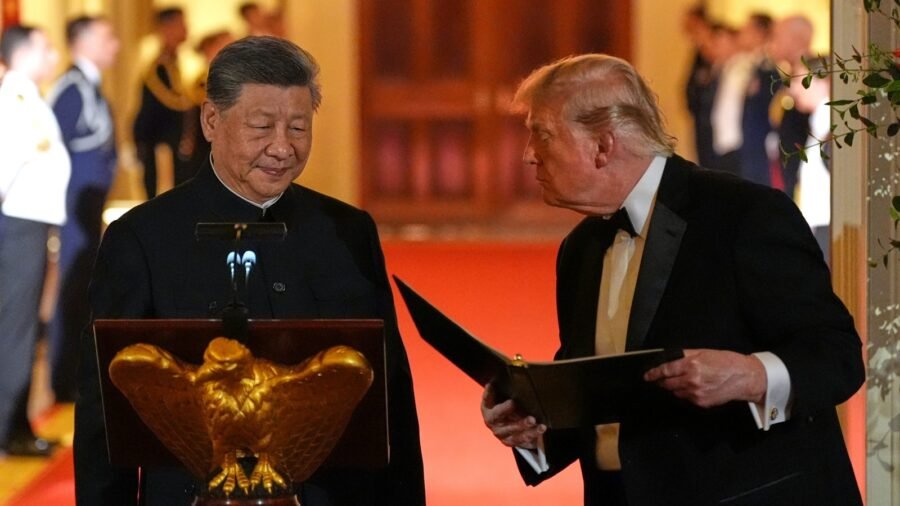
A smoke and mirrors summit in which Xi emerged with the upper hand
Advertisement
One of them, of course, involved the question of the regulation of artificial intelligence. Trump made clear that he was not interested in placing any restrictions on the growth of AI, while Xi suggested that drawing up some rules of the road were desirable. Trump’s unwillingness to regulate AI probably stems from two sources. First, he has an ideological hostility toward almost any form of regulation, especially of nascent technologies. Second, he probably believes that the unbridled pursuit of AI is necessary and desirable to maintain the American lead over China.
Even the crucial issue of trade and tariffs was simply kicked down the road. An interim US-China trade agreement expires in November. At the meeting, the two sides agreed to extend it by two more months. This agreement does little or nothing to address the underlying trade dispute but simply puts off the day of reckoning.
Trump also failed to provide any reassurance to America’s long-standing ally in East Asia, Taiwan. Xi had sought to persuade Trump to make some statement that the US did not support Taiwan’s independence. However, Trump offered no such assurance. This, however, represented a very tenuous affirmation of the well-established American policy that holds that no change in the status quo can take place using force.
Advertisement
Nor, for that matter, did Trump deal with other vital issues that have considerable significance in the bilateral relationship. Two of them, in particular, merit discussion. First, Trump did not address the issue of Chinese support to Russia in the conduct of its war against Ukraine, even though such assistance is crucial in sustaining its war effort. Second, perhaps even more disturbingly, he failed to bring up Chinese support, including the provision of satellite imagery, to Iran in the ongoing conflict with the US. This lapse on his part is especially troubling. For all his bluster and that of his Secretary of War, Pete Hegseth, Iran remains a capable adversary that has shown few signs of capitulating, while enduring considerable hardships. Chinese assistance, at least in part, has enabled Iran to maintain the war effort.
Other issues of considerable significance to American foreign and security policy interests also went unaddressed. Based on news reports, it appears that there were no questions raised about China’s continued territorial claims in the South China Sea, and the ongoing modernisation and expansion of its nuclear forces. These are, no doubt, contentious issues. However, the failure to tackle them at this meeting clearly represents a failure of US policymaking.
In the end, the pageantry that surrounded the summit appears to have masked the utter lack of substance that has emerged from it. That said, the clear winner, in the immediate term, that emerged from this meeting was Beijing. At a time when Xi faces a domestic economic slowdown, in large part because of a housing crisis, it gave him significant breathing room. More to the point, with a Communist Party congress looming next year, the easing of tensions with the US enables Xi to consolidate his position at home.
The outcomes of the summit, without a doubt, were closely watched in India. US-India ties, which had mostly enjoyed a steady upswing for decades, are now in difficult straits for a range of reasons. They cover the gamut from Trump’s dalliance with Pakistan to the unresolved trade dispute and the looming prospect of sanctions under the terms of the Lindsay O Graham Russia Sanctioning Act of 2026. These differences, quite understandably, have caused considerable misgivings in New Delhi about the current state and as well as the future of the US-India partnership, at least during the remainder of Trump’s term in office.
Given the downturn in the relationship, Trump’s seeming enthusiasm for Xi’s visit had stoked fears of the possible emergence of a US-China condominium. These concerns, while understandable, should now be somewhat allayed. Even though it is more than apparent that Xi was treated virtually as an equal during this visit, key underlying differences in the relationship were merely set aside. Consequently, the idea that the two parties would pursue a global partnership while setting aside crucial differences has not come to fruition. Nor, for that matter, despite the upcoming G20 meeting scheduled for December of this year, which Xi is expected to attend, is there any real prospect of such an accord, tacit or otherwise, emerging?
Nevertheless, New Delhi cannot afford to be complacent when the US-India relationship is laden with considerable uncertainty. China is, after all, India’s principal long-term rival.
The writer is a senior fellow and directs the Huntington Programme on US-India Relations at the Hoover Institution, Stanford University

Why must a woman always trade curiosity about the world for safety?
By Sohail Khan · 28 Sep
Best places in India to see tigers in the wild
By Sohail Khan · 28 Sep
China’s space diplomacy brings Pakistani astronauts closer to orbit
By Sohail Khan · 28 Sep
Leave a Reply