Why government wants CCTV at medical stores, and chemists don’t
The Union Health Ministry has proposed mandatory CCTV surveillance at medical stores as it looks to curb the abuse of prescription drugs. A draft notification by the ministry also calls for maintaining the recordings for three months.
The Health Ministry said in a statement that this would ensure stricter control over prescription medicines, especially habit-forming drugs listed under Schedule X of the Drugs and Cosmetics Rules, 1945. In the draft notification, the ministry said the step seeks to address concerns over the “unauthorised access to and sale of Schedule H, H1 and X drugs”.
Chemists, however, have flagged concerns over the move, saying it will pose a financial burden for small pharmacists and violate the privacy of customers. The proposed requirement will not apply to wholesalers.
Why was this step taken?
Story continues below.
Subscribe to see fewer ads.
The measure was first proposed in 2021 to prevent the abuse of drugs by children. CCTV footage from medical stores selling Schedule H, H1, and X drugs — all prescription drugs, including strong antibiotics and psychotropic substances — was to be shared with the child welfare police officer of a particular area.
The Drugs Consultative Committee of the Central Drugs Standard Control Organisation (CDSCO) — India’s national regulatory authority for drugs, cosmetics and medical devices — also deliberated on a mobile app-based information system (MIS), where the pharmacists could upload the details of sale of these prescription drugs.
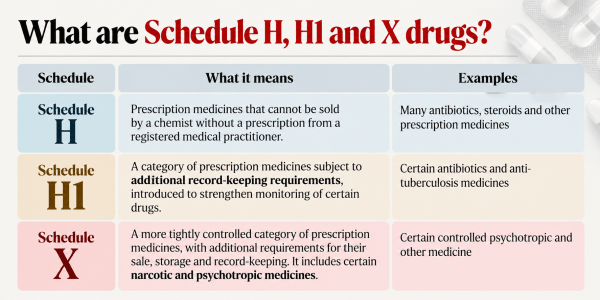 Schedule H, H1 and X drugs
The panel discussed whether a new schedule should be created to list all habit-forming medicines, thereby ensuring stricter regulations in only a limited number of shops selling these addictive prescription drugs. A six-member sub-committee was formed to look into the issue.
H G Koshia, the head of the committee and former commissioner of Gujarat’s Food and Drugs Control Administration, said: “Round-the-clock surveillance will, in a way, create fear among medical store owners and pharmacists so that they are not inclined to sell these medicines without a prescription for children. The CCTV footage is mainly meant to verify whether there has been a sale to a minor without prescription, not all sales can be verified in this manner.” While routine inspection every three months may be difficult, the data can be retrieved when there is a complaint.
Story continues below this ad
The Drugs Consultative Committee decided to implement the app-based system and CCTV surveillance plan earlier this year.
“After detailed deliberation, DCC agreed that a separate robust MIS or a centralised drug portal may be developed which should be capable of providing all relevant information including the real time data… Further, DCC also agreed that installation of CCTV camera at medical stores may be made mandatory by amending the Rules. DCC also proposed that camera shall be placed appropriately in the premises so that sale made at such premises may be verifiable,” show the minutes of the committee meeting held in April this year.
How common is prescription drug addiction in children?
Opioid use — which includes heroin and pharmaceutical opioids found in strong painkillers and opium — is the second-most common form of addiction among children, affecting nearly 1.8% of them. Cannabis use affects 1.9% of children, according to one of the most comprehensive studies of drug use by AIIMS published in 2019.
Story continues below this ad
This is followed by alcohol use (1.3%) and inhalant use (1.17%). The latter is the only form of addiction more common in children than adults.
Of the estimated 2.3 crore total opioid users (adults and children) in the country, 25 lakh are dependent on pharmaceutical opioids, while the highest 63 lakh are dependent on heroin, according to the study.
What do chemists say?
The All India Organisation of Chemists and Druggists — one of the largest organisations of brick-and-mortar medical stores representing 12.4 lakh people — raised several objections to the mandatory installation of CCTV cameras. They also wrote to the union health secretary Puniya Salila Srivastava on the same, calling for financial support.
These were some of the objections they raised:
Story continues below this ad
One, it would put a financial burden on pharmaceutical stores, especially the smaller ones.
“While many stores in cities such as Delhi and Mumbai may already have CCTV cameras, this is not true for most of the country. Moreover, storing the data for three months is extremely costly. The high storage DVRs cost around Rs 30,000 and one is not enough to store data for three months. Stores might have to shell out nearly a lakh to put the system in place. How can a store with, say, sales of Rs 5,000 to 10,000 do that?,” said Rajeev Singhal, general secretary of the organisation.
Two, power failures and issues with connectivity in rural places pose serious hurdles.
“And, what happens if the recording stops because there is no electricity or the data doesn’t get properly stored? Now, the drug regulator would be legally able to cancel the license of a store for such a technical issue,” said Singhal.
Story continues below this ad
Three, and most importantly, it would violate patient privacy, the organisation said. “Patients come to us to buy, say, TB medicines but they do not want anyone to know that they have TB. There are people who come to buy, say, a condom but again do not want people to know about it. How do we protect their privacy?” said the association.

Why Canada’s new temporary study policy matters for foreign workers
By Sohail Khan · 19 Sep
Kareena Kapoor’s strict screen-time rules for Taimur and Jeh: ‘Need to be hyper about this’
By Sohail Khan · 19 Sep

Leave a Reply