What is ‘enemy state’ in UN Charter, which Japan wants removed
Story continues below.
Subscribe to see fewer ads.
The UN Charter, which was drafted towards the end of World War II and came into force in its immediate aftermath on October 24, 1945, includes numerous references to “enemy states”. The Allies, who were instrumental in the drafting process and subsequently occupied permanent seats on the UN Security Council (UNSC), viewed it as a mechanism to counter the re-emergence of militarism or fascist politics in the erstwhile Axis Powers without having to seek recourse to the newly established UNSC.
The term finds mention in three Articles of the UN Charter: 53, 77, and 107.
Paragraph 1 of Article 53 of the Charter states: “The Security Council shall, where appropriate, utilize such regional arrangements or agencies for enforcement action under its authority. But no enforcement action shall be taken under regional arrangements or by regional agencies without the authorization of the Security Council, with the exception of measures against any enemy state, as defined in paragraph 2 of this Article, provided for pursuant to Article 107 or in regional arrangements directed against renewal of aggressive policy on the part of any such state, until such time as the Organization may, on request of the Governments concerned, be charged with the responsibility for preventing further aggression by such a state.”
Paragraph 2 of Article 53 says: “The term enemy state as used in paragraph 1 of this Article applies to any state which during the Second World War has been an enemy of any signatory of the present Charter.”
Story continues below this ad
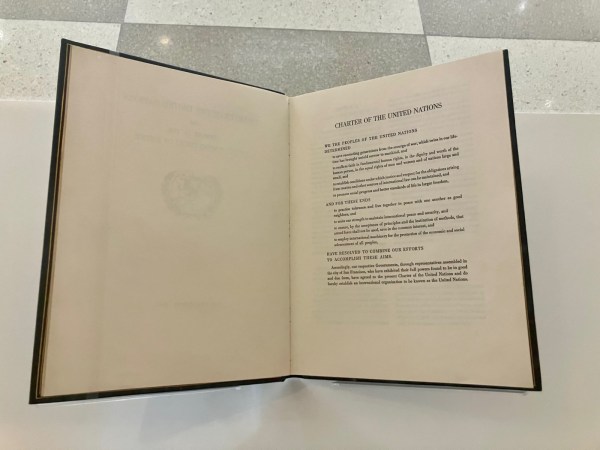 The Charter of the United Nations on display at UN headquarters in New York. Photo: Wikimedia Commons
Article 107 states: “Nothing in the present Charter shall invalidate or preclude action, in relation to any state which during the Second World War has been an enemy of any signatory to the present Charter, taken or authorized as a result of that war by the Governments having responsibility for such action.” In simple terms, it allows the Allied Powers the legal right to take enforcement actions against the vanquished Axis “enemy states” without needing prior approval from the UNSC. This acts as an exception to the general rule that bans the use of military force without UN approval.
Paragraph 1(b) of Article 77 pertains to the application of the “trusteeship system” to “…territories which may be detached from enemy states as a result of the Second World War”. Under the Charter, the UN was to establish an “international trusteeship system for the administration and supervision” of “trust territories” (Article 75), which refer to “territories whose peoples have not yet attained a full measure of self-government” (Article 73). There were 11 such territories, located across Africa and the Pacific Islands.
Why Takaichi asked for scrapping it
In the past, Japanese leaders have criticised the presence of these clauses in the UN Charter. The UNGA had recognised the clauses as “obsolete” in 1995, and adopted a resolution in 2005 to delete references to “enemy States” from the Charter.
But support from the UNSC, especially the five permanent members (also called the Big Five), has been lacking. The Big Five — the US, the UK, France, Russia, and China — can veto any measure.
Story continues below this ad
“The problem with a UN Charter Resolution is that it needs all five permanent members to approve it in their national capacity — not just in their votes in the General Assembly but they must also ratify it back home,” Manjeev Singh Puri, former Indian ambassador and Deputy Permanent Representative to the UN (2009-12), told .
As to why these clauses have persisted for over eight decades, Puri said, “The world hasn’t really changed, has it? Has it not been a kind of Pax Americana in a certain way, with the permanent members having a certain sway on the ultimate state of geopolitics in the world through the Security Council veto?”
According to him, the clauses have been in a “moribund situation” since 1995 but they remain a talking point in domestic politics, especially in Japan. “Another reason why the clauses have not been dropped is that Japan continues to host US troops on its soil,” Puri said, pointing to reservations that China and Russia might have.
Analysts say that there are also concerns among the Big Five that any revision in the language of the Charter could lead to further demands, such as reforming the composition of the UNSC, which would diminish their influence.
Story continues below this ad
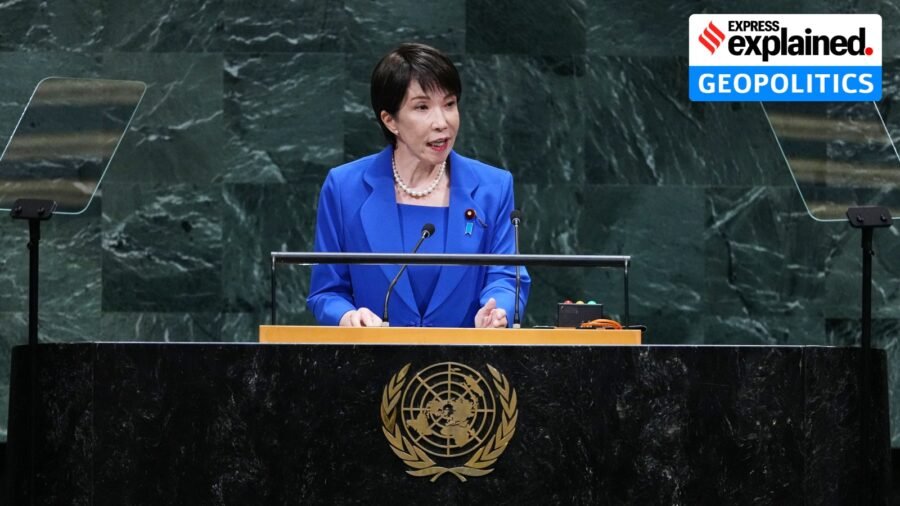
Notably, Takaichi’s address to the UNGA in New York also pushed for deletion of the “enemy state” clauses as part of a larger appeal for reform of the UN and specifically the UNSC, which she said was “a matter of utmost importance”.
“The current structure of the Security Council, whose mandate is to maintain international peace and security, reflects the international situation as it stood in 1945. We need to transform it without delay into a structure that truly reflects the current realities of the international community. To this end, it is essential to expand the number of both permanent and non-permanent members in order to ensure the legitimacy and representativeness of the Security Council,” she said. She added that a majority of UN member-states supported such expansion.
Increasing hostility
Takaichi’s comments also gain significance as they come on the back of rising hostilities with China and Russia, with both exerting economic and military pressure on Japan.
China has restricted access to rare earth magnets that Japanese firms need for manufacturing, even as Chinese fighter aircraft and warships have engaged in military drills close to the Japanese coast. Matters escalated particularly after Takaichi indicated in November last year that Japan could intervene militarily if China were to attack Taiwan. Although Taiwan calls itself a self-governed democracy, China has long considered it part of its territory.
Story continues below this ad
Russia, too, has engaged in military exercises close to Japan and criticised the latter’s proposals of raising defence spending.
The diplomatic rhetoric employed by both China and Russia against Japan have also referred to these “enemy state” clauses. China has said that the clauses serve as a safeguard of the postwar international order, whereas Russia has argued these clauses invalidate Japan’s claims in their territorial dispute over the southern Kuril Islands. In August, Russian President Vladimir Putin had visited the disputed territory, which Takaichi said had hurt “the feelings of the Japanese people and is absolutely unacceptable”.

6 ways highly sensitive people can build healthier relationships
By Sohail Khan · 24 Sep
Woman loses 56 kg in 1.5 years, shifts focus to muscle gain and strength
By Sohail Khan · 24 Sep
How 10-minute deliveries are fuelling India’s growing waste crisis
By Sohail Khan · 24 Sep
Leave a Reply