‘Water security is national security’: C P Radhakrishnan opens India International Water Week
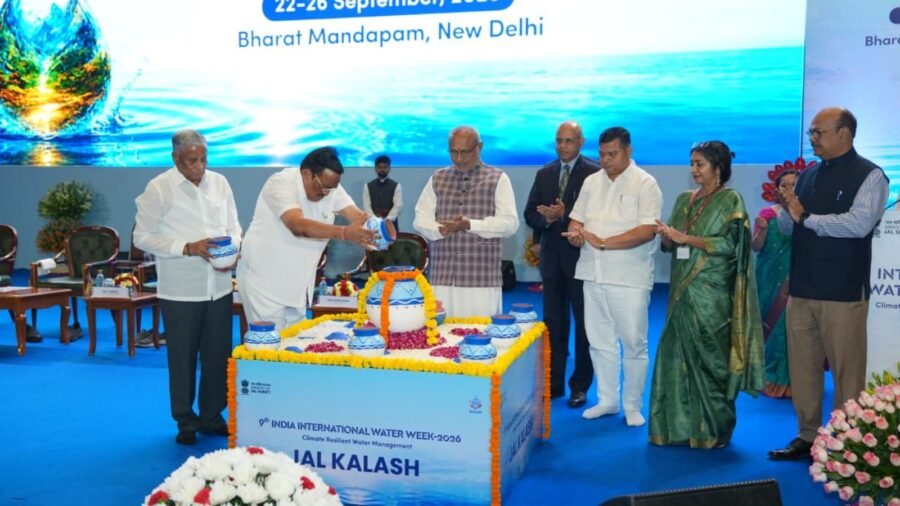
He urged the citizens to conserve, store, manage, and use water resources wisely for future generations and all living beings.
Story continues below.
Subscribe to see fewer ads.
On issues related to water management, Radhakrishnan said, “We need systems capable of managing periods of excessive rainfall as well as prolonged dry spells. River-basin management, groundwater recharge, rainwater harvesting and efficient irrigation should therefore work together as part of an integrated approach,” he said.
Linking Ganges with Cauvery
Underlining the importance of river linking projects, the Vice President said, “Water is a subject very close to my heart. More than 2 decades ago, I undertook a 19,000 km Rathyatra in my native state of Tamil Nadu with a five-point programme. The most important point is the linking of rivers. I have said that the Ganges should be linked with Cauvery so that the entire water requirement of the country should be taken care of. There is no flood on one side and drought on the other side. That is what the inter-river linking projects can deliver.”
Radhakrishnan said that during his stint as a Member of Parliament, he had discussed these issues in detail with the then Prime Minister Atal Bihari Vajpayee, and now with Prime Minister Narendra Modi and Jal Shakti Minister C R Patil.
Quoting Tamil poet Subramania Bharatiyar, Radhakrishnan highlighted the importance of sharing the resources of Ganga and Cauvery. “In this context, the theme of the Water Week, ‘Climate Resilient Water Management’ is highly relevant,” he added.
Story continues below this ad
Radhakrishnan said that a major issue concerning water is the dispute among states over water sharing.
“While we are busy settling these disputes, some parts of the country face drought-like conditions, and in other parts of the country there are floods,” he said.
Inter-state water-sharing agreements
Stating that 10 inter-state MoUs have been signed for water-sharing under the rule of Prime Minister Narendra Modi, Radhakrishnan said, “Some shining examples of this cooperation are Ken-Betwa and Kishau projects.” He also congratulated Patil and his ministry for resolving these disputes.
Radhakrishnan said that as India moves towards becoming a developed economy by 2047, efficient and sustainable water management will be critical.
Story continues below this ad
“Agriculture accounts for more than 80 per cent of water use, while industrial demand is also increasing. Greater water-use efficiency, recycling, and reuse are therefore important,” he said.
He said, “No single institution, sector, or state can address water issues alone. The scale and complexity of water challenges demand cooperation. We need a multi-stakeholder and multi-dimensional approach that combines technological innovation, sound policy, scientific knowledge, local experience, and community participation”.
The Vice-President expressed confidence that the deliberations at India International Water Week (IIWW-2026) will generate innovative technological, political, socio-economic, and environmental approaches for climate- resilient integrated water management.
“As we inaugurate this important event, let us remember: Jal Suraksha will lead to Jan Suraksha and Rashtra Suraksha; that is very important,“ he added.
Story continues below this ad
The five-day event, organised by the Union Ministry of Jal Shakti, will include 49 sessions across various themes in the water sector.
Holistic approach needed: C R Patil
On the occasion, Union Jal Shakti Minister C R Patil highlighted the need for a holistic approach in water management.
“By its very nature, water does not remain confined by boundaries; rivers flow from one region to another, groundwater connects various communities, and an excess or deficit of rainfall causes floods or droughts in far-flung areas. For this reason, it is essential to view water management through a holistic perspective rather than in fragmented parts,” Patil said.
Referring to the recent incident in the Himalayan region and the 2023 disaster in Sikkim, Patil said the disasters remind us that the risks associated with climate change are changing too.

Over 4,200 books withdrawn from circulation in J&K — 94% of them in Kashmir
By Sohail Khan · 22 Sep
Leave a Reply