To build Viksit Bharat, India must be drug-free: Amit Shah
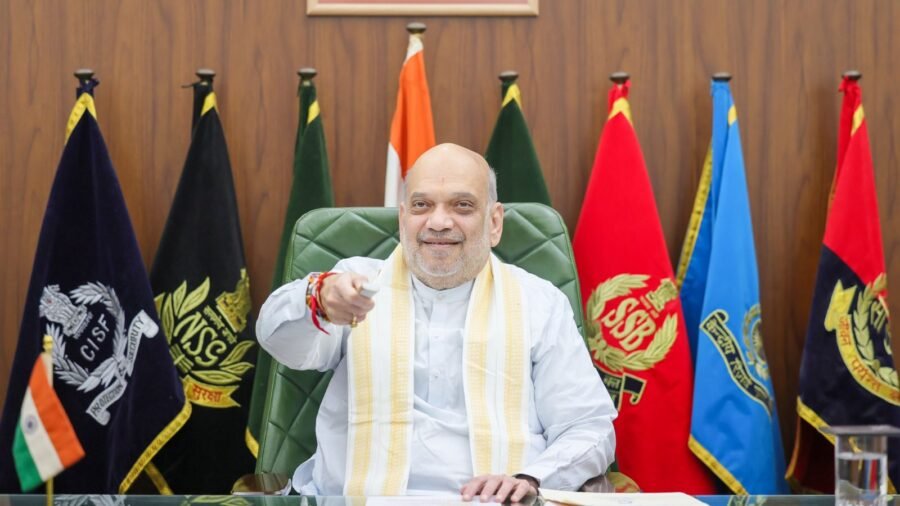
Union Home Minister Amit Shah on Tuesday said India must deliver a decisive blow to narcotics networks and set a deadline of December 31, 2029, to uproot the drug trade from the country, calling the fight against drugs the most difficult battle before the government.
Addressing the 3rd National Conference of Anti-Narcotics Task Force (ANTF) heads in Delhi, Shah said the Centre and states would have to move from meeting to mission, reporting to result, seizure to dismantling of networks, and case to conviction to achieve the goal of a drug-free India.
The two-day conference, organised by the Narcotics Control Bureau (NCB), is being attended by ANTF heads from 36 states and Union Territories, representatives of government departments, and other stakeholders.
Story continues below.
Subscribe to see fewer ads.
Shah said that under Prime Minister Narendra Modi’s leadership, the government had taken a series of steps over the past five years to achieve the goal of a drug-free India.
“The time has now come to deliver a decisive blow against narcotics, which have become the most serious threat to the country and the world,” he said, adding that collective efforts would be required to win the battle.
He said the Centre had achieved success in tackling long-standing challenges such as terrorism in Kashmir, insurgency in the Northeast, and Naxalism with the cooperation of states. He also warned that the battle against drugs cannot be abandoned despite being the hardest of all.
Linking the anti-drug campaign to the goal of a developed India by 2047, Shah said the country’s youth could not be allowed to be weakened by addiction. “To build a Viksit Bharat by 2047, to save future generations, and to connect the youth with India’s development, the only option before us is to make India drug-free,” he said.
Story continues below this ad
Calling the Vision Document 2026-2029 like the Gita for all those involved in the campaign, Shah said it had been prepared after consultations with more than 35 departments and contained clear targets and timelines.
He said the document would be reviewed periodically and that neither the Ministry of Home Affairs nor the NCB could achieve the objectives alone.
The minister said the roadmap focuses on enforcement, intelligence and operations, control of precursor and synthetic drugs, demand and harm reduction, and capacity building and coordination. More than 100 targets have been categorised under these pillars. Under the target of registering one lakh Nashamukt Mitras, Shah said 46,780 had already been registered by various ministries and were operational.
He also called for states to form teams of officers capable of thinking out of the box to respond to emerging challenges such as synthetic drugs, diversion of precursor chemicals, new communication technologies, the dark net, crypto, dead-drop delivery systems, and international drug networks.
Story continues below this ad
Shah said anti-narcotics efforts should move away from a seizure-centric approach and focus on dismantling entire networks. Backward and forward linkages, financial investigations and digital trails must be pursued, he said, adding that the funds of drug dealers must be targeted.
He said cartels should be attacked at three levels: entry points, inter-state distribution systems and local sales networks within districts. Districts, he added, would be categorised into clusters based on whether they were points of manufacture or entry, transportation corridors, or areas of consumption.

Over 4,200 books withdrawn from circulation in J&K — 94% of them in Kashmir
By Sohail Khan · 22 SepEC announces biennial polls on October 16 for 11 Rajya Sabha seats across UP, Uttarakhand
By Sohail Khan · 22 Sep

Leave a Reply