The evolution of state protections under Article 371, and what 371K could mean for Ladakh
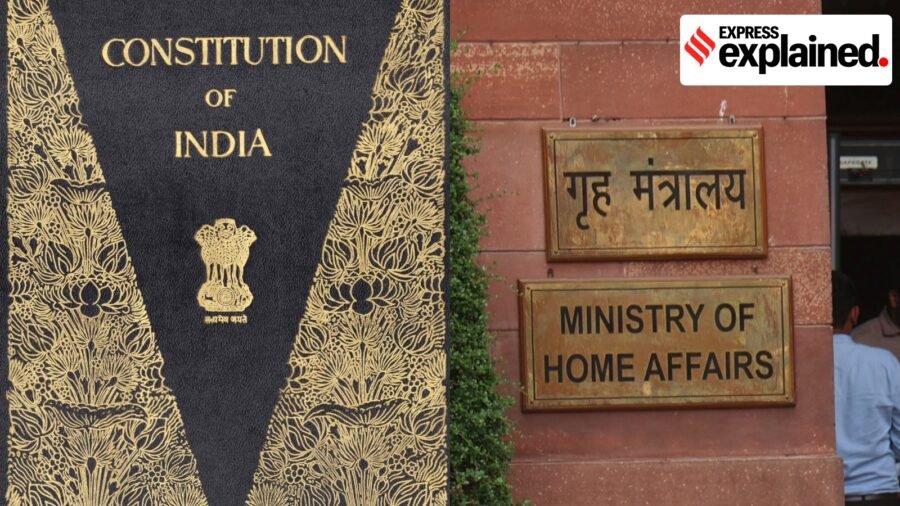
The Union government has proposed inserting a new Article 371K in the Constitution to provide special Constitutional safeguards for Ladakh. The proposal follows an “in-principle understanding” between the Ministry of Home Affairs and representatives of the Apex Body, Leh (ABL) and Kargil Democratic Alliance (KDA) to create a directly elected Union Territory-level body with legislative, executive, financial and planning powers.
But what exactly is Article 371? Why does it exist in so many different forms? And what would make a possible 371K different from the provisions that already exist?
What is Article 371 — and why was it created?
Articles 371 and 371A through J are generally associated with special Constitutional protections, such as for the Northeast or tribal regions. But this was not the original purpose of Article 371.
Story continues below.
Subscribe to see fewer ads.
At Independence, India did not consist only of the provinces directly administered by the British, but also hundreds of princely states, which had acceded to India under very different historical and administrative circumstances. The Constitution classified these territories — including Hyderabad, Mysore, Jammu and Kashmir, Rajasthan and others — as Part B States.
The Constitution-makers were concerned about these newly integrated states immediately functioning within the same framework as the former British provinces. The original Article 371, adopted in 1950, was, therefore, a transitional provision for Central supervision. It placed the governments of the Part B States under the general control of the President for 10 years, or for such longer or shorter period as Parliament might prescribe.
Six years later, however, the States Reorganisation Act and the Seventh Constitutional Amendment of 1956 abolished the old Part A, Part B and Part C classification of states and created a more uniform structure of states and Union territories.
In doing so, the original Article 371 disappeared. Parliament replaced it with one that today provides special arrangements for Maharashtra and Gujarat, particularly for equitable development of regions such as Vidarbha, Marathwada, Saurashtra and Kutch.
Story continues below this ad
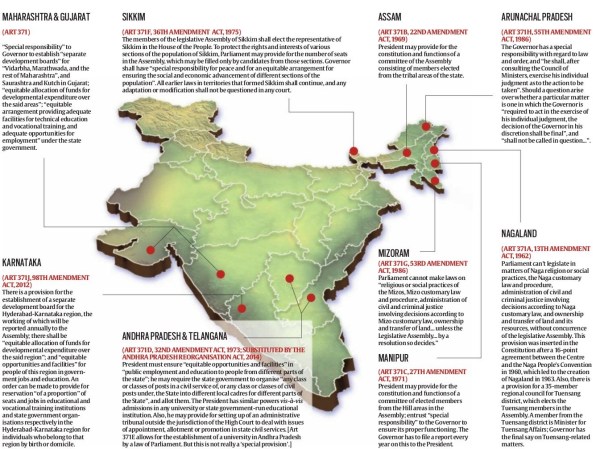 Special provisions for several states.
So how did Article 371 become associated with special protection?
India’s Constitutional system was designed to be flexible enough to accommodate regions whose historical circumstances, social structures or political demands were different from the rest of the country. Thus, Parliament repeatedly created bespoke Constitutional arrangements.
Nagaland
After Independence, the Naga political movement challenged India’s claim over Naga areas. The conflict eventually led to the 16-Point Agreement of 1960 which became the basis for the creation of Nagaland as a separate state.
One of the understandings was that Naga religious and social practices, customary law and procedure, and ownership and transfer of land and its resources would receive special protection. When Nagaland was created in 1963, these arrangements were incorporated into the Constitution through the insertion of Article 371A in the Constitution.
Assam
Story continues below this ad
Article 371B, inserted in 1969, arose from a different concern. Assam contained large tribal and hill areas that already had special arrangements under the Sixth Schedule. Growing demands from these areas led Parliament to provide another layer of political representation.
The 22nd Constitutional Amendment of 1969 allowed the President to create a committee within the Assam Legislative Assembly comprising members elected from the tribal areas covered by the Sixth Schedule. It created a mechanism through which representatives from protected tribal areas could have a distinct voice within the state legislature.
Manipur
When Manipur became a full state in 1972, the political relationship between its predominantly tribal hill areas and the Imphal Valley had to be addressed.
Article 371C was thus inserted to provide for a special committee of the Legislative Assembly consisting of members elected from the hill areas, with a special responsibility for the Governor to report to the President on their administration.
Andhra Pradesh
Story continues below this ad
In Andhra Pradesh, tensions between the Telangana and Andhra regions produced political agitations and led to the Six-Point Formula of 1973 which intended to address grievances over education, government employment and regional development.
Thus came Article 371D providing for equitable opportunities in education and public employment across different parts of the state. Here, it was born out of a regional equality and employment dispute, not an ethnic or cultural autonomy movement.
Sikkim
Insertion of Article 371F, dealing with Sikkim, was essentially for integration of the erstwhile independent state into the Indian union. In 1975, following political developments and a referendum, Sikkim became India’s 22nd state. Article 371F was inserted to manage that transition.
Mizoram and Arunachal Pradesh
The 1986 Mizo Peace Accord between the Government of India and the Mizo National Front paved the way for Mizoram’s statehood. Article 371G was thus inserted to protect Mizo religious and social practices, customary law and procedure, customary administration of justice, and ownership and transfer of land. Parliamentary laws concerning these matters do not automatically apply unless the Mizoram Assembly agrees.
Story continues below this ad
For Arunachal Pradesh, which became a state in 1987, Article 371H took a different approach, giving the Governor a special responsibility for law and order.
Goa and Karnataka
Article 371I, inserted when Goa became a state, is comparatively modest: it simply requires the Goa Legislative Assembly to have at least 30 members.
In 2012, Parliament added Article 371J for the Hyderabad-Karnataka region, now Kalyana Karnataka, to address regional backwardness through a development board, equitable allocation of funds and opportunities in public employment and education.
So the history of Article 371 is really a history of asymmetric federalism — the willingness of the Indian Union to give different regions different constitutional arrangements when a common formula is politically or administratively inadequate.
So what could Article 371K do for Ladakh?
Story continues below this ad
Ladakh is seeking something that does not neatly fit any existing 371 provision. The proposed Article 371K would apply to a Union Territory without a legislature. The emerging proposal envisages a directly elected UT-level body with legislative, executive, budgetary, planning and financial powers.
The MHA has said the body would have legislative powers over land, culture and language, forests, environment and natural resources, as well as other subjects reserved for the UT under Article 240.
The May 22 minutes, subsequently endorsed in July, also recorded that for subjects under the elected body’s jurisdiction, control and supervision of civil servants, including their APARs, would be exercised by the elected executive body.
The Ladakh leaders are also seeking control over law and order. Existing Article 371H gives the Governor special responsibility for law and order in Arunachal Pradesh. Ladakh’s leaders want the opposite. Similarly, the land protection sought by Ladakh resembles the philosophy of 371A and 371G, under which certain Parliamentary laws relating to land and customary practices do not apply automatically. But Ladakh is simultaneously seeking a much more substantial democratic governing institution.
What will be written into 371K
Story continues below this ad
If the provision merely creates an elected body and lists subjects over which it can legislate, its protection would be relatively limited. Manipur is an example where hill tribes have argued that Article 371C has failed to deliver on its promise of meaningful autonomy and protection.
If Ladakh’s 371 constitutionally protects the proposed elected body’s control over land, natural resources, recruitment and administration, it would be considerably stronger.
If it says that certain Central laws will not apply to Ladakh unless approved by the elected body, it would resemble the stronger protective mechanism of Articles 371A and 371G. And if it places law and order and the bureaucracy under the elected executive, the Ladakh head of government would be more powerful than J&K chief minister.
This is why the draft promised by the Centre is crucial. And that is what Ladakh leaders have been demanding.

3 cups, then conversation: Shah Rukh Khan reveals coffee-fuelled morning ritual
By Sohail Khan · 16 Sep
Faster recovery, pain management: Why elite athletes are using collagen
By Sohail Khan · 16 Sep
Dear Editor, I Disagree: Dialogue at BRICS is a means, not an end
By Sohail Khan · 16 Sep
Leave a Reply