Tata Sons after RBI directive: What happens to shareholders after listing
The Reserve Bank of India’s decision to reject Tata Sons’ request to surrender its registration as a Core Investment Company has brought the Tata group holding company one step closer to the stock market. The decision effectively revives the long-standing question of mandatory listing and, more importantly, raises a much larger issue: what could Tata Sons be worth if it eventually comes to the market, and how might its distinctive shareholder structure evolve?
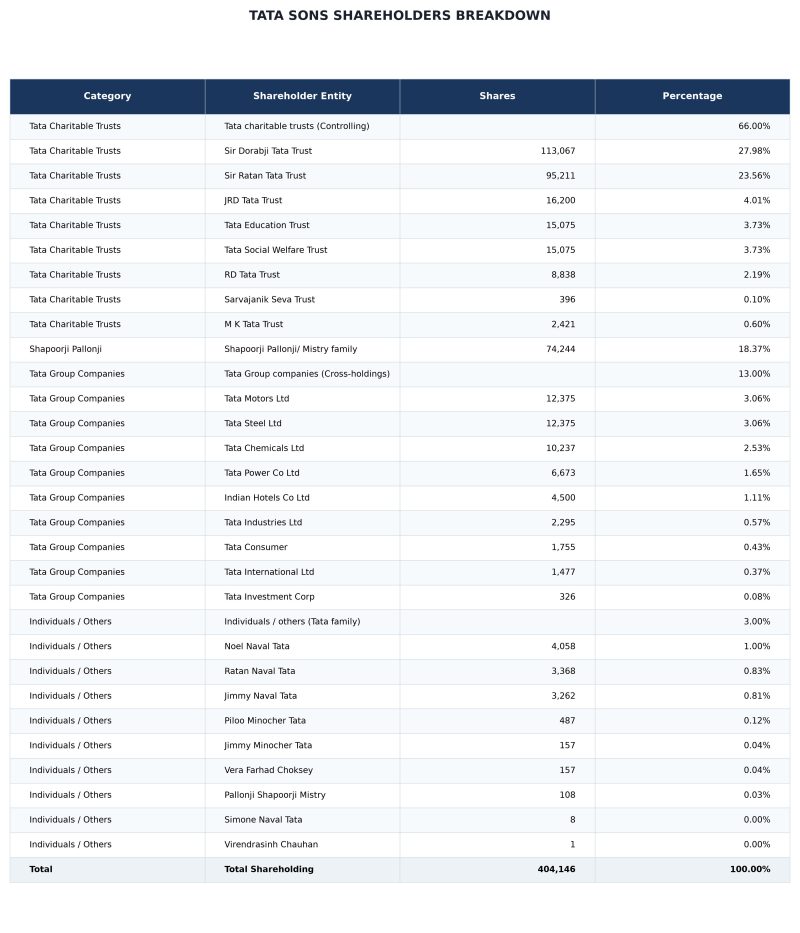
Tata Sons is unlike a conventional holding company. Around 66 per cent of its equity is held by Tata charitable trusts, 18.37 per cent by the Shapoorji Pallonji family, approximately 13 per cent by Tata group companies, and the remainder by individuals, primarily members of the Tata family. Tata Trusts Chairman Noel Tata’s stake will be worth Rs 10,000 crore at a valuation of Rs 10 lakh crore. The company’s ownership structure has remained largely unchanged and closely protected for decades.
Unless Tata Sons approaches the court and obtains an order against the RBI directive, the company’s IPO will become a reality in the coming months.
Story continues below.
Subscribe to see fewer ads.
The valuation question
There is no official valuation and established research firms are yet to come out with a valuation report. But Tata Sons’ own financial numbers provide an important starting point. Its net worth rose to about Rs 1.79 lakh crore in FY26, while the market value of its listed investments was about Rs 11.89 lakh crore as of March 2026, down from Rs 14.28 lakh crore in the previous year, according to the company’s Annual Report.
Tata Sons has already repaid its debt to escape the RBI classification among upper layer NBFCs.
The market value of Tata Sons, however, cannot simply be calculated by adding the market capitalisation of all the listed Tata companies in which it owns shares. A holding-company discount is normally applied because an investor in Tata Sons does not directly own the underlying shares. “Worth noting that listed holding companies (when all underlying companies are listed) NAV trade in the range of 70 per cent discount,” Founder of Helios Capital Samir Arora said in an ‘X’ post.
Earlier valuation exercises have produced widely different numbers. One analysis had estimated Tata Sons at around Rs 8 lakh crore, after applying a 60 per cent holding-company discount and assigning value to its unlisted businesses. With the Tata group having expanded substantially into semiconductors, electronics, batteries, aviation and other businesses, and with the value of its listed investments running into several lakh crore rupees, a valuation in the Rs 8-12 lakh crore range could be a reasonable market starting point. The final IPO valuation would depend on the value assigned to unlisted businesses and the holding-company discount, analysts said.
Story continues below this ad
Recent conservative estimates have put Tata Sons’ valuation around Rs 10 lakh crore, said a market analyst. Other estimates of over Rs 12 lakh crore are being floated around in the market.
“The continued private status of Tata Sons imposes an artificial ‘Holding Company Discount’ on its listed subsidiaries. By remaining unlisted, Tata Sons denies the 20 lakh plus shareholders of entities like Tata Chemicals or Tata Motors the fair-market valuation of their indirect holdings, effectively suppressing billions in shareholder wealth,” proxy advisory firm InGovern Research Services said in a recent report.
How much does Tata Sons have to offer?
Under the revised framework for very large issuers, a company with a post-issue market capitalisation of more than Rs 5 lakh crore has a minimum public offer requirement of Rs 15,000 crore and at least 1 per cent of post-issue market capitalisation, subject to a minimum dilution of 2.5 per cent.
If Tata Sons is valued at Rs 10 lakh crore, the minimum public offer would effectively be about Rs 25,000 crore (Rs 15,000 crore plus one per cent of post issue market capitalisation). The 2.5 per cent minimum dilution becomes the binding requirement. This could make Tata Sons one of India’s largest IPOs, although the amount would still be far below the company’s overall valuation. It will have to increase public shareholding to 15 per cent in five years and 25 per cent in ten years.
Who gains from the listing?
Story continues below this ad
The biggest beneficiary, at least on paper, would be the Tata charitable trusts, which collectively own around 66 per cent of Tata Sons. At a valuation of Rs 10 lakh crore, their stake would be worth approximately Rs 6.6 lakh crore. The Sir Dorabji Tata Trust’s 27.98 per cent holding would be valued at about Rs 2.80 lakh crore, while the Sir Ratan Tata Trust’s 23.56 per cent stake would be worth roughly Rs 2.36 lakh crore.
The Shapoorji Pallonji/Mistry family’s 18.37 per cent stake would be valued at approximately Rs 1.84 lakh crore. This underscores why a Tata Sons listing is also critically important for the Mistry family. The SP Group has been exploring ways to monetise a portion of its Tata Sons holding as it seeks to reduce its debt burden.
The Tata operating companies that own shares in Tata Sons could see their holdings acquire a market value. Nine Tata group companies – mainly Tata Steel, Tata Motors and Tata Chemicals — which hold 13 per cent stake will get Rs 1.3 lakh crore valuation for their stake. The stake of Tata Chemicals will be valued at Rs 25,300 crore, much higher than its current market capitalisation of Rs 15,593 crore. Stakes of Tata Steel and Tata Motors would be worth around Rs 30,000 crore each.
Noel Tata who holds 4,058 shares of Tata Sons will then be worth Rs 10,000 crore. His half-brother Jimmy Tata will be worth around Rs 8,100 crore due to his holding of 3,262 shares.
Story continues below this ad
A public listing would create a transparent and observable market price for the stake, providing shareholders with a clear reference point for its underlying value. This could materially improve liquidity and price discovery for an asset that has historically been difficult to monetise, while also giving existing holders greater flexibility to realise value without relying on bespoke private transactions or negotiated sales.
IPO will not necessarily mean Tata Trusts lose control
The Sebi’s minimum dilution rule of 2.5 per cent does not mean Tata Trusts would suddenly lose control of Tata Sons. If the IPO were structured as a fresh issue of shares worth Rs 25,000 crore at a post-issue valuation of Rs 10 lakh crore, the trusts’ stake would decline only marginally. Such a structure, however, appears unlikely.
If the IPO instead comprises largely an offer for sale (OFS), existing shareholders would sell their shares to the public. The Mistry family’s SP group which holds 18.37 per cent stake, could be a natural seller, given its long-standing interest in unlocking value from its investment in Tata Sons. Tata Trusts, by contrast, may be reluctant to dilute their controlling position, particularly given the central role Tata Sons plays in the governance and control of the wider Tata group.
The listing would not merely be an IPO. It would represent a fundamental change in the ownership architecture of the Tata Group and come under greater regulatory and investor scrutiny. It will have to meet SEBI’s eligibility and minimum public-shareholding/ listing requirements, make timely disclosure of material events, financial results and other required information to the stock exchange and maintain proper corporate governance, including an appropriate board structure, audit committee, independent directors and controls against insider trading and unfair practices.
Story continues below this ad
The RBI’s decision has opened that door. The next battle is likely to be fought in the courts over the RBI’s decision. If the courts uphold the RBI’s position, then valuation, dilution, and, above all, the question of who will sell the family silver will come into the picture.
 Source: TATA group

In German far-right party AfD’s rise, a bigger question for democracy
By Sohail Khan · 14 Sep
Mehbooba Mufti writes | The 80-20 Hindu-Muslim political game is making losers of us all
By Sohail Khan · 14 Sep
R Madhavan turned ₹17.5-crore Mumbai home’s balcony into an organic garden — how you can too
By Sohail Khan · 14 Sep
Leave a Reply