Rupture in Election Commission: How dissent has played out in the poll panel in the past
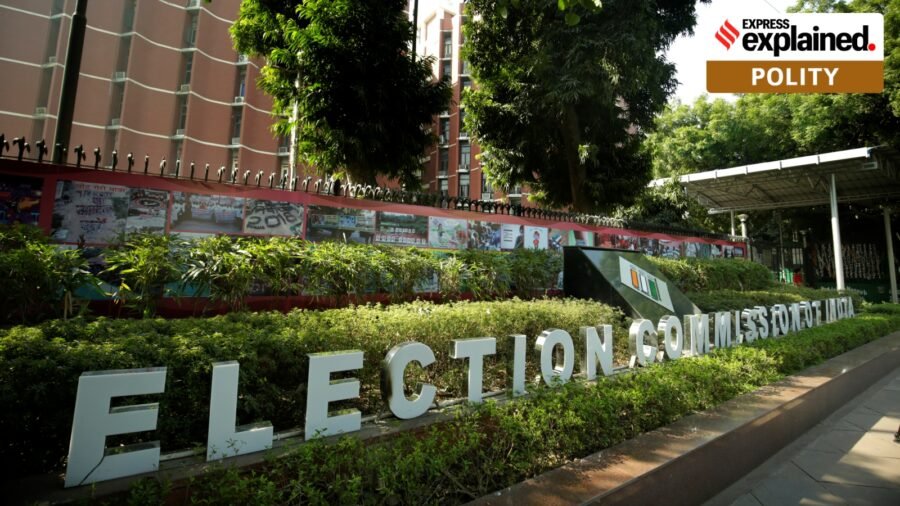
It further says that the commission will consist of the Chief Election Commissioner (CEC) and “such number of other Election Commissioners” that the President may appoint, subject to provisions of law. The CEC “shall act as the Chairman of the Election Commission”.
Story continues below.
Subscribe to see fewer ads.
How the Election Commission is supposed to arrive at decisions is laid out in the Chief Election Commissioner and Other Election Commissioners (Appointment, Conditions of Service and Term of Office) Act, 2023.
Section 17 of the Act says that the “business of the Election Commission shall be transacted in accordance with the provisions of this Act.”
“The Election Commission may, by unanimous decision, regulate the procedure for transaction of its business and also allocation of its business amongst the Chief Election Commissioner and other Election Commissioners. All business of the Election Commission shall, as far as possible, be transacted unanimously, and if the Chief Election Commissioner and other Election Commissioners differ in opinion on any matter, such matter shall be decided according to the opinion of the majority,” Section 18 of the Act says.
Since the Election Commission currently has three members, if the decisions are not unanimous, two of the three members can decide the matter. While the Chief Election Commissioner chairs the poll panel, all three members — the CEC and the two ECs — all have one vote.
Story continues below this ad
Have there been differences of opinion and dissent in the commission in the past?
Ever since the Election Commission was permanently expanded from a single-member body to a three-member commission in 1993, differences between the individuals who occupy the posts have emerged.
Then Chief Election Commissioner T N Seshan and Election Commissioners M S Gill and G V G Krishnamurthy were known to have clashed. In fact, Seshan had challenged the appointment of the two ECs in the Supreme Court, which upheld the appointment and ruled that the three members would have equal status.
The Supreme Court judgment in T.N Seshan vs. Union of India in 1995 made it clear that the three members would have an equal say in decision-making.
In January 2009, then CEC N Gopalaswami had written to the President seeking the removal of Election Commissioner Navin Chawla, citing a “lack of political neutrality”. With no such action from Rashtrapati Bhavan, Chawla eventually was appointed CEC.
Story continues below this ad
Election Commission officials say that differing opinions on matters before the commission, whether it is the conduct of elections or administrative matters, are a routine occurrence. However, when it comes to finally taking a decision, the commission takes a call unanimously or by majority. The Commission generally meets once or twice a week to discuss pending matters, officials say.
In case an Election Commissioner disagrees with the majority view, he or she can record a dissent note on the file.
Former Election Commissioner Ashok Lavasa had done exactly that in 2019, when he disagreed with the majority view of giving Prime Minister Narendra Modi and then BJP chief Amit Shah a clean chit on complaints of Model Code of Conduct violations before the commission. Lavasa had also objected that his dissent notes were not being recorded in the final orders passed by the commission. Lavasa, who was likely to take over as Chief Election Commissioner on the basis of seniority, opted to resign from the Commission in 2020.
Before the Election Commission issued its order starting the Special Intensive Revision of electoral rolls on June 24, 2025, Election Commissioner Sukhbir Singh Sandhu had observed on the draft order that the exercise should not lead to harassment to voters and citizens
Story continues below this ad
“Care should be taken that genuine voters/citizens, particularly old, sick, PwD (persons with disabilities), poor and other vulnerable groups do not feel harassed and are facilitated,” Sandhu had written. However, this, EC sources said, was an observation, and eventually the SIR order was unanimous.
Since then, as has reported, ECs Sandhu and Vivek Joshi have recorded their objections on files several times, whether it relates to the functioning of the poll commission’s IT infrastructure or the insertion of a new declaration in the voter enrolment form (Form 6).
What has the Election Commission said on the matter?
In a press statement on Wednesday, the Election Commission sought to differentiate between observations, which it said were standard and a part of the internal checks and balances, and decisions of the Commission.
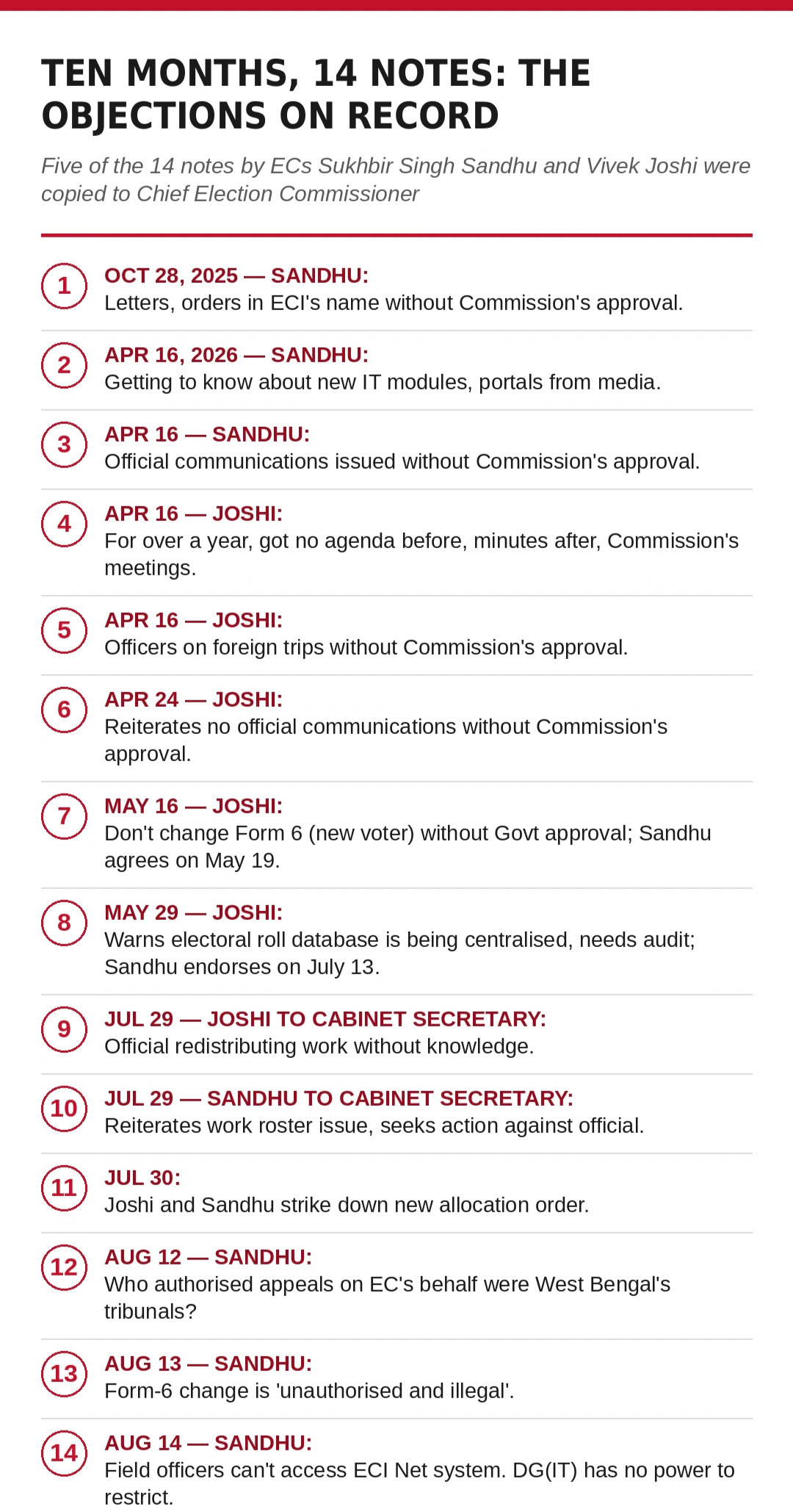 The objections on record.
“Any operational queries or inputs raised by Commission members during draft stages are part of standard administrative practice aimed at safeguarding voter rights. The suggestions given by the Commissioners were for further improving the electoral processes. Differing views and observations are a normal part of deliberation in any institution. They are a part of the decision-making process before a final decision is taken. Not only the three Commissioners, but every officer of the Commission is fully authorized to give his suggestions to the Commission for improving the electoral system,” the poll panel said.
Story continues below this ad
The Election Commission has said that all decisions taken in recent months have been the outcome of “unanimous decisions”. It cited the recent elections in Bihar, Kerala, Tamil Nadu, Puducherry, Assam and West Bengal, saying that these polls required “wide-ranging administrative and operational machinery and many Commission approvals and instructions.”

Kochi Is changing the way it dates, talks about sex and relationships
By Sohail Khan · 26 Sep
Post-World War II norms cannot fix today’s problems
By Sohail Khan · 26 Sep
A bronze medal, quiet gains in table tennis
By Sohail Khan · 26 Sep
Leave a Reply