America and China’s leaders indulge in pageantry as crises mount
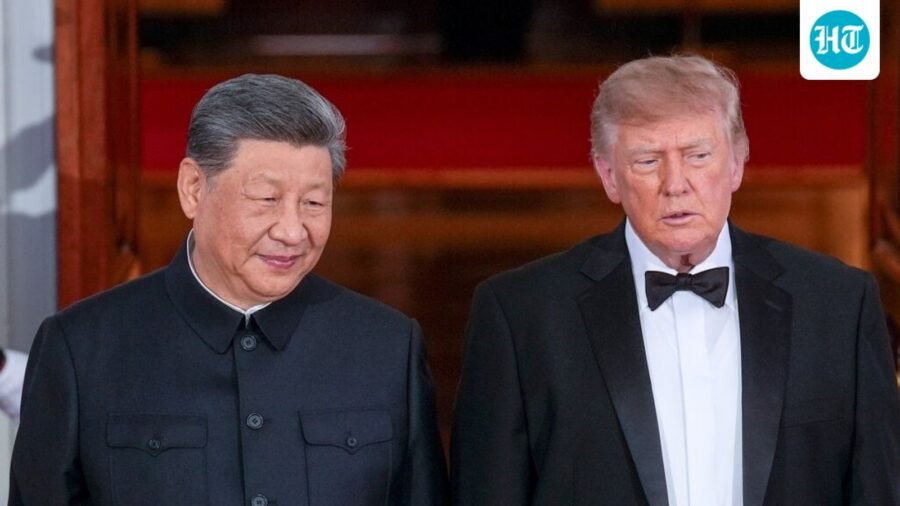
Donald Trump and Xi Jinping squandered a chance to tackle the world’s gravest threats
Published on: Sep 26, 2026, 08:01:01 IST
Prefer HTon Google
Share via
Copy link
QUITE POSSIBLY both Donald Trump and Xi Jinping felt like winners at the end of their meeting in Washington. Each new display of pomp and pageantry—and there were many over the course of the three-day state visit—was crafted to flatter the dignity of the American and Chinese leaders. It was harder to detect substantive achievements from this parley between strongmen.
That amounts to a dereliction of duty, and leaves the rest of humanity as the losers. The list of urgent global crises and threats is long. Wars in Iran, Sudan, Ukraine and beyond are ending lives and roiling markets for energy and food. Every week brings fresh reports of AI agents breaking free of human trainers to roam digital networks in feral packs. In their respective military headquarters, the main mission of American and Chinese commanders is to prepare to fight and win a conflict with one another, most probably over Taiwan, the democratic island that China claims for its own.
In such a moment, the two most powerful men on Earth could have talked. They could have explored whether their countries are doomed to compete in every sphere, or whether some risks are so severe that America and China are duty-bound to collaborate, and address them together. Given the unusual dominance that both men enjoy over their respective political systems, Mr Trump and Mr Xi could have agreed on a few concrete, world-saving ambitions, and tasked aides with delivering on them.
Deep Dive
Powered ByAsk
Instead, the two leaders put selfish interests first. Mr Trump likes a grand show, with himself at the centre, and he got one. Not long ago, when previous American presidents hosted Chinese leaders, the flag-waving folderol of state visits was seen on the American side as a necessary but annoying distraction. The real aim, for Democratic and Republic administrations alike, was to understand and ideally shape the thinking of the Communist Party boss in their midst. Great ingenuity went into creating opportunities for unscripted conversations. The fear was a Chinese leader woodenly reciting talking points. Confident in the soft power of American freedoms and spontaneity, White House officials would push Chinese leaders to meet regular folk at rodeos, factories and places of learning, or to hold joint press conferences with their American hosts at which journalists could ask awkward questions. American presidents would often push Chinese visitors to expand or liberalise academic and business contacts. To previous administrations, it was frustrating when ultra-cautious Chinese negotiators wanted to pre-plan every moment of a visit, and obsessed over empty questions of protocol.
Instead, Mr Trump seemed bent on aping and outdoing China’s preferred version of a state visit. There were honour guards lining the red carpet as Mr Xi stepped off his plane, to be greeted by Mr Trump himself—a mark of esteem for a visiting head of state that has not been seen in decades, popes aside. Mr Trump offered Mr Xi a brief glimpse of the White House ballroom that he is building, and that he has previously said was inspired by his admiration for the vast Great Hall of the People in Beijing. The time for one-on-one talks was brief. Far from seeking a free-ranging press conference, Mr Trump staged tightly choreographed photo opportunities, and was overheard by photographers praising the friendliness and deference of Chinese journalists in Mr Xi’s entourage. American news organisations that had been banned from the White House for displeasing Mr Trump were suing the president even as the visit unfolded, as Mr Xi doubtless knew, though his poker face gave nothing away.
The “deliverables” publicly sought by the American side, to use the ugly jargon of summits, were narrow in scope. Notably, Mr Trump and his team want China to agree to export more of the rare-earth elements and other hard-to-obtain minerals needed by American companies. They want China to buy more agricultural goods from American farmers, not least in the run-up to the midterm elections. And they want China to halt supplies and assistance to Iran’s armed forces and to use its leverage as the largest buyer of Iranian oil to push Iran to sue for peace. Because Mr Trump’s negotiators believe that China is not sticking to previously-made undertakings, a trade truce agreed by America and China in South Korea last year was extended by only two further months, rather than the two years reportedly sought by China.
On the Chinese side, Mr Xi’s aims were also more self-serving than his lofty rhetoric about peace and the “progress of humanity” might suggest. For Mr Xi, being treated as an equal by Mr Trump was an imperative, and not just for the sake of his pride. Mr Xi is expected to seek a fourth term as leader at a party congress next year. Though he hardly has to worry about anyone opposing this plan, in part because all possible doubters have been purged, it helps him to be seen ascending to a new level of global stature. As for China’s national interest, Mr Xi’s stated aim was to bind Mr Trump and America to a form of peaceful co-existence that Chinese officials call “a constructive China-US relationship of strategic stability”.
That tangle of words actually describes a straightforward ambition. China hopes to construct a safe enclosure around the bilateral competition with America, made up of red lines that must not be crossed. The thickest and reddest of those lines concern Taiwan. China has been trying for some time to nudge Mr Trump to say that he opposes the island seeking formal independence. That would mark a change from America’s current stance, which is to say that it does not support Taiwanese independence. Though the distinction sounds arcane, such a statement from a president would induce alarm on the island, for it would seem to rule out American help in the event of a war triggered by a Taiwanese government that definitively rejected rule from Beijing. This Washington meeting saw China try again, with an official Chinese readout saying that opposition to an independent Taiwan is the foundation of stable relations. As Mr Xi took off, there was no evidence that Mr Trump had ceded ground on this point.
It is a sign of the changing times that the loudest call for increased people-to-people exchanges came from Mr Xi, rather than his American host. The Chinese leader invited 100,000 American students to visit his country, where doubtless the hope is that they will be dazzled by Chinese high-speed trains, dancing robots and other signs of modernity. Once it was American presidents, starting with Jimmy Carter, who urged China to send 100,000 students to breathe free air on America’s campuses.
Public statements by the two leaders offered few indications of serious engagement on AI governance. Mr Trump claimed in a Truth Social post that Mr Xi is on board with his attempt to address public distrust of AI by rebranding artificial intelligence as “super-intelligence”. A bit less trivially, Mr Xi spoke of the need to ensure human control of AI. Optimists can only hope that more weighty work is continuing at the level of senior officials, building on talk of an agreement between the treasury secretary, Scott Bessent, and his counterpart, the Chinese vice-premier He Lifeng, to share alerts on severe AI risks. Alas, for now, the fear is that America and China are more focused on winning a contest for primacy in the field of AI, and much else. While the superpower competition rages, pageantry is one area where Mr Trump and Mr Xi can see mutual benefit. Meanwhile, the 21st century hurtles onwards, without responsible leadership.
See Less
Arming Taiwan an important US interest, Taipei official says after Trump-Xi summit
By Sohail Khan · 26 Sep

Will the AI frenzy add up to anything?
By Sohail Khan · 26 Sep
Leave a Reply