Punjab depends on agriculture. Why it still lacks a dedicated farm policy
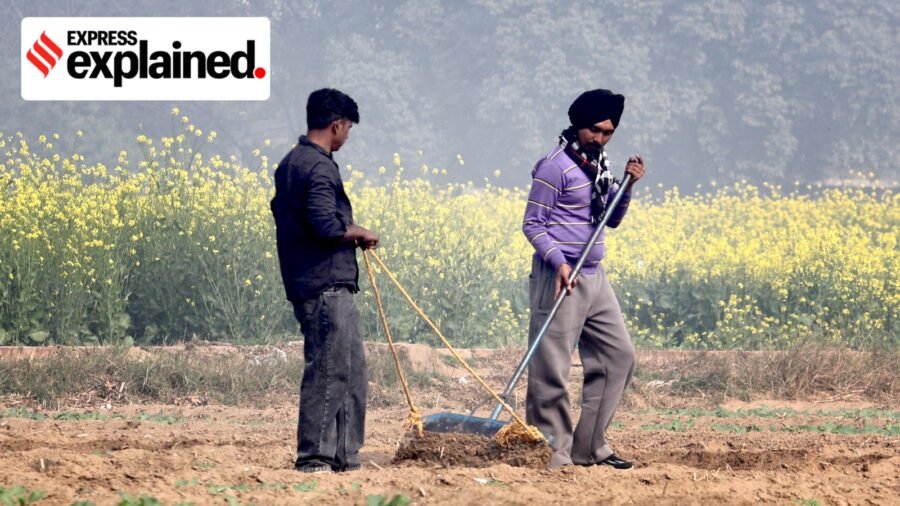
Punjab is primarily an agrarian state, yet it has never had a comprehensive agricultural policy. The previous Congress-ruled government made an attempt to formulate one, but the draft never translated into a policy.
The Aam Aadmi Party (AAP), which came to power in 2022, made efforts towards this end, with an 11-member committee drafting the 200-page Punjab Agricultural Policy 2023. This March, a 13-member Punjab Vidhan Sabha committee, led by its chairman, MLA Gurpreet Singh Banawali, examined the same policy and recommended its implementation. The committee also wrote to Punjab Chief Secretary, K A P Sinha, seeking its implementation.
This raises a larger question: if a policy has already been prepared by experts, submitted to the government, discussed with stakeholders, and subsequently examined by a legislative committee, why is Punjab still without a clear implementation road map? This assumes greater significance, with the government set to complete its term in a few months and Assembly elections round the corner.
Story continues below.
Subscribe to see fewer ads.
The 2023 policy
The Punjab Government constituted an 11-member Agricultural Policy Formulation Committee on January 13, 2023, under Sukhpal Singh, chairman of the Punjab State Farmers’ and Farm Workers’ Commission.
The committee included the current Chief Secretary K A P Sinha, then Special Chief Secretary, Agriculture and Farmers’ Welfare; Satbir Singh Gosal, Vice-Chancellor of Punjab Agricultural University; Inderjeet Singh, Vice-Chancellor of Guru Angad Dev Veterinary and Animal Sciences University; and agricultural and economic experts such as Sucha Singh Gill, B S Ghuman, Gurkanwal Singh, and Balwinder Singh Sidhu.
According to the Commission, around 1.02 lakh suggestions were received from different organisations and stakeholders, which were examined before the policy was prepared. The draft was submitted to the Punjab government on October 13, 2023. But implementation did not follow.
Policy proposals
The Punjab Agriculture Policy 2023 goes beyond crop diversification: it addresses groundwater depletion, farm debt, farm incomes, insurance, labour, research, marketing, livestock, and horticulture.
Story continues below this ad
Water and diversification: It targets at least 30% water saving initially, restricts long-duration paddy varieties and proposes stopping paddy cultivation in critically stressed areas, while promoting canal irrigation, micro-irrigation and water-saving technologies. It encourages alternatives to the wheat-paddy cycle, including cotton, maize, sugarcane, pulses, oilseeds, vegetables, and horticulture, with timely canal water and improved cotton seeds in cotton-growing areas.
Debt, pension, and insurance: It proposes a one-time debt settlement, debt-swapping, and relief for small farmers, along with a Punjab-specific crop insurance scheme and fund, livestock insurance, and pension after 60 for farmers owning up to five acres and farm labourers.
Research, seeds, and markets: It proposes 13 Centres of Excellence, making Punjab a seed hub through region-specific clusters, continuous seed research, stronger agricultural research and extension, and market research institutions.
Cooperatives and rural economy: It seeks to strengthen 3,523 multi-purpose cooperative societies and promotes organic and natural farming, horticulture, livestock, dairy, mechanisation, women’s role in agriculture and modernisation of land-lease laws.
Story continues below this ad
The policy also proposes measures aimed at reducing the government’s long-term financial burden. For instance, it recommends grid-connected solar systems for agricultural tubewells. The Commission told the Assembly committee that the scheme would require substantial initial investment but could recover its cost over time and subsequently generate revenue worth thousands of crores of rupees.
The policy also links water conservation with Punjab’s agricultural power subsidy burden, which was around Rs 8,000 crore, arguing that reducing groundwater extraction and promoting water-efficient agriculture could eventually reduce the state’s expenditure on subsidised farm power.
The 2026 committee
The issue received a fresh push from the Punjab Vidhan Sabha’s Committee on Agriculture and Allied Activities, headed by MLA Gurpreet Singh Banawali. The committee held 16 meetings before submitting its fourth report to the Assembly on March 12, 2026.
At its meeting on July 8, 2025, the committee heard representatives of the Commission about the policy and examined its recommendations. In the end, the committee unanimously recommended the policy’s implementation. Banawali indicated that the government need not implement every recommendation simultaneously and that, if full implementation is not possible at once, it can be done in phases.
The hurdles
Story continues below this ad
So, if phased implementation is indeed possible, why has a first phase not been clearly defined? Experts said that discussions around the policy point towards several possible constraints.
The first is finances. Pension, debt settlement, crop insurance, compensation, research, water conservation, and other measures would require substantial public expenditure at a time when Punjab’s finances are already under pressure.
Diversification is also politically and economically difficult, because farmers have relatively assured procurement for wheat and paddy, while alternative crops need comparable price support, markets, and infrastructure. Some recommendations would also require support and coordination from the Centre.
Finally, the policy requires a clear implementation architecture: budgets, timelines, departmental responsibilities, measurable targets, and accountability mechanisms.
Story continues below this ad
“In short, the policy explains what needs to be done, but the government has yet to spell out how, when and with what money it will be done,” a senior officer in the Punjab Finance Department told .
Farmers’ organisations have also repeatedly called for implementation. Jagmohan Singh, general secretary of the Bhartiya Kisan Union (Dakuanda), had stressed that Punjab needs a dedicated agricultural policy, with successive governments preparing a roadmap and securing funding for debt settlements, an assured minimum support price, and pension plans to make the proposals a reality.
Despite repeated attempts, Agriculture Minister Gurmeet Singh Khudian could not be reached for comment on the delay and the government’s plans for policy implementation.

New e-commerce rules: What changes for your online shopping
By Sohail Khan · 13 Sep
Diarrhoea, white spots and 5 other surprising signs your body may be low on zinc
By Sohail Khan · 13 Sep
With peak summer looming, why is Keralam facing a power cut crisis?
By Sohail Khan · 13 Sep
Leave a Reply