On BRICS sidelines, Mirwaiz meets Iran’s Araghchi, writes to Pezeshkian
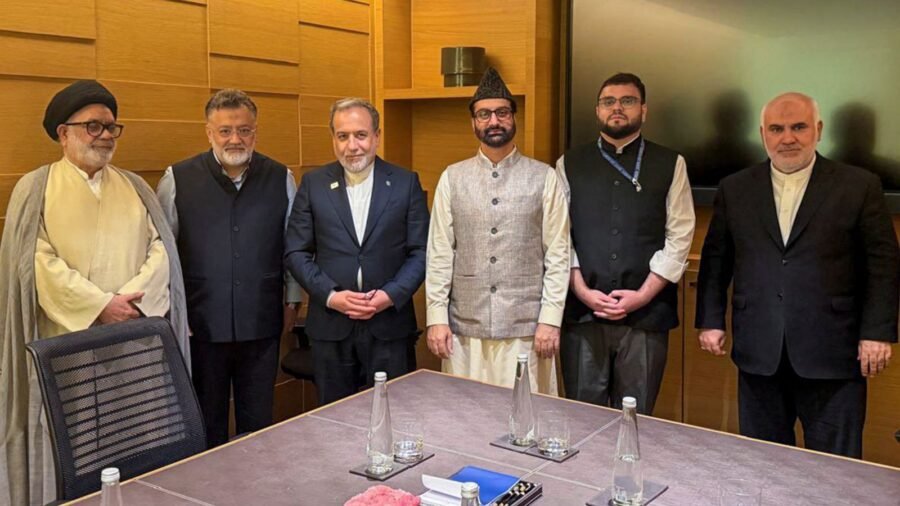
With its legacy of Mahatma Gandhi’s philosophy of Ahimsa, India can play a constructive role in encouraging restraint, engagement and diplomacy, Kashmir’s chief cleric and separatist leader Mirwaiz Umar Farooq has written in a letter to Iranian president Masoud Pezeshkian.
Mirwaiz met Iranian Foreign Minister Abbas Araghchi on the sidelines of the Brics summit on Saturday night. The meeting came a day after Valley-based political and religious leaders attended an inter-faith conference that was also addressed by Iranian president Masoud Pezeshkian.
In a letter to Pezeshkian, handed over to Araghchi, Mirwaiz called for engagement for resolution of issues, saying the “painful consequences of prolonged tensions and unresolved differences” has strengthened his conviction of engagement and dialogue.
Story continues below.
Subscribe to see fewer ads.
“We had a detailed meeting with him (Araghchi),” Mirwaiz told . “We discussed politics, conflict, peace engagement and dialogue. We also discussed Mahatma Gandhi’s non-violence as a way forward.”
Mirwaiz said even though Araghchi is an academic, he has a great political insight.
On Friday, when Iranian president Pezeshkian addressed an interfaith dialogue that brought together a diverse group of Indian religious heads, including Hindus, Sikhs, Christians and Muslims, together, Mirwaiz was accompanied by Shia leaders, Aga Syed Hassan Moosavi and Imran Raza Ansari. Moosavi’s son and Peoples Democratic Party (PDP) legislator Syed Muntazir Mehdi was also present at the meeting.
“Nobody among us had a meeting with him (Pezeshkian),” said legislator Mehdi. “There was a huge rush at the conference and he (Pezeshkian) left after his address. We barely had a handshake with him.”
Story continues below this ad
In the letter to Pezeshkian, Mirwaiz expressed his solidarity with Iran and called engagement and dialogue as the only way forward.
‘Wisdom, restraint needed more than ever’
“This is a time when wisdom, restraint and statesmanship are needed more than ever. Differences, however serious, cannot ultimately be resolved through endless confrontation. War only multiplies human suffering,” Mirwaiz said in the letter. “Eventually, even the most difficult disputes have to return to the table of dialogue, engagement and negotiation.”
With Iran’s conflict with the US and Israel drawing in many Arab countries, Mirwaiz has called for unity among the Muslims irrespective of sectarian divide. Referring to Iran’s slain supreme leader Syed Ali Khamenei’s Jamia Masjid visit in the 1980s, Mirwaiz referred to his speech urging for unity among different sects of Muslims.
“I also believe strongly that this conflict must not be allowed to become another cause of division within the Muslim Ummah. At a moment when Muslims in different parts of the world are already facing Islamophobia and uncertainty, sectarian differences and political rivalries must not be permitted to further weaken us,” the letter said. “Our unity does not mean that Muslims must agree on every political or theological question. It means that our differences should never overcome our fundamental bonds of faith, brotherhood and shared humanity. All must stand together against sectarianism and against every attempt to turn political conflicts into divisions within the Ummah.”
Story continues below this ad
Drawing on the Iran-Kashmir relations, Mirwaiz also presented to President Pezeshkian, through foreign minister Araghchi, a walnut-wood replica of Srinagar’s Jamia Masjid.
‘Centuries of cultural and spiritual interaction’
“Kashmir and Iran have also shared centuries of cultural and spiritual interaction. Persian scholarship, literature, art and spirituality have left a deep imprint upon Kashmiri civilization,” the letter read. “These are bonds between peoples that have survived changing political circumstances and generations.”
In a reference to the India-Pakistan dispute on Kashmir, Mirwaiz has said it has strengthened his belief that dialogue is indispensable for conflict resolution.
“Our own experience in South Asia has taught us the painful consequences of prolonged tensions and unresolved differences. It has also strengthened my conviction that engagement and dialogue are ultimately indispensable,” the letter read. “India, with its legacy of Mahatma Gandhi’s philosophy of Ahimsa, can also play a constructive role in encouraging restraint, engagement and diplomacy. The grave challenges facing our world cannot be settled through ever-widening wars. Confrontation will only aggravate them; ultimately they must be addressed through dialogue and negotiation.”
India and Vietnam discuss defence ties, emphasise maintaining regional stability
By Sohail Khan · 13 Sep
‘80% Indians non-vegetarian’: Rahul Gandhi’s BRICS dinner remark
By Sohail Khan · 13 Sep
Leave a Reply