PM Narendra Modi to Vladimir Putin: Must move from endless war towards an end to war
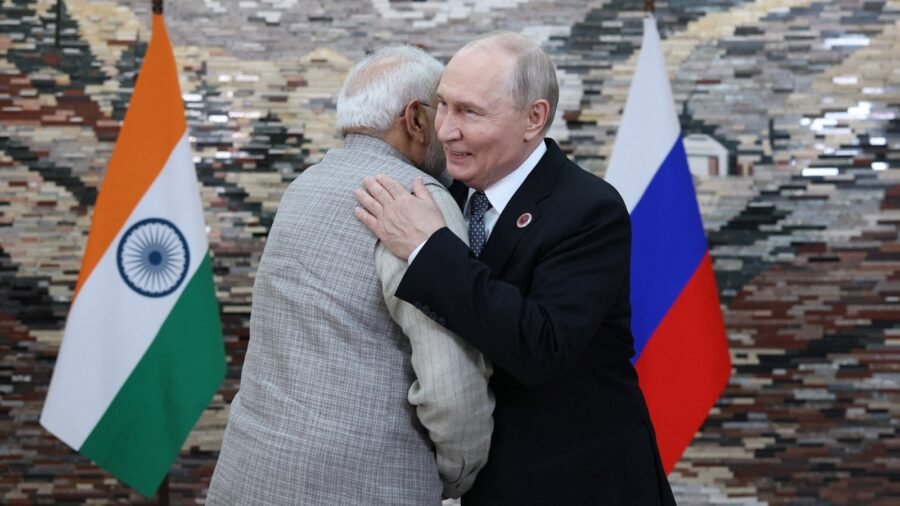
Four-and-a-half years into the war between Russia and Ukraine, Prime Minister Narendra Modi on Monday called on Russian President Vladimir Putin to move from “endless war” to “end of war”.
Modi has raised the issue with Putin earlier too. “This is not the era of war,” he told Putin in September 2022. Then, in a meeting with Putin in Moscow in July 2024, Modi said that “peace talks do not succeed amid bombs, guns and bullets”, and a “solution (to any conflict) cannot be found on the battlefield”.
In his televised opening remarks at the start of the bilateral meeting in Bishkek on Monday, Modi told Putin: “We have been discussing the Ukraine issue. When we met previously, you briefed me in detail on all aspects of the matter. As you know, India supports all efforts towards peace, and will continue to do so.”
Story continues below this ad
“Every day of war sets humanity back, whereas every step taken towards peace fills humanity with new hope and enthusiasm. We must move away from endless war towards an end to the war,” Modi said. “This is crucial for the well being of humanity. A peaceful resolution to all issues at the earliest is the call of humanity, and this is India’s message. The land of Gandhi and Buddha shares a single message: the path of peace,” he said.
Focus areas for the India-Russia friendship remain… pic.twitter.com/tclMVJ72KS
— Narendra Modi (@narendramodi) August 31, 2026
Modi said Putin’s visit to India in December last year was “highly successful and truly memorable”. “It is a matter of deep satisfaction for us that our cooperation continues to scale new heights and that we are working together for the welfare of the people of both nations,” he said.
“Focusing on national interest as the paramount priority has been our shared approach, and this will remain our guiding principle in the future as well,” he said, hinting at India buying Russian energy over the last four-and-a-half years of the war to cushion the inflationary impact on Indians.
Story continues below this ad
Putin, on his part, said that relations between the two countries “continue to strengthen on the principles of a special and privileged strategic partnership”. Addressing Modi, he said: “This is undoubtedly facilitated by your personal attention to the development of Russia-India relations, as well as by the close personal friendship that has developed between us, for which I am very grateful to you.”
Flagging economic ties, he said, “Trade and economic cooperation is showing positive trends overall. There was a slight decline last year, but in the first half of 2026, trade turnover increased by 2.6%. A week ago, the Intergovernmental Commission met in Moscow and also reported good results.” He was referring to External Affairs Minister S Jaishankar’s recent visit to Moscow where they discussed the upward trend.
“I would also like to say a few words about humanitarian cooperation. India is among the leaders in terms of the number of students studying in Russia: over the past 10 years, their number has increased seven-fold and now stands at almost 40,000,” Putin said.
Underlining people-to-people ties, he said both Indian and Russian culture festivals are held regularly. The next one is scheduled to take place in India in 2027. Tourist exchanges are also developing rapidly, increasing by 16% in 2025, Putin said.
Story continues below this ad
“This time, our meeting is taking place on the eve of the SCO Summit — an organisation that works to deepen contacts among the countries of the Global South and East, promotes the region’s socio-economic and cultural development, and contributes to building a just multipolar world,” he said.
Next year, “we will mark the 80th anniversary of the establishment of diplomatic relations, and, of course, we are seriously preparing for the upcoming BRICS Summit in New Delhi in September,” he said, confirming his visit to India.
The two leaders are expected to meet again in Delhi for the BRICS leaders’ summit on September 12-13.
Speaking on multilateral cooperation, Putin said: “We closely coordinate our efforts within the UN, BRICS, G20 and, of course, the SCO. Today, we have a very good opportunity to compare notes and chart the way forward in developing Russia-India relations.”
Story continues below this ad
Addressing reporters after the meeting, Foreign Secretary Vikram Misri said the PM “reiterated to President Putin his readiness, India’s readiness, to do whatever is feasible, is necessary at our end to move this conflict towards a conclusion because it is exacting a very heavy toll on the global community at large.”
Asked about the fate of Indians recruited in the Russian Army, Misri said of the total 227 recruited, 51 Indians had “perished” in the war so far. He said 139 Indians had been discharged, and the Indian Embassy in Moscow is engaging with the Russian authorities to bring them back to India.
On trade ties, Misri said: “Last year, when President Putin had come to India for the annual summit, the PM had shared with him a paper that detailed some market access-related issues that Indian products still faced in Russia, some non-tariff barriers. I am glad to report that, with the cooperation of our Russian friends, we’ve had significant progress on that front; market access has improved significantly in several areas of interest, including meat exports, marine products exports, dairy exports. So, increasing the market access in these areas and diversifying the basket will both be pursued by us in order to impact the trade deficit that is growing.”
In a statement, the MEA said: “The two leaders reviewed progress in bilateral cooperation in a range of fields, including political, economic, defence, energy, space, mobility and people-to-people ties.”
Story continues below this ad
“The leaders exchanged views on India-Russia engagement in the multilateral arena, in particular in BRICS under India’s chairship for 2026. They also shared perspectives on key regional and global issues of mutual interest, including the conflicts in West Asia and the Black Sea region, which have impacted maritime trade and the safety and security of Indian seafarers. The PM reiterated that dialogue and diplomacy was the way forward in resolving conflicts,” it said.
The MEA said the two leaders “agreed to remain engaged to further strengthen the Special and Privileged Strategic Partnership between the two countries, which continues to register significant growth and has shown resilience in the backdrop of geopolitical uncertainties”.
SIR draft rolls see over 13 crore deletions so far, Delhi leads with 33% left out
By Sohail Khan · 1 Sep
Vehicles without insurance could be denied fuel at Madhya Pradesh petrol pumps
By Sohail Khan · 1 Sep

Leave a Reply