PM Modi, Donald Trump talk trade, defence as US tariff threat over Russian oil looms
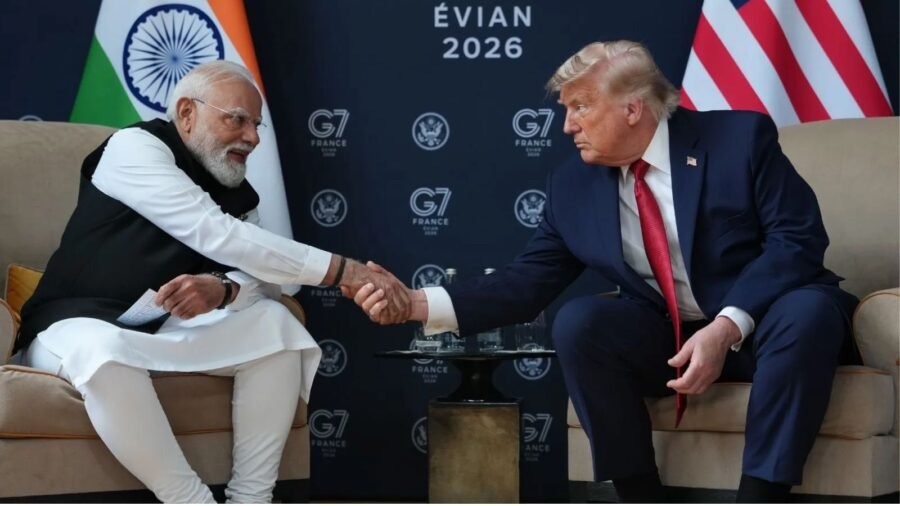
Prime Minister Narendra Modi spoke to US President Donald Trump on Wednesday, in their first phone conversation since the American President signed the law that has granted powers to impose 100 per cent tariffs to India, China and other countries for importing Russian energy.
This is Modi’s first conversation with Trump since April when the two leaders had spoken after the agreement on a fragile ceasefire between US and Iran over the war in West Asia.
“Had a productive conversation with President Trump. We reviewed our bilateral cooperation in trade, defence, energy, critical technologies and other areas. We agreed to maintain close engagement to take our Comprehensive Global Strategic Partnership forward,” Modi said, after the conversation.
Story continues below.
Subscribe to see fewer ads.
“We also exchanged views on regional and international issues, including ongoing efforts to advance global peace and security,” he said.
According to PMO statement, the two leaders reviewed progress in bilateral cooperation across trade, defence, energy, critical technologies and other areas of mutual interest.
“They reaffirmed their commitment to advancing the India-US Comprehensive Global Strategic Partnership and agreed to maintain close engagement to deepen cooperation for the benefit of the people of both countries,” it said, adding that the leaders also exchanged views on regional and international developments and discussed ongoing efforts to promote global peace and security.
“Both leaders agreed to remain in touch,” it said. Modi is expected to travel to the US for the G20 leaders’ summit in December this year. But, before that US Secretary of State Marco Rubio is expected to travel to India in the third week of October.
Story continues below this ad
The conversation took place a day after External Affairs minister S Jaishankar, while underlining the complex nature of the Indo-US trade deal negotiations, had said the two sides have reached a situation where there is “more or less an understanding on the trade agreement”.
Flagging terrorism emanating from Pakistan as one of India’s key concerns, he said if this is “not fully appreciated” by the US, then it has “an impact” on Delhi’s relationship with Washington. Jaishankar was speaking at the Asia Society Policy Institute in New York Monday, after spending an entire week at the UN General Assembly session.
On the India-US trade negotiations, Jaishankar pointed to the “stakes” and “complexity” involved. “Bear in mind, India is a society of small producers, small agriculture producers, small factories. Apart from the per capita gap between India and the United States, the nature of production, nature of society is very different.”
“A trade negotiation required a certain amount of … patience and detailing to see it through… the expectation that it could rapidly move forward, I think, was tested against a ground reality which was much more complex,” he said.
Story continues below this ad
“Today, we have reached a situation where there is more or less an understanding on the trade agreement.”
On Pakistan, he had said, “What for us in India is particularly important is the issue of terrorism. That we feel that… as a country perhaps there are very few countries which have been subjected to the kind of terrorism that we have from a neighbour as part of a deliberate, conscious policy over many, many decades.”
“Now, if something which matters so deeply to us, there isn’t enough understanding or appreciation or empathy of that, I think that creates a problem too. That you know if… one of my primary concerns is not fully appreciated by my partner, then clearly there is an impact of that on the relationship,” he had said, referring to the ties between India and the US.
Key leaders absent, Opposition bloc rejects Rahul Gandhi as its face: BJP
By Sohail Khan · 30 Sep
Jharkhand court frames charges against CM Hemant Soren in land case
By Sohail Khan · 30 Sep
Leave a Reply