Pakistan’s westward turn — strategic depth or overstretch
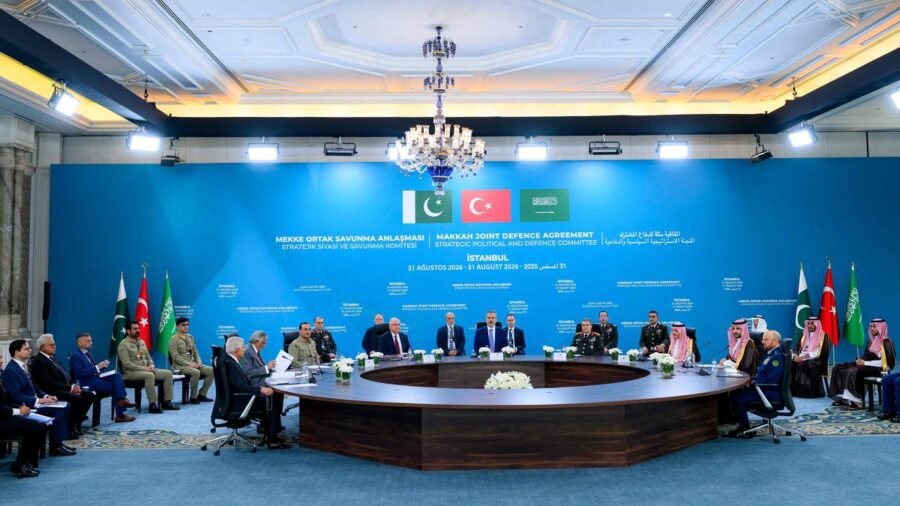
The defence cooperation agreement signed by Pakistan and Kuwait on August 27, 2026, is the latest manifestation of Pakistan’s rapidly expanding strategic footprint in West Asia. The agreement assumes greater significance when viewed alongside Pakistan’s membership of the Saudi Arabia-Türkiye-Pakistan defence arrangement and its recent role as an intermediary between Iran and the United States.
Enduring links
Pakistan’s West Asian orientation has deep historical roots. From its inception, it attempted to combine its South Asian geopolitical identity with that of a major Muslim power. During the Cold War, Pakistan, Iran and Türkiye were linked through the Central Treaty Organization (CENTO) and subsequently through the Regional Cooperation for Development.
The decisive turn towards the Arab world came after Pakistan’s defeat and dismemberment in 1971. It sought to compensate for its diminished position in South Asia by emphasising its Islamic identity, symbolised by the Islamic summit held in Lahore in 1974. Pakistan simultaneously developed extensive military relationships with Saudi Arabia and the Gulf monarchies.
However, Islamabad diligently attempted to avoid allowing its Saudi relationship to make it a party to the Saudi-Iranian rivalry. In 2015 Pakistan’s Parliament refused to send troops to participate in the Saudi-led Yemen war. Pakistan had compelling reasons for caution: a substantial Shia population at home and a long and occasionally turbulent border with Iran.
What is new, therefore, is not Pakistan’s involvement in West Asia but its increasing institutionalisation. The Makkah Agreement of August 7 stipulated that an armed attack against one member would be regarded as an attack against all. The three countries moved quickly to give the arrangement institutional substance. At the August 31 meeting in Istanbul, their Foreign and Defence Ministers and military chiefs decided to establish a permanent secretariat in Saudi Arabia, with a Pakistani serving as its first Secretary-General for three years. They also agreed to strengthen military interoperability and pursue defence-industrial cooperation, including joint technology development and production.
The combination is potentially formidable because of Saudi financial power, Türkiye’s conventional military capability and rapidly expanding defence industry, and Pakistan’s large armed forces and nuclear capability.
But the new arrangement is already confronting Pakistan with the contradictions inherent in its expanding West Asian role. Renewed Houthi missile and drone attacks against Saudi Arabia created the first serious test of the Makkah pact. The Houthis’ recent capture of Mocha port and Perim island have further added to their capability to choke off Saudi shipping through the Bab al-Mandab. With the Strait of Hormuz effectively closed by Iran, a frustrated Saudi Arabia may re-launch a full-fledged war against the Houthis. This could create a major dilemma for Pakistan especially if Riyadh decides to invoke the collective-defence provision of the Makkah agreement.
Pakistan wants to be Saudi Arabia’s security partner, Türkiye’s strategic ally, Iran’s friend and interlocutor, Washington’s useful intermediary, and an increasingly important security provider to the Gulf monarchies. These roles are compatible when regional tensions are manageable. They become irreconcilable when they are not.
What it means for India
For India, Pakistan’s westward turn presents both a challenge and a potential relief. A Pakistan embedded in a network of West Asian security relationships may acquire defence in depth. Saudi financial resources, Turkish defence technology and Pakistan’s expanding relationships with Gulf militaries can theoretically increase Islamabad’s resilience in a confrontation with India. Türkiye is already Pakistan’s most vocal major supporter on Kashmir. Pakistan’s nuclear status also enhances its strategic value to Arab states concerned about an increasingly unstable regional order because of nuclear-armed Israel’s aggressive policies.
But strategic depth can easily become strategic overstretch. Pakistan’s security establishment has historically concentrated overwhelmingly on India. A Pakistan increasingly required to devote diplomatic, military and intelligence resources to Iran, Saudi Arabia, the Gulf, Yemen and the Red Sea may have fewer resources to concentrate on India.
The current Saudi-Houthi confrontation and the distinct possibility of it spawning a war clearly demonstrate the danger of Pakistan’s strategic overstretch. The deeper Pakistan becomes embedded in West Asian security arrangements, the harder it will become to remain aloof from the region’s conflicts. If the Houthi-Saudi confrontation escalates, Islamabad may eventually have to choose between honouring the credibility of its collective-defence commitments and maintaining its carefully cultivated relationship with Tehran, the Houthis’ principal ally.
India should therefore resist interpreting Pakistan’s growing West Asian role in purely negative terms. Saudi Arabia, the United Arab Emirates and the other Gulf states have major economic and strategic relationships with India that they are unlikely to sacrifice for Pakistan. New Delhi should continue deepening these relationships as a counter to Pakistan’s expanding footprint in West Asia.
The consolidation of Pakistan’s West Asian relationships undoubtedly provides it with greater strategic depth vis-à-vis India. But those very relationships expose it to some of the world’s most combustible rivalries. For India, therefore, Pakistan’s westward turn contains a paradox. A Pakistan more deeply embedded in a West Asian security structure may in theory look strategically stronger. But a Pakistan entangled in mutually contradictory West Asian commitments will soon discover that it could be indefinitely stuck in a quagmire of its own choosing. It is far more difficult to get off the tiger than to get on it.
Mohammed Ayoob is University Distinguished Professor Emeritus of International Relations, Michigan State University, and the author of ‘From Regional Security to Global IR’ (2024)

A rising graph: On the doping culture in Indian sports
By Sohail Khan · 14 Sep
Revisiting Kuwait’s invasion amid war
By Sohail Khan · 14 Sep

Leave a Reply