Once down to just 5, the black robin is now New Zealand’s Bird of the Year
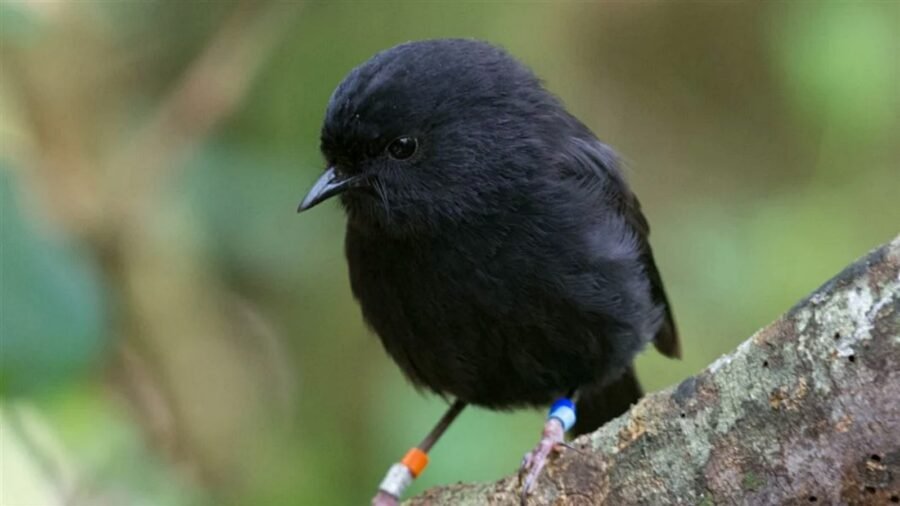
For a bird that lives on two remote islands, that is quite the fan following. But the real reason the karure’s win matters has little to do with popularity. At one point, there were almost no black robins left to vote for.
The bird that came back from five
View this post on Instagram
A post shared by Department of Conservation (@docgovtnz)
By 1980, the species had been reduced to just five birds. Even more alarmingly, only one was a fertile female. Her name was Old Blue.
Conservationists paired her with a male known as Old Yellow, and the two became the founding pair of the population that survives today.
Saving the species required extraordinary human intervention. Conservationists developed an intensive breeding programme and even used Chatham Island tits as foster parents for black robin eggs and chicks, helping more young birds survive.
The gamble worked.
Story continues below this ad
Today, around 350 adult black robins live on two predator-free nature reserves in the Chatham Islands. Every living black robin can trace its ancestry back to the tiny population from which the species was rescued.
Old Blue herself lived for about 14 years, becoming the matriarch of a species that had once seemed almost certain to disappear.
Small bird, big personality
The black robin is found naturally only in the Chatham Islands, about 800 kilometres east of mainland New Zealand. It is a small, dark-plumaged bird that spends much of its time in forest and low vegetation.
It may look rather serious, but there is plenty going on in that little black body.
Story continues below this ad
Black robins build cup-shaped nests in vegetation, cavities and other sheltered spots. Females generally lay around two eggs, although clutches can range from one to three. Incubation lasts roughly 18 days, and chicks leave the nest at around three weeks old.
The species also has a fascinating genetic story. Because the entire modern population arose from an exceptionally small number of birds, today’s black robins are genetically very similar. That is an extraordinary testament to how much a species can recover from a tiny founding population, but it also remains a vulnerability: low genetic diversity can leave a species less equipped to respond to future threats such as disease.
Why New Zealand takes its bird election so seriously
New Zealand’s Bird of the Year competition has become famous for turning conservation into something resembling a national election, complete with campaigns, rivalries, memes and deliberately ridiculous political language.
This year, the birds were grouped into “parties” including Shy Birds, Floor Birds, Night Birds and High Birds.
Story continues below this ad
The jokes are part of the appeal, but they also serve a serious purpose. As per Forest & Bird, which runs the competition, around 80% of New Zealand’s native birds are in some degree of trouble or serious trouble.
The competition gives some of those species something they would never otherwise have: a very large audience.
And this year, the audience chose a bird that knows a thing or two about second chances.
The black robin went from five birds, one fertile female and the brink of extinction to hundreds of survivors and a national title.
Story continues below this ad
For a tiny bird that spends most of its life quietly going about its business on a couple of remote islands, that is quite a comeback story!
Explore more captivating stories about pets and animals here, and make us your daily stop for the latest from the animal kingdom.

A smoke and mirrors summit in which Xi emerged with the upper hand
By Sohail Khan · 28 Sep
Why must a woman always trade curiosity about the world for safety?
By Sohail Khan · 28 Sep
Best places in India to see tigers in the wild
By Sohail Khan · 28 Sep
Leave a Reply