No fire & brimstone: Delhi pushes back against making BRICS a geopolitical bloc
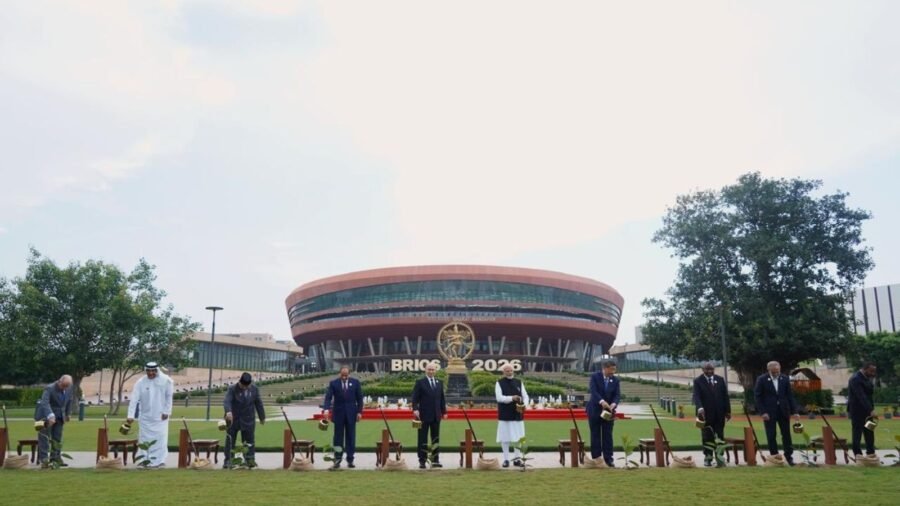
Underlying the wordy 140-paragraph declaration of the Delhi BRICS Summit is India’s careful steering of the 20-year forum, amid deepening great-power conflict involving its own members, economic uncertainty, accentuated by wars in Europe and the Middle East.
Delhi’s diplomatic success lies in keeping BRICS “boring”, if you will, amid the rhetorical excess about radical global change that often accompanies its summits.
Advertisement
The declaration reaffirms the political diversity of the forum and dispels the notion of an ideological crusade against the West — one that some supporters of BRICS desire and many of its critics assume is already under way.
It contains familiar criticism of unilateral sanctions, tariffs and protectionism, as well as strong language on Gaza and other humanitarian crises. But it does not turn BRICS into a collective political front against the United States or the West.
Its principal achievement is to underline a simpler proposition: A more fragmented world requires more, not less, practical cooperation among major nations. The emphasis is on reforming the international order, not demolishing it.
Advertisement
The Delhi Summit’s emphasis on resilience, innovation, cooperation and sustainability moves the focus towards supply chains, health, food security, climate adaptation, digital systems, small enterprises and development finance. This does not make BRICS a transformative economic institution. But it makes the forum more useful than an ideological platform devoted to denouncing American dominance.
The most consequential Indian success may be what the Summit did not do. For several years, “de-dollarisation” has been presented by some BRICS enthusiasts as the defining test of the forum’s strategic purpose. Russia, facing Western sanctions, has understandable reasons to seek alternatives to dollar-centred financial channels. China, too, wants to reduce exposure to American financial power and increase the international use of its own currency and expand its global influence.
But India has no interest in turning BRICS payments cooperation into a political battle against the dollar. The Delhi declaration steers clear of a common BRICS currency. It supports the more modest objective of making cross-border payments faster, cheaper and more reliable.
The Summit’s emphasis is on continuing technical work and consultations, not on decisive moves towards replacing the dollar. It explicitly recognises that there can be no “one-size-fits-all” approach. It preserves the right of every BRICS member to reduce particular vulnerabilities in its financial links without committing the grouping to an implausible project of monetary separation from the West. It keeps BRICS focused on financial functionality rather than geopolitical theatre.
This distinction matters greatly for India. New Delhi has deepened cooperation with America, Europe, and US allies in Asia in the domains of trade, technology, defence, and supply-chain resilience. At the same time, Delhi remains committed to an independent foreign policy and to the democratisation of the global order. India can pursue both aims only if BRICS remains a forum for pluralism rather than an instrument of China-Russia confrontation with the West.
Delhi has also left a small but distinctive Indian stamp on BRICS through its digital agenda. The declaration’s attention to inclusive and resilient digital systems, digital public goods and AI capacity-building gives India’s experience with digital public infrastructure a place in the BRICS conversation. India’s success with large-scale payments platforms and public digital systems gives it credibility on this issue.
Yet the verbosity serves a purpose — preventing BRICS from hardening into an ideological bloc. It has enabled Russia, China and Iran to voice their grievances, allow the articulation of the developing world’s concerns, press for global reform, and preserve the freedom of all to maintain their separate engagement with the US.
BRICS has not resolved the conflicts among its members, including between India and China, or ended their competition for influence. It has simply avoided imposing an ideological straitjacket on them and making the world worse off.
Contrary to the widespread sentiment, BRICS has no magic wand to solve the world’s problems. That game is being played elsewhere. India and the world will watch with great interest Chinese President Xi Jinping’s visit to Washington later this month, the latest US peace initiative on Ukraine with Kyiv and Moscow, and the continuing tussle between the US and Iran in the Middle East.
The writer is a contributing editor on international affairs for


Don’t tilt your head back: The surprising trick to swallowing capsules easier
By Sohail Khan · 12 Sep
Leave a Reply