Netanyahu faces another UN walkout: What this means, and history of such protests
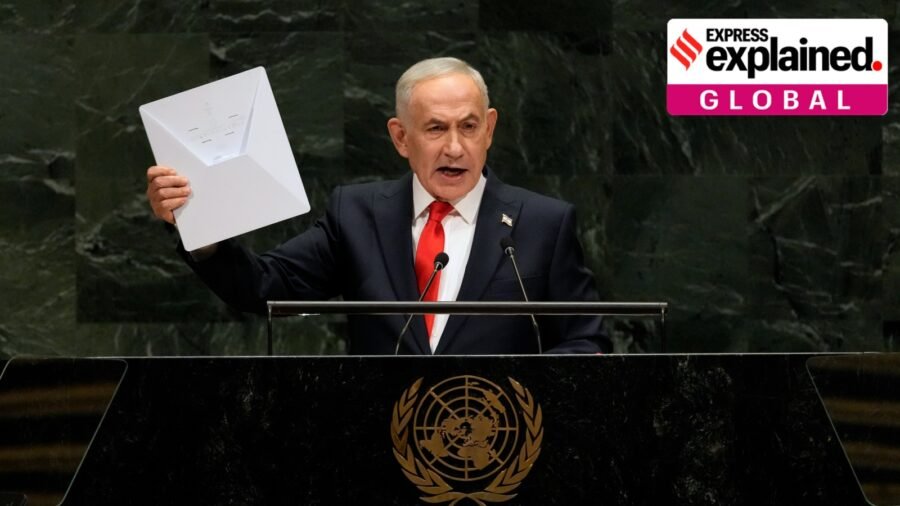
The walkout
Netanyahu was quick to respond to the sight of the departing delegates. Opening his address, he labelled those who had walked out as “moral cowards” and clarified that any remaining delegates who wished to leave should feel free to do so.
Story continues below.
Subscribe to see fewer ads.
Pressing ahead with a nearly 40-minute speech which defended Israel’s military actions, he also condemned the policies of countries like Britain and France which oppose Israeli settlement activity in the West Bank and have recently applied trade sanctions on the former.
The walkout, however, was not merely a spontaneous reaction inside the chamber.
Ahead of Netanyahu’s address, the Palestinian Mission to the UN had urged diplomatic missions to bring as many staff as possible into the General Assembly chamber and collectively leave once the Israeli prime minister was announced. The gesture was intended to signal opposition to Israel’s policies and military campaign.
The sight of diplomats leaving a UNGA address is not without precedent. In fact, walkouts have repeatedly been used at the UN as a symbolic form of diplomatic protest — including during addresses by other world leaders. Over the years, world leaders have faced similar displays of disapproval, making the walkout a recurring form of political theatre at the UN.
Previous instances
Story continues below this ad
Some of those earlier instances where a nation or leader has been on the receiving end of a diplomatic walkout are:
2025: RUSSIA
Dignitaries walked out of Russia’s speech to the UN Human Rights Council in Geneva in support of Ukraine in February last year.
The delegates, including the ambassadors of France, Germany and Britain, gathered outside the room where the session was taking place to mark three years since Russia’s invasion of Ukraine. Simon Manley, Britain’s Ambassador to the UN and the World Trade Organization, told Reuters, “Our support for Ukraine is ironclad. We want to see a just and enduring peace in line with the UN charter.”
2024: ISRAEL
Netanyahu faced a walk-out during his UNGA speech in September 2024 as well. Delegates left the auditorium to protest Israel’s war on Gaza and attacks on Lebanon. At the time, the war was approaching its one-year mark.
2022: RUSSIA
Story continues below this ad
In March 2022, around 100 diplomats walked out of a speech by Russia’s Foreign Minister at the UN Human Rights Council in protest over his country’s invasion of Ukraine. The walkout included envoys from the European Union, the US, the United Kingdom and others.
Ukraine’s ambassador to the United Nations in Geneva led the walkout.
2011: IRAN
Diplomats walked out in September 2011 after then Iranian President Mahmoud Ahmadinejad at the UN attacked the US and other major powers as militarist, imperialist and unfit to dominate global governance.
Ahmadinejad also referred to the “mysterious September 11 incident” — or 9/11, a reference to the terrorist attacks on September 11, 2001 — as a pretext to attack Afghanistan and Iraq. The walk-out was led by US diplomats.
2010: IRAN
Story continues below this ad
US diplomats and other Western delegations walked out of a UN summit in September 2010 as Ahmadinejad said that some believe the 9/11 attacks on the US was the work of Americans to save Israel.
The walk-out was led by two US officials. They were followed by the British and other Western delegations.
Ahmadinejad said there was a theory that “some segments within the US government orchestrated the attack to reverse the declining American economy and its grip on the Middle East in order also to save the Zionist regime.”
What a ‘walkout’ means
There is no formal UN procedure governing a diplomatic “walkout”. Neither the UN Charter nor the General Assembly’s Rules of Procedure specifically requires, authorises or prohibits a delegation from leaving the chamber during another country’s address.
Story continues below this ad
Leaving the hall is therefore a symbolic act of protest. Its significance, however, comes from the setting. The UNGA is the organisation’s main deliberative and representative forum, bringing representatives of almost every country in the world together in one place. When diplomats leave during a leader’s speech — particularly when dozens do so together — their absence itself becomes the message.
Such walkouts can serve different purposes. A government may use one to publicly distance itself from another country’s policies, express solidarity with an opposing side or register its disapproval without disrupting proceedings. The case of the US diplomatic corps exiting the chamber during Ahmadinejad’s speeches in 2010 and 2011 illustrates that.
Importantly, participating in a walkout does not necessarily mean that all the countries involved share an identical position on the underlying dispute. More than 40 countries joined in the 2022 walkout during Russian Foreign Minister Sergey Lavrov’s address at the UN Human Rights Council to protest Russia’s invasion of Ukraine. The participating governments, however, differed in their broader positions on the conflict, including on questions surrounding diplomacy, sanctions and the eventual terms of peace.
The practice is also not new. Diplomats have walked out of speeches by leaders at different UN forums for decades, not just in the 21st century. These are often in response to remarks considered inflammatory or to protest a country’s military actions or policies.
Story continues below this ad
In this sense, the walkout has become a recurring form of diplomatic signalling. It does not change a resolution, trigger a vote or carry a legal consequence in itself. Its power lies largely in its visibility, where the simple act of leaving a room becomes a public statement signifying disagreement.
The election umpire’s independence begins with its appointment
By Sohail Khan · 25 Sep
US and China are unlikely to limit the development of increasingly capable AI systems
By Sohail Khan · 25 Sep

Leave a Reply