The election umpire’s independence begins with its appointment
Advertisement
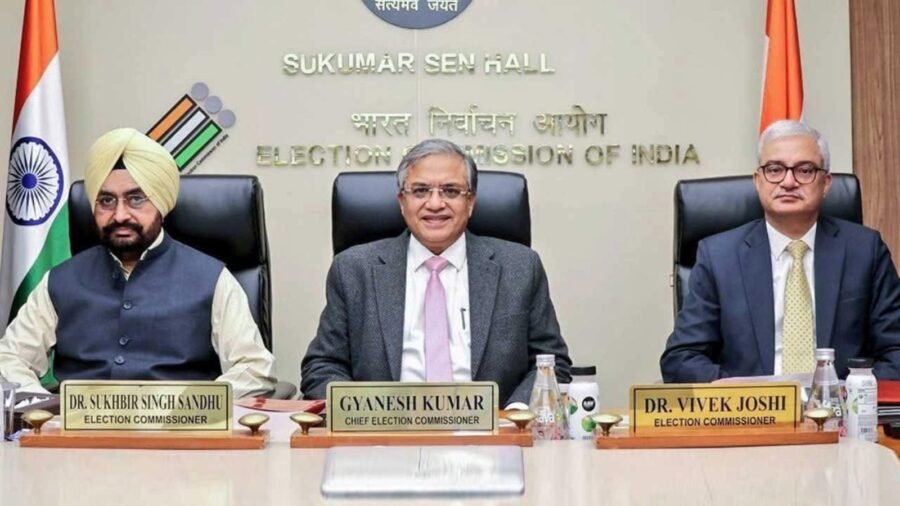
For seven decades, however, Parliament did not make that law. In Anoop Baranwal (2023), a Constitution Bench prescribed an interim arrangement comprising the Prime Minister, the Leader of the Opposition and the Chief Justice of India. With godspeed and much like it had acted in the Shah Bano case, Parliament filled the legislative vacuum through the Chief Election Commissioner and other Election Commissioners (Appointment, Conditions of Service and Term of Office) Act, 2023, and replaced the CJI with a cabinet minister nominated by the PM.
On Wednesday, a two-judge bench of the Supreme Court referred petitions challenging the 2023 law to the CJI for constituting a Constitution Bench due to disagreement between the two judges, Justice Dipankar Datta and Justice Satish Chandra Sharma.
In Justice Datta’s words, the Narendra Modi government’s plea to refer the issue to a Constitution Bench emerged “in gradual course of his (the Attorney General’s) arguments”. The plea found no place in the counter affidavit and came two years into the litigation. Justice Datta rejected it, while Justice Sharma accepted it. Interestingly, in the Aligarh Muslim University judgment (2024), both the judges had found the referral to a Constitution Bench by a two-judge bench in a 1981 verdict problematic.
Advertisement
Justice Datta’s opinion rightly rests on an elementary and decisive distinction: Application of law is not interpretation. In Thakur Ganga Singh (1960), the Court held that a question of interpretation arises only when competing constructions of a provision are canvassed. Parliament answered the disclosure judgment in Association for Democratic Reforms (2002) with Section 33B of the Representation of the People Act. In PUCL (2003), a three-judge bench struck this down and called the demand for a reference “totally misconceived”. A parliamentary overruling of a judgment does not, by itself, make the constitutional question new. Where the governing principle has already been conclusively established, the remaining task is simply to apply it to the facts of the case.
What, then, did Anoop Baranwal settle? The bench held that “a person who is in a state of obligation or feels indebted to the one who appointed him, fails the nation”, that one “weak-kneed before the powers that be” cannot be an Election Commissioner, and that an appointment “must not be overshadowed by even a perception” that a “yes man will decide the fate of democracy”.
Justice Datta distilled this into a binding declaration of the ECI’s independence — the appointment process must be free of exclusive executive control. That standard, he held, “is binding on all courts”. What is not binding is the machinery the bench devised to meet it. The CJI’s inclusion was “a deliberate signalling advice, and not a mandate”. Demonstrating judicial reasoning at its best, Justice Datta distinguished the principle, which binds, from the prescription, which Parliament was free to change. The principle is that appointments must be insulated from exclusive executive control, and that “it is not enough for the ECI to be independent, it must also appear to be independent”. Justice may not be done, but it should at least appear to have been done.
When the bench asked whether the PM’s nominee would ever oppose him in case of a difference of opinion between the PM and the Leader of the Opposition, the Attorney General’s answer was, “probably no”. The petitioners were more emphatic, saying, “certainly no”.
Whether the selection committee meets that constitutional principle is a question of application. It cannot become a question of interpretation merely by “repackaging an existing constitutional principle in a seemingly new factual or legislative setting”, Justice Datta held.
Though Justice Sharma demonstrated judicial humility, the difficulty lies in his reasoning. He accepts that the Anoop Baranwal committee was an “ad hoc arrangement”. He acknowledges that free and fair elections are part of the Basic Structure, which “no court can or would, possibly, doubt”. He also accepts that “to the extent law has been declared under Article 141”, it “is to be applied”. He then describes what remains: “Whether the said Act fails the test of free and fair elections has to be independently examined”. To examine whether a statute fails a settled test is the very definition of application.
Justice Sharma notes that the question of whether Parliament, “was justified in not including a neutral selector” is “an important question arising for the first time before this Court”. However, this sentence cannot bear that weight because the neutral selector was the very reasoning of Anoop Baranwal, which included the CJI “as a neutral arbiter”.
Justice Sharma did not find the Solicitor General’s reliance on NJAC (2015) problematic. If the Law Minister’s presence in the committee to appoint judges offended the judiciary’s independence, his argument ran, “a corresponding degree of constitutional independence” must be recognised for the executive. Justice Sharma accepted the analogy as a “constitutional principle”. However, the SG’s argument turns NJAC on its head. NJAC shielded an independent institution from the executive; the SG’s analogy invokes it to shield the executive’s hold over another independent institution. Article 324 — which gives the ECI constitutional status — protects the independence of the umpire, not the players. And the executive, as Justice Datta courageously notes, is itself “a participant in the electoral process”.
Since the two judges could not agree on upholding the law, they should have read it down by requiring the selection committee to make its decisions unanimously. Such a requirement, in our opinion, would ensure that an Election Commissioner could be appointed only with the agreement of both the government and the Opposition, providing a stronger assurance of the appointee’s independence and credibility.
To err is human. A democracy can survive an umpire’s wrong call, but it cannot survive the suspicion that the umpire was deliberately chosen to make it.
Mustafa is vice-chancellor, Chanakya National Law University, Patna. Anand is a scholar at NUJS, Kolkata. Views are personal
US and China are unlikely to limit the development of increasingly capable AI systems
By Sohail Khan · 25 Sep
Foundational literacy does not end at Grade 2. Neither should our attention
By Sohail Khan · 25 Sep

Leave a Reply