Japan’s reputation for precision meets its own Asian Games
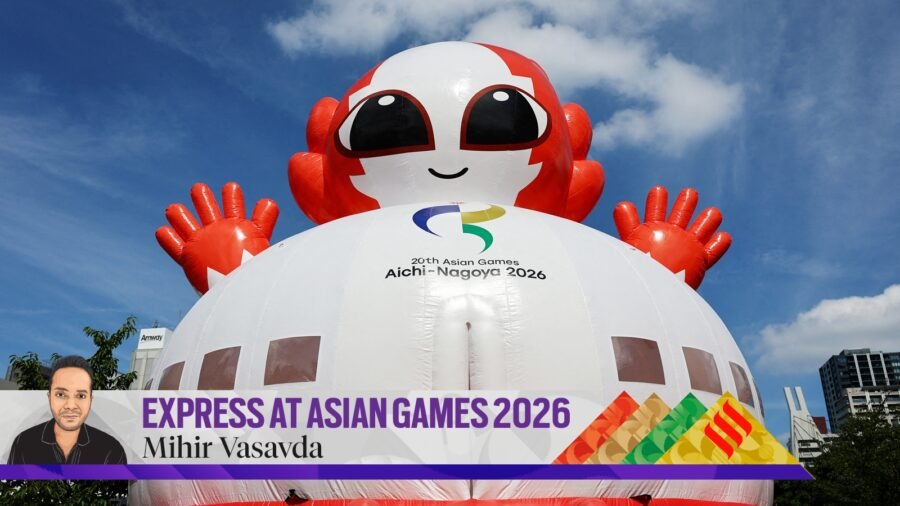
The streets of Nagoya have dried. The trains are moving. The banners are up. The volunteers are in place. And across a city preparing to host the Asian Games and welcome 17,000 athletes and officials, the instinct is to carry on as though nothing happened.
Something, however, did. A week ago, the port city was dealing with record rainfall. Schools shut, trains were suspended and hundreds of Asian Games athletes had to be evacuated from their accommodation. Water leaked into some competition venues.
Now, with the opening ceremony on Saturday, the city looks remarkably composed. But the Games itself is confronting many a battle, putting under scrutiny the Japanese reputation for precision, which even delivered an Olympic Games in the middle of a pandemic.
Story continues below.
Subscribe to see fewer ads.
On Friday, even the formal welcome for teams stumbled. India’s ceremony at the Garden Pier athletes’ village was delayed and then abruptly halted, leaving the Indian delegation and five other nations waiting. The organisers apologised and said there was “some trouble,” without offering any further explanation. The promise to resume in 15 minutes turned into nearly two hours.
It was another small episode in a Games that has accumulated an unusually long list of them before the opening ceremony.
India’s shooters, for instance, landed at approximately 9pm on September 15. By the time they reached their accommodation, it was nearly 5am.
Another 30-35 Indian athletes were not allocated rooms. As a contingency measure, the Indian Olympic Association booked 18 extra hotel rooms and planned to reserve 10 more in case any accommodation issues surface, chef de mission Sahdev Yadav said. “They (organising committee) informed us that more players than expected had come (from India). But as far as India is concerned, that’s not the case. We stuck to the number of players they had invoiced,” Yadav said. “But they removed some names, so we booked hotels for them… we faced difficulty with regard to 30-35 athletes.”
Story continues below this ad
Sports Minister Mansukh Mandaviya said the country has set up three layers of assistance for its athletes, drawing on Nagoya’s 2,000-strong Indian diaspora community. Two officials have been stationed at the airport, three more at the athlete welcome centre, and the residences of Indian diaspora members have been identified in advance, in case accommodation issues persist. Almost half of India’s 501-member contingent is yet to reach Nagoya.
The logistical issues haven’t spared anybody, be it South Korea or China, Qatar or Thailand, or even hosts Japan themselves.
The accommodation and the travel itself has become a story of a Games that wanted to be a trendsetter. There is no traditional athletes’ village. Instead, the 17,000 athletes and officials are spread across hotels, temporary container-style accommodation and the Costa Serena cruise ship docked at Nagoya Port. The OCA said the arrangements were a conscious attempt to avoid building an expensive village that could become a post-Games white elephant, and insist every registered participant has been provided with accommodation.
An official of the continental body, speaking anonymously, told this paper that apart from the cost-saving measures, this was also done because the declining and ageing population in the region meant there weren’t many buyers for the repurposed flats after the Games.
Story continues below this ad
Tayyab Ikram, the head of the OCA’s coordination commission, said: “We had clear statistics about what is happening in the real estate values. We don’t want to leave a white elephant after the Games here.”
The complaints, meanwhile, keep coming. One theory doing the rounds in Japan is that the absence of one familiar force from the organisation of a major sporting event may have mattered.
Dentsu, Japan’s giant advertising and sports-marketing agency, is not involved in the Games’ operation in the way it has been in previous major events. The agency’s absence follows the fallout from the Tokyo Olympics corruption and bid-rigging scandal, which led to restrictions on Dentsu and other major agencies.
Former Japan Wrestling Federation vice-president and Aichi-based Shigakukan University president Ikuko Tanioka, speaking to Yahoo Japan, pointed directly to the unusual structure of these Games. “Dentsu and Hakuhodo, the major advertising agencies, are not involved in the operation of these Asian Games. Aichi Prefecture and Nagoya City have organised the organising committee, and various people have come together to prepare for the Games,” he was quoted as saying.
Story continues below this ad
Tanioka was describing the structure rather than establishing a direct cause of the problems. But in Japan, a question has surfaced: has an attempt to move away from the traditional big-agency model exposed the difficulties of organising an event on this scale?
There have been other own-goals, too. The welcome ceremony for the Costa Serena, the cruise ship being used as a floating hotel, featured performers dressed as Oda Nobunaga, Toyotomi Hideyoshi and Tokugawa Ieyasu, regarded as Japan’s three big unifiers. Hideyoshi’s appearance prompted an official complaint from South Korea because of his role in Japan’s invasions of Korea in the 1590s, an awkward historical choice at an event whose slogan is “Imagine One Asia.”
All of which makes the backdrop particularly ironic. Nagoya is a city whose reputation has been built on making things work. This is Toyota country, home ground of the world’s most famous Japanese carmaker, but also the industrial ecosystem behind brands Indians know well, from Toyota and Lexus to Denso and Mitsubishi Heavy Industries. Organisation, logistics and control, through its famous warlords and world-renowned factories, is something Nagoya is familiar with. And now, those traits are being tested.
Not least because there is one more complication on the horizon. A typhoon threat is being monitored for Monday, just two days after the opening ceremony, with organisers preparing contingency plans that include possible evacuations and moving the cruise ship offshore if necessary.
Story continues below this ad
Nagoya has already survived the rain. It is enduring an organisational storm. Now, it’s bracing for the winds.

Abhishek Sharma reveals Suryakumar’s influence after record knock
By Sohail Khan · 18 Sep

Leave a Reply