Isro, Europe renew ties till 2032 to work on space weather, robotic space exploration
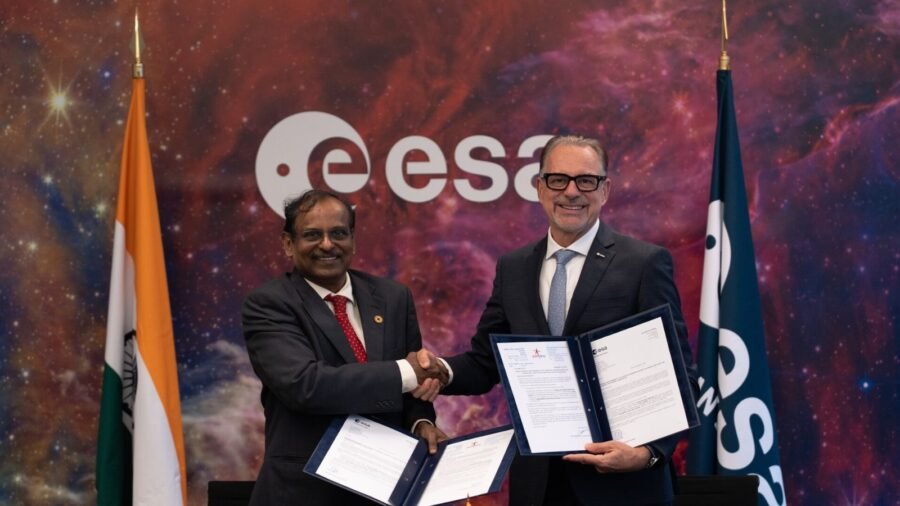
The Indian Space Research Organisation (Isro) and the European Space Agency (ESA) have announced the renewal of their existing cooperation till 2032.
The decision was made at the recently concluded International Space Summit in Paris, where the chiefs of the two space agencies signed a pact extending their long-standing cooperative agreement. At the summit held on September 9 and 10, the signatories confirmed and reaffirmed long-term commitment by both Europe and India to expanding cooperation in space.
Some of the recent engagements between the European and the Indian space agencies have been for missions Aditya-L1, Proba-3, and the upcoming Chandrayaan-5, to name a few.
Story continues below.
Subscribe to see fewer ads.
According to Josef Aschbacher, Director General, ESA, the renewed agreement will help both the space agencies pursue “greater ambitions together while delivering tangible benefits for our citizens and economies “.
“As space activities expand beyond Earth orbit and new opportunities emerge in exploration, sustainability and advanced technologies, international cooperation remains essential. ESA and Isro have built a trusted partnership spanning more than two decades,” Aschbacher said in a statement on Monday.
Isro Chairman V Narayanan said the partnership has also demonstrated the value of international cooperation in advancing space activities.
“The renewal of this agreement reflects the shared ambition of Isro and ESA to pursue innovation and scientific progress for the benefit of our societies, ” he added.
Story continues below this ad
The latest agreement expands the collaboration in space weather and human and robotic exploration, considering the growing importance of sustainable use of outer space. Space weather is an important area as any minute variation in it can directly affect the smooth operations of space-based assets like satellites, which then affect communication systems, the power grid, and navigation services on Earth.
With human space exploration gaining momentum, a slew of robotic missions are planned, including India””s Gaganyaan-1, which will launch Vyommitra — a female humanoid into space, in a mission scheduled sometime before March 2027.
The Isro-ESA cooperation began in 1978, initially to support mutual needs in Earth observation and remote sensing — data sharing, ground stations, and tracking and scientific validation to monitor land, oceans, weather, and disasters, according to an Isro officer involved in the joint engagements.
However, the two space agencies collaborated closely on science missions and programmes after the Cooperative Agreement inked in January 2002. The 2002 agreement provided a framework for cooperation between the two agencies across a broad range of space activities. ESA and Isro support and complement one another in tracking mission launches, providing expert reviews and scientific collaborations.
Story continues below this ad
In May 2025, during the Global Space Exploration Conference in New Delhi, the two agencies signed a Joint Statement of Intent on human exploration, as the two sides are yet to have their indigenous human space exploration programmes. For instance, India””s Gaganyatris have received training at some ESA centres in recent years.
In March this year, a new agreement was again signed for joint calibration and scientific studies to share technology, data and infrastructure to make space missions more reliable and affordable.

‘Woman made to walk on nails’: Viral videos prompt notice from human rights body
By Sohail Khan · 23 Sep
Madhya Pradesh’s sports push: A complex in each constituency – with a helipad
By Sohail Khan · 23 Sep
IAF to host second edition of multinational air exercise Tarang Shakti 26 this week
By Sohail Khan · 23 Sep
Leave a Reply