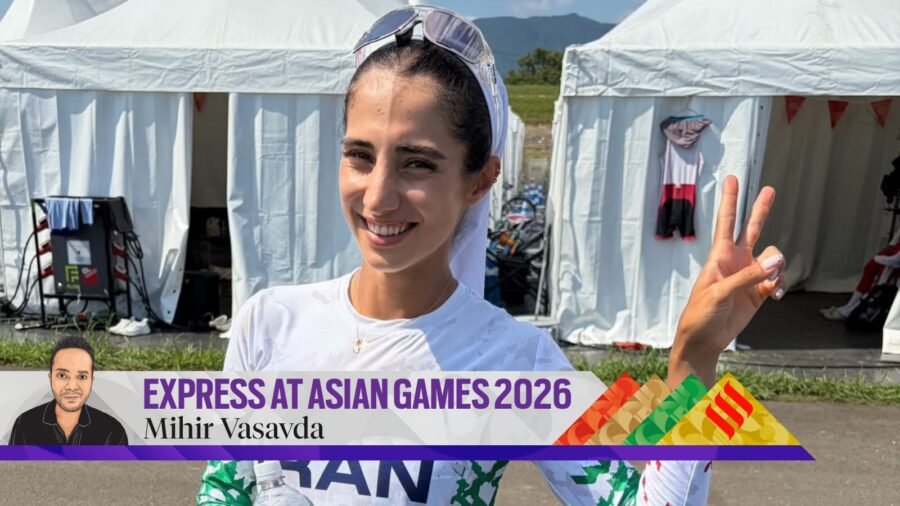
Iranian rower trained through bombing raids to win Asian Games gold
Story continues below.
Subscribe to see fewer ads.
The war had begun six months before the Games, catching the athletes unprepared. On its first day, the federation cancelled its training camp and sent the rowers back to their homes. “We faced a lot of difficulties after the war began, but we wanted to show that we are strong. We have given every rower an ergometer so they could continue training at home,” said Iran’s rowing federation chief Mohsen Shadi Naghadeh.
Zarei returned to Hamadan. Her teammates went back to their own cities.
The conflict began in February, following large-scale attacks by the United States and Israel, and disrupted sporting preparations across Iran. For the rowers, there was little choice but to find a way to train around it. “All the cities in Iran were affected by the war,” Zarei said. “In the first month of the war, it was really hard, harder than before.”
There were interruptions. Sometimes they had to leave home when the bombing intensified. Sometimes they had to stop what they were doing and move somewhere else. But the training continued. “It was both of them,” Zarei said, when asked whether, in those first weeks, she was trying to save her life or trying to row.
Story continues below this ad
The rowing team was not alone in trying to salvage an Asian Games preparation thrown into chaos. Iran’s women’s kabaddi team also had its camp disrupted by the war and had to move between cities before travelling to Sonepat in India in August, where the players trained twice a day and played practice matches to regain the rhythm lost during the conflict.
For Zarei, those first 45 days were spent almost entirely indoors. She estimates she covered about 20 kilometres a day on the ergometer, alone in her room, following a training schedule sent by her coach. “I was preparing to start training, and then I heard the bombing sounds,” she said. “It was so close to our home. When you looked out of the window, you could see the smoke.”
…
Eventually, the team was able to return to camp and resume rowing on water. Zarei trained in Urmia, where Iran’s rowing federation had access to a two-kilometre course. The uncertainty of those 45 days did not disappear when she returned to the water. Another memory was waiting for her.
At the Hangzhou Asian Games three years ago, she had finished fourth, the only member of Iran’s rowing team to leave without a medal. “It was really a hard moment,” she said.
Story continues below this ad
That fourth-place finish continues to rankle her, and so do the three years that followed: the training, the effort to stay positive, the belief that she could do better. “Three years of hard work, being motivated, trying to stay positive, trying to believe in myself and believing in God,” she said. “Today, I’ve got first place.”
As she crossed the finish line in Nagoya, the emotion of those three years, and of those weeks in Iran, came out. Zarei splashed the water and broke down.
Throughout the war, she had kept returning to the same thought. “The only thing was thinking about the medal, thinking about my people, thinking about my family and my future,” she said. “Because this medal really matters for Iranian people, especially Iranian girls.” Then the tears. “I cried,” she said. “It was a moment that I really cannot explain in words.”
For 45 days, Zarei had trained without a boat, without teammates beside her, with the sound of bombing sometimes breaking into her sessions. “I told myself, I will do my best. I will have training every day. Please help me to get the best result.”
It was gold.

Asian Games: Naruka, Dhaliwal combine for mixed team bronze in skeet
By Sohail Khan · 24 Sep
Gambhir on dropping Samson for Sooryavanshi: ‘…Only night I could not sleep’
By Sohail Khan · 24 Sep
Leave a Reply