Satnam Singh and Salman Khan win India’s first rowing medal in Nagoya
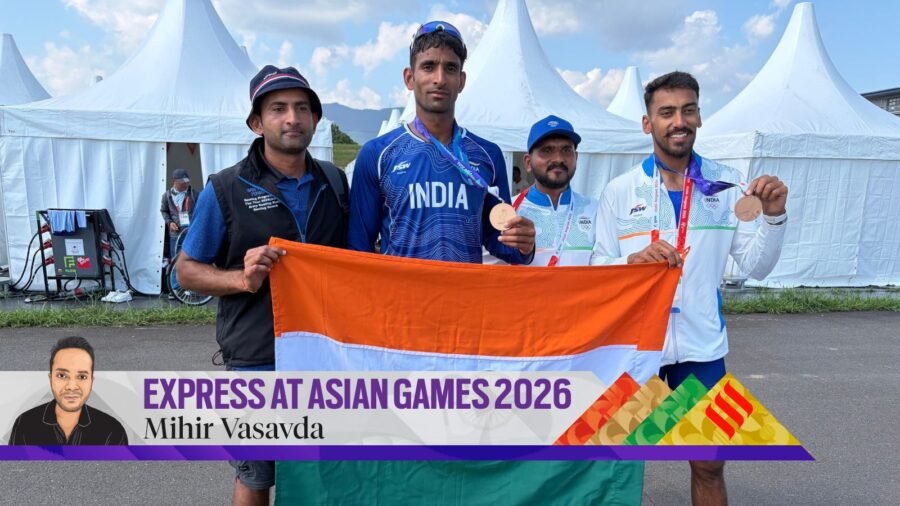
It was a medal neither man had expected to win under the circumstances. For Salman, the road to that boat had been as unlikely as the pairing itself. The man from Amethi didn’t even want to become a rower. He spent his childhood in Tauru, Haryana, where his father worked on truck bodywork. After his father’s untimely death in 2016, the family returned to their hometown, and Salman, the eldest among six siblings, moved to Delhi. “My brothers had to study, sisters had to be married. I was the eldest, so it was my responsibility. I had to earn,” he says.
Story continues below.
Subscribe to see fewer ads.
So he became an Uber driver, behind the wheel of a WagonR, mostly between Delhi and Gurgaon, driving from 5am to 9am and again from 5pm to 10pm. “In 2018, one of my friends called me and convinced me to try for the Army. I had failed the written exam once before, so I wasn’t sure of passing again. But he convinced me, saying I had good height and body,” says the 6’4″ rower.
Salman trained three times a day, often alone, and made it into the Army, where, like many rowers before him, he found the sport almost by accident. He thought about quitting after two poor years, but his commanding officer talked him into staying. By the time he arrived in Nagoya, he was an established member of India’s rowing team.
What he could not have anticipated was that, just days before his event, his carefully prepared crew would be broken up amid a series of controversial last-minute changes. Salman and Satnam were meant to compete in the quadruple sculls with Balraj Singh and Jakhar Khan. Five days before the event, that boat was gone, and the two of them had to prepare for a race they had never rowed together.
The changes left them devastated. “We were so depressed. We couldn’t eat or sleep,” Salman says. “We were crying. The emotions were there because we had been training for the last six months together. It’s a brotherly relation. We hadn’t rested even one day for six months.
Story continues below this ad
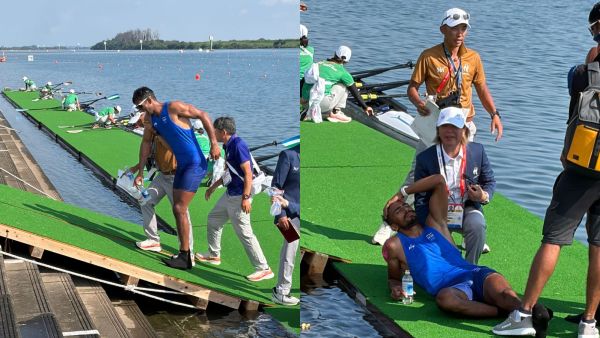 Indian rowers Satnam Singh and Salman Khan.
Whatever the coaches said, we did.”
Some rowers considered not training at all, but Satnam, who serves with the Navy, saw it differently. “We came today because we couldn’t let the country down. The trust the country has placed on you, the belief and money that has been spent on you. And on the last day you didn’t come out. People wouldn’t see why this happened. It would simply be that this is what you did.”
Before the race, Salman called the coaches who had brought him this far and told them what had happened, how upset he was. Their answer stayed with him. “They told me, ‘Salman aisa chappu maro ki nadi ka paani bahar aa jaye,'” he says. Row the oar so hard that the water of the river itself comes out. “Itna motivation. You get so motivated you feel you can row with a stone as well.”
The two of them fell back on six months of training together and squeezed everything they had out of the boat. The Chinese and Uzbek pairs, both seasoned, went out fast, and Salman found himself instinctively egging his partner on. “I just kept saying, jor se mar, jor se mar,” he says. Satnam adds: “The biggest benefit we had is that we had a tailwind, and the others were heavier than us. In a tailwind, whatever has a lighter weight helps. That’s the only thing that helped us.”
Story continues below this ad
With 200 metres to go, they dug deeper still. Salman’s mind had already gone somewhere else, to what the medal could mean, to the possibility of a DSP job in Uttar Pradesh. Satnam’s mind, by contrast, had gone blank. “Aatma bahar aa jaati hai,” he smiles.
There was only the boat, the calm water, and the line. They crossed it, and for a few seconds there was almost nothing left in either of them. They tried to get up and could barely stand. Stepping out of the boat, India’s two six-footers buckled, needing help just to walk after two kilometres under a blazing sun. Then, still gasping, they found each other, embraced, and began to cry.
Not tears of joy. They were thinking of their teammates, Balraj and Jakhar, who couldn’t be on the podium with them. “We won a medal but what happened to our partners, Balraj and Jakhar, was very wrong. We felt we could win a gold on that boat,” Salman says. “But I also feel proud that despite being in this boat for just five days, we could win a medal for the country.”
Five days for a farmer and a former Uber driver, a Singh and a Khan, thrown together by circumstance and onto the podium.
Asian Games: Naruka, Dhaliwal combine for mixed team bronze in skeet
By Sohail Khan · 24 Sep
Gambhir on dropping Samson for Sooryavanshi: ‘…Only night I could not sleep’
By Sohail Khan · 24 Sep
Asian Games: Satnam and Salman deliver a medal and a message
By Sohail Khan · 24 Sep
Leave a Reply