How Russia sanctions Bill could give Trump upper hand in trade talks with India
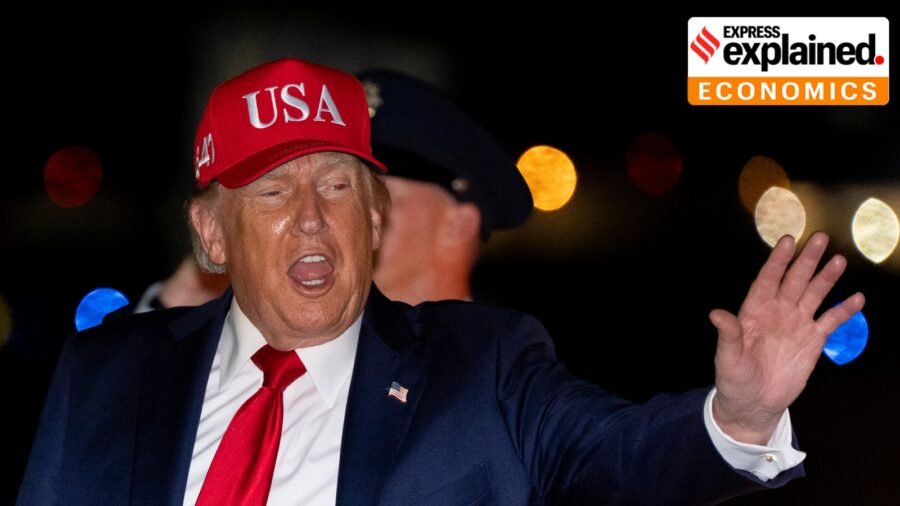
US India trade deal: The US House of Representatives has passed a Bill that could give President Donald Trump additional leverage to curb Indian exports to the US .
The ‘Lindsey O. Graham Sanctioning Russia and Iran Act of 2026’ gives Trump the powers to slap duties of up to 100% on foreign nations that purchase Russian oil and natural gas — India and China are among its biggest importers.
The Bill had been cleared by a wide majority by the US Senate (the country’s upper house) last month. On Wednesday, the US House (the lower house) passed it by 262 votes to 159, as 58 Democrats broke with party leaders to join all but seven Republicans in favour. All that’s needed now is Trump’s approval.
Story continues below.
Subscribe to see fewer ads.
The US President in February this year had lost the authority to impose “reciprocal tariffs” after the US Supreme Court had struck down the US president’s lack of authority under the 1977 International Emergency Economic Powers Act (IEEPA) to impose broad import duties. Since then, the administration has been finding newer ways to impose trade restrictions.
Before his powers were struck down, Trump used reciprocal tariffs as leverage in trade negotiations with India; New Delhi, however, is yet to officially sign a deal. Government officials have maintained that India is looking for a tariff advantage over other competitors to sign a trade deal with the US.
The Ministry of External Affairs (MEA) said on Thursday that it remains committed to ensuring the nation’s energy security “through diversified sourcing and on the basis of evolving market dynamics”.
Trade experts said that Congressional approval places such Russian oil-related tariffs on stronger legal ground. After the Act is signed, the US Trade Representative will identify the targeted countries and recommend tariff rates. These countries would normally have 180 days to reduce Russian energy imports or negotiate with Washington. However, the president can shorten this period.
Broad concessions offered by India
Story continues below this ad
While India had not signed a trade agreement with the US, both countries had reached a deal in February and had also released a joint statement. Besides, New Delhi has been quietly opening its market in sectors of US interest during the last several months.
India has so far agreed to several US demands as part of the trade deal, particularly in the digital sector. Most prominently, during the last Union Budget, India announced a tax holiday to foreign companies for setting up data centres in the country until 2047, seemingly acting on a key US demand.
Last year, the government had abolished the 6% ‘Google tax’ amid tariff pressure as the US said that digital services taxes are against its tech companies — the likes of Apple, Amazon, Google and Facebook. India has also stepped up energy imports from the US, opened its nuclear sector, reduced duty on a range of items of US interest and has also
The US has also shown accommodative signs. In July, the US imposed 10% tariffs on India, lower than the 12.5% rate proposed in March when the United States Trade Representative (USTR) identified 60 countries under Section 301 of the US Trade Act, citing imports of goods produced with forced labour.
Story continues below this ad
India has been in touch with US authorities over the proposed legislation. The MEA statement said: “This issue has been discussed at high levels in recent months with various US interlocutors… The Indian side has also made clear its determination to take all necessary measures to protect its trade and economic interests.”
Inflation pressure in US, midterms
Earlier this month, US President Donald Trump warned the Federal Reserve (Fed) to cut interest rates, or else the US would stop trading with countries with which it has a trade deficit. However, the Fed on Wednesday, for the first time in three years, increased the federal funds rate target range by 25 basis points (bps) to 3.75-4%.
The 12-member Federal Open Market Committee (FOMC) said that “inflation remains elevated” and its decision to increase rates will support a “timelier return” to the 2% inflation target. With US 10-year bond yield (a benchmark for global borrowing costs) inching towards 5% and US debt crossing a record $40 trillion could impose some constraint on Trump to impose additional tariffs.
International think tanks estimated that the US government will spend little over $1 trillion this fiscal year paying interest on the debt, which is equivalent to its national defence spending. According to the Council on Foreign Relations, the US debt-to-GDP ratio has now reached 125%, adding that federal borrowing needed to finance the US effort in World War II had only pushed the debt-to-GDP ratio to 106%.
Story continues below this ad
The US is also heading into mid-term elections on November 5. With Brent crude rising above $100 a barrel, fuel prices in the US are also picking up. And in a rare announcement, Trump promised $5,000 to every American during a public rally. This came amid inflation concerns in Washington.
India’s rising dependence on Russian oil
With much of the West shunning Russian crude following the country’s February 2022 invasion of Ukraine, Russia began offering discounts on its oil to willing buyers, including Indian refiners. This is how a peripheral supplier of oil to India became India’s biggest source of crude, displacing the traditional West Asian suppliers.
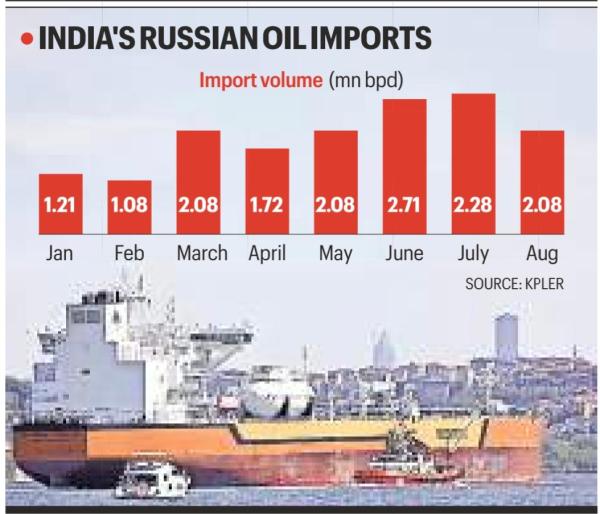 India’s total oil imports in August stood at 4.62 million bpd, down 8.4% from July’s 5.04 million bpd. (Source: Kpler)
This proved to be a strong energy security hedge amid the West Asia crisis, as oil flows from the Gulf dried up. Analysts say that despite the threat of sanctions, Russian crude remains the most practical and competitive source of supply for Indian refiners and is extremely difficult to replace in the current market.
According to vessel tracking data from commodity market analytics firm Kpler, India imported 2.08 million barrels per day (bpd) of Russian oil in August, accounting for 45% of the country’s total oil imports. The share was even higher, at over 50%, in the preceding two months.

In 25 years, how the impossible was made routine
By Sohail Khan · 17 Sep
Graphs, Data, Perspectives | Why the US Fed hiked rates, and what to make of its decision
By Sohail Khan · 17 Sep
Leave a Reply