Graphs, Data, Perspectives | Why the US Fed hiked rates, and what to make of its decision
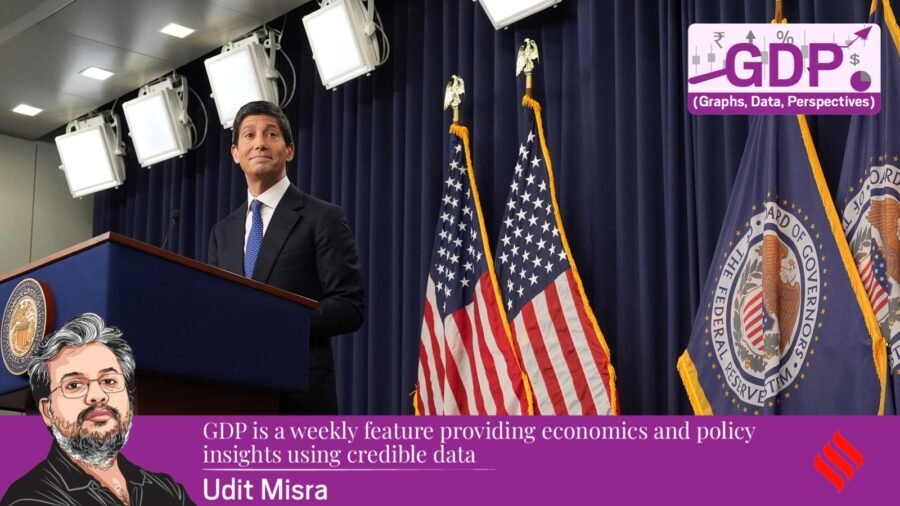
The Federal Reserve (or Fed), which controls monetary policy in the US, has decided to raise the Federal Funds Rate (FFS) by 25 basis points (one basis point is one-hundredth of a percentage point).
Raising the FFR makes it costly for banks to borrow from each other and, thus, makes all loans extended by US banks costlier as well.
Higher cost of credit drags down economic activity as it discourages overall demand in the economy. Lower demand for goods and services helps cool down prices in the economy. This decision is typically taken when a central bank is concerned about curbing inflation (the rate at which the general price level goes up from one year to another).
Story continues below.
Subscribe to see fewer ads.
The Fed’s decision is keenly watched the world over because by tweaking the cost of credit, it also affects stock markets both in the US and the world over.
What stood out about the Fed’s decision was that even though it was taken unanimously, which has been a rarity in the recent past, its interpretation is ambiguous.
Was it hawkish, not so hawkish, actually dovish or not dovish enough?
Here’s an argument for each interpretation.
What are hawkish and dovish policies?
The US Fed has a dual mandate: Pursuing both price stability and maximum employment.
Story continues below this ad
For price stability, the Fed has a target of 2% inflation (as measured by Personal Consumption Expenditures or PCE Price Index). In other words the PCE Index should not rise by more than 2% from one year to another.
On maximum employment, there is no numerical target. According to the Fed, “it is the highest level of employment or lowest level of unemployment that the economy can sustain while maintaining a stable inflation rate”.
Notwithstanding the dual mandate, often the Fed’s focus is either more curbing inflation or boosting employment, depending on what it thinks is the bigger concern.
Hawkish
Story continues below this ad
A hawkish central bank or a rakish policy decision is one that is primarily focused on maintaining price stability and not letting inflation go above 2%.
On the face of it, an increase in the FFR — the first in three years — suggest that the new Fed Chair Kevin Warsh has seen enough of price rise in the wake of the West Asia crisis and tariffs, etc, and is even willing to go against the wishes of President Donald Trump by raising interest rates — and that too less than two months before the crucial midterm elections that could make or break the Trump presidency.
Indeed, Warsh noted that while “economic activity is expanding at a solid pace” and “the unemployment rate has changed little” yet “inflation had remained elevated”. He said, “today’s policy action would support a timelier return to the (Fed’s) 2% goal”.
Not so hawkish
However, there is a second interpretation that would argue that this policy isn’t all that hawkish. To understand this, look at the table below that provides the Fed’s Summary of Economic Projections (SEP).
Story continues below this ad
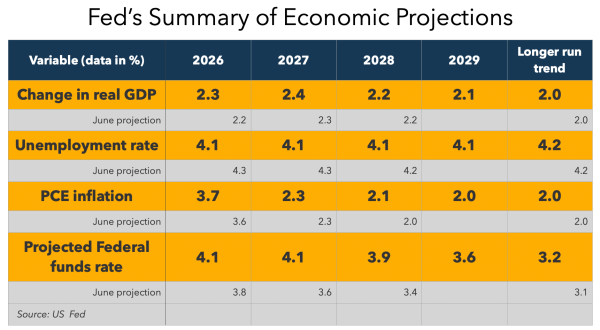 US Fed’s Summary of Economic Projections.
Four times a year, the Federal Reserve releases a summary of Federal Open Market Committee (FOMC) participants’ projections for GDP growth, the unemployment rate, inflation, and the appropriate policy interest rate.
The FOMC is the 12-member entity within the US Fed that decides the monetary policy.
The projections provide information on the values that participants view as the most likely to prevail in the current year and the subsequent two years as well as over the longer run.
Story continues below this ad
The table has details of where the median FOMC projection was for each of the four variables not just in the September meeting but also in the June meeting (which was the last one).
As can be seen, the FOMC expects economic growth to be stronger than its June assessment. Even more crucially, the growth rate is expected to be higher than the long-run trend not just this year but also for the next three years.
Unemployment rate projections have been pulled back, and they, too, are expected to be better than the long-run average.
Finally, inflation is expected to get worse since the June assessment. Even more crucially, FOMC does not expect inflation to get back to its 2% target level before 2029. The last time US inflation was below 2% was February 2021 — that’s six years and seven months ago. And, the SEP projects that it will take another three years before inflation gets back to 2%.
Story continues below this ad
Given such a projection, a hawkish central bank would have signalled many more interest rate hikes, but as the last couple of rows in the SEP show, the Fed has only pencilled in a single 25-basis point rate hike over the next year. Many in the markets believe the Fed will have to undertake an additional three rate hikes in the next 12 months.
From this perspective, the Fed’s decision wasn’t hawkish enough.
Actually dovish
It is for these very reasons mentioned above, that one could argue that although this is a hike in interest rate, it is still a dovish stance by the Fed.
Story continues below this ad
Considering that the Fed is unlikely to have opted for the October policy review for a rate hike since it would have been just too close to the midterm elections, it stands to reason that the Fed chose to do the bare minimum it could in September before it froze for another policy review in October.
Not dovish enough
While some may argue that this policy was not hawkish enough or rather dovish, there was at least one man who vociferously believed that this policy decision was not dovish at all.
President Donald Trump took to social media to criticise the Fed decision.
Story continues below this ad
“Interest Rates in the United States should be 1%, or less, because we are the Best Credit in the World — BY FAR. Our Country is BOOMING with new Investment! If we stopped Trading with every country that we have a Deficit with, which is most of them, we would make, at least, 1.5 Trillion Dollars a year. The word “Deficit” is nothing more than a fancy word for LOSS. We are “carrying” almost every country in the World, and that cannot go on any longer. LOWER THE INTEREST RATES FOR THE UNITED STATES OF AMERICA, AND FAST!” he said on Truth Social.
This is not the first time Trump has lashed out at the Fed for not cutting interest rates. He has in the past openly berated Warsh’s predecessor Jay Powell for being “too late” in cutting interest rates.
PM Modi to inaugurate Semicon India 2026: A look at India’s renewed semiconductor focus
By Sohail Khan · 17 Sep
‘Is it normal to have a blood sugar level of 110 at age 54, or am I diabetic?’
By Sohail Khan · 17 Sep
Why are moths attracted to bright lights?
By Sohail Khan · 17 Sep
Leave a Reply