How recreating Asian Games archery venue in Sonepat helped India win mixed team gold
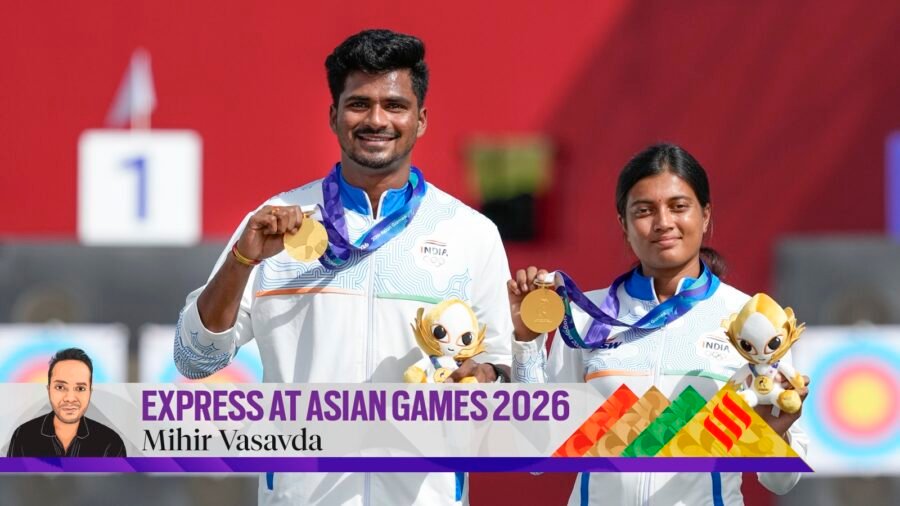
On Wednesday, India showed why that preparation mattered.
They swept all three compound team golds at the Asian Games — the women’s team, men’s team and mixed team. And thrice, they beat South Korea (two times in semis and once in final), Asian Games’ most dominant archery nation. The mixed-team victory, secured by Chikitha Taniparthi and Sahil Jadhav after a shoot-off, also earned India their first Olympic quota place for Los Angeles 2028.
Story continues below.
Subscribe to see fewer ads.
“We have been proving ourselves from the past few years,” Jyothi Vennam, who paired with Chikitha and Prithika Pradeep for women’s team gold, said. “We have been winning each and every medal possible at the highest and I think, yeah, maybe we are better than South Korea.”
Wednesday was also India’s best gold-medal day of these Games so far. Alongside the archery hat-trick, Neeru Dhanda and Kynan Chenai won the mixed trap gold in shooting, giving India four golds in a single day.
But the significance of the archery sweep stretches beyond another successful Asian Games.
When India swept all five compound golds at Hangzhou in 2023, compound was still fighting for its place on the Olympic stage. Now it has one. The International Olympic Committee has added mixed-team compound to the Los Angeles 2028 programme, making it the first Olympic medal event for the discipline.
Story continues below this ad
That has changed the equation. An event that once had Asian Games and World Championship glory at stake now has an Olympic medal at the end of the road, and countries that had lagged behind India have started investing accordingly.
China, according to Teja, began serious preparations around 2018 and has steadily built itself into a force. At these Games, China’s Liao Jiahao and Liu Jinyi finished first and second in men’s qualification. South Korea, the traditional Asian archery powerhouse, has also sharpened its compound programme. Its mixed team set a world record earlier in the competition, while 14-year-old Kang Yeonseo became the first under-18 women’s archer to shoot a perfect 150 in a 15-arrow match.
“Everyone doubled down on their preparation,” says David Cousins, the high-performance coach brought in specifically to prepare India for the Olympic push. “It got a lot harder and it will get harder after this, for sure.”
India’s response has been to double down, too.
At SAI Sonepat, Teja and the coaching staff recreated the competition environment and then repeatedly put their archers through pressure situations. A second team from the Centre of Excellence was brought in to compete against the national team two to four times a week. “We set up the exact same environment,” Teja says. “We installed the same screens, used the same music system, set up identical targets, and built the same podium, flags and colour scheme.”
Story continues below this ad
The pressure was deliberately manufactured. If the world record was 238, the target was 238. If six arrows were required, all six had to be 10s, with at least three Xs — the tiny centre at the heart of the 10-ring, where the highest-scoring arrows land. Sometimes, the rule was even simpler: only six Xs would allow the session to end.
Perfect test
The mixed-team final against Korea provided the perfect test. The teams were locked at 157-157 after four ends. The gold came down to a shoot-off. Chikitha Taniparthi and Sahil Jadhav shot 20; Korea’s Park Jungyoon and Choi Yonghee managed 19.
It was precisely the kind of moment the Sonepat sessions had tried to manufacture. “The biggest thing is just they’ve been through training scenarios that are way more complicated and way more mentally and emotionally stressful than this,” Cousins, a five-time World Championship gold medallist, says. “It’s just getting them to internalise that they trust everything you put them through, that they trust themselves, that they believe in their teammates and themselves, and then just get up there and execute with no doubts.”
Cousins added that securing early Olympic qualification will give the archers a head start over the rest. “The nice thing about securing the first Olympic spot is that we can use 2027 to be a little bit more tactful and almost be offensive, not defensive,” Cousins says.
Story continues below this ad
The three golds in Nagoya, then, are more than a continuation of India’s Asian Games dominance. They are an early statement in a new Olympic race, one in which China, Korea and others have begun investing heavily in catching up.
And India might not be finished here. They still have a chance to add two more individual compound golds on Thursday, when the men’s and women’s individual titles are decided.
They brought Okazaki to Sonepat. When they finally reached Okazaki, it felt familiar.

India vs South Korea LIVE, Asian Games hockey semis: Salima Tete’s bunch eyes final berth
By Sohail Khan · 30 Sep
Compound vs recurve archery: How are the two disciplines different
By Sohail Khan · 30 Sep
India makes it three out of three in archery, beat China in thrilling men’s compound final
By Sohail Khan · 30 Sep
Leave a Reply