How NASA’s Roman Space Telescope can help us decode the universe’s greatest mysteries
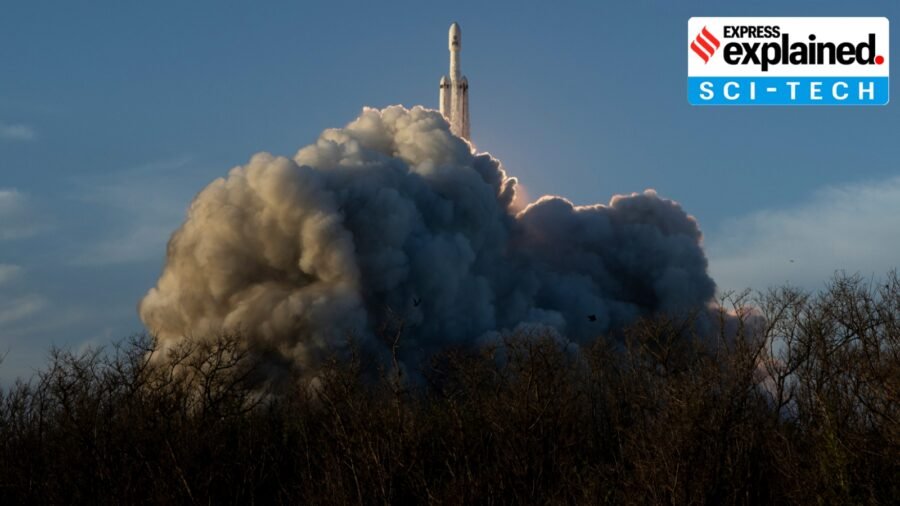
NASA on Sunday (August 30) launched a powerful, next-generation space telescope that can search for clues for some of the universe’s deepest mysteries, including mysterious phenomena such as dark matter and dark energy.
The telescope, launched on a SpaceX rocket, is named after the late Nancy Grace Roman — known as the “mother of Hubble” owing to her role in the creation of the Hubble Space Telescope, which has been operating since 1990.
Who was Roman, and what is the purpose of the telescope named after her?
Story continues below this ad
What will the Nancy Grace Roman Space Telescope do?
In terms of scientific capabilities, the Nancy Grace Roman Space Telescope lies between the Hubble Space Telescope and the James Webb Telescope. It will be able to scan vast swathes of the cosmos and may provide new insights about dark matter, dark energy and exoplanets. Let’s look at what these terms mean, and how the new telescope could improve our understanding of these.
-
Exoplanets: These are planets located outside our solar system and are often found orbiting a star or a “remnant star” (the remains of a star that has burnt out).
The Roman Space Telescope, which can scan a wide area of space, may be able to identify many more exoplanets. This search could help us finally answer that tantalising question: Are we alone in the universe? So far, more than 6,000 exoplanets have been identified.
-
Dark matter and dark energy: Scientists estimate that ordinary matter makes up only about 5% of the universe. The rest is composed of little-understood phenomena called dark matter and dark energy.
Story continues below this ad
Scientists believe that dark matter, which makes up about 27% of the universe, is an invisible glue that holds galaxies together. On the other hand, dark energy, estimated to make up around 68% of the universe, is believed to be a repulsive force that has expedited the universe’s expansion since the Big Bang. This telescope will conduct the most detailed dark matter studies ever, potentially helping to map how it is structured and distributed throughout the cosmos, especially during the process of early star birth.
-
Besides this, this telescope will help measure how gravity subtly bends the path of light across vast distances (a phenomenon known as gravitational lensing). The Roman telescope will, therefore, provide a comprehensive three-dimensional map of the distribution of galaxies and galaxy clusters across the universe.
How will the Nancy Grace Roman Space Telescope work?
The Roman Space Telescope, weighing about 8,000 kgs and about the size of a tour bus, will operate from the Lagrange Point 2 — a vantage point between Earth and Sun located approximately 1.2 million kilometres from Earth.
Story continues below this ad
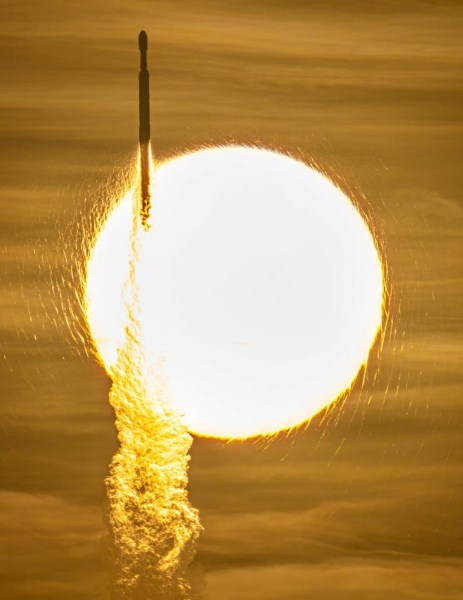 A SpaceX rocket carries NASA’s newest space telescope. @NASA/X
The James Webb Space Telescope, launched in 2021, has also been operating from this zone.
At this point, the gravity from the Sun and Earth works together with an object’s motion around the Sun. This can help the Roman telescope remain steady. Lagrange Point 2 also offers stable optical performance and an unobstructed view of the universe for imaging.
The telescope, which will downlink approximately 1.4 terabytes of data per day to ground stations in New Mexico, Australia and Japan, and is expected to contribute up to 20 petabytes of data over its five-year mission life.
It has two major science instruments on board:
Story continues below this ad
Wide field instrument: This is a 300-megapixel infrared camera that can capture a patch of the sky about 1.5 times bigger than the apparent size of a full Moon. The telescope can also process images 1,000 times faster than the Hubble telescope.
Coronagraph: Just like humans cannot look directly into the sun but can see its rounded rim with the help of eye goggles/protective shields, astronomers use coronagraphs to mask the extreme bright light emitted by celestial bodies in order to study its immediate space surroundings.
The Roman Space Telescope will deploy one of the most advanced coronagraphs. In principle, it will block the glare from stars and enable scientists to see the faint reflected light from planets in orbit around them. It aims to image the dusty disks around nearby stars in visible light which could, in turn, help see the older, colder and fainter stars in the close vicinity.
Who was Nancy Grace Roman?
Born in 1925 in the US, Roman was NASA’s first chief astronomer and made significant contributions in building space-based telescopes at a time when ground-based telescopes were the preferred option. She did in 2018. Now, over a century since her birth, NASA is launching an infrared space telescope named after her.
Story continues below this ad
Roman was deeply involved in NASA’s Great Observatories programme: Hubble Space Telescope, Chandra X-ray Observatory, Compton Gamma Ray Observatory and Spitzer Space Telescope.
All these observatories took astronomy to newer heights and opened up avenues for scientists to study the universe across much of the electromagnetic spectrum and complement it with ground-based telescopes.


Don’t buy a lab-grown diamond before checking these 7 things
By Sohail Khan · 29 Sep
Towards a gender just Uniform Civil Code
By Sohail Khan · 29 Sep