Hindi Diwas: How the Constituent Assembly settled India’s language row
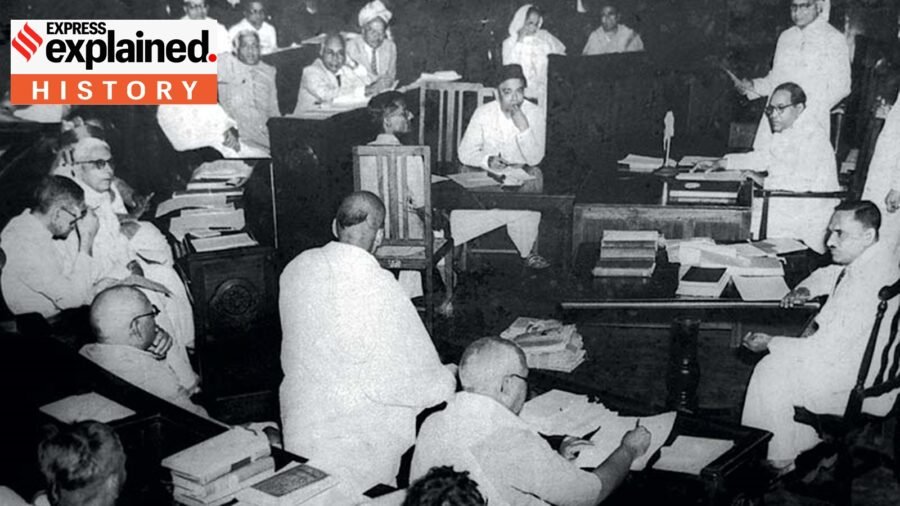
In one of the earliest sessions of the Constituent Assembly, RV Dhulekar, a Congressman from the United Provinces, made an aggressive plea for Hindustani to be used in constitution-making. When told that not everyone in the Assembly knew the language, he retorted: “People who are present in this House to fashion a constitution for India and do not know Hindustani are not worthy to be members of this Assembly. They better leave.”
His remarks sparked a commotion. Although the Chairman intervened to restore order, the language question remained one of the most contentious issues before the Assembly.
On September 14, 1949, after years of debate, the Assembly adopted the language compromise commonly known as the Munshi–Ayyangar formula. Rather than declaring a ‘national language’, it designated Hindi as the ‘official language of the Union’, while English would continue to be used ‘for all official purposes’ for 15 years after the commencement of the Constitution. The date is now commemorated as Hindi Diwas.
The long-debated language problem
Story continues below.
Subscribe to see fewer ads.
Within the Constituent Assembly, the language of the Union government was one of its most divisive questions. At Independence, most Indians spoke one of roughly a dozen major regional languages, while Hindi was the most widely spoken language. English was the language of colonial administration, even though less than 1 per cent of Indians spoke it.
The main questions then were whether English should be replaced, wholly or partly, by an indigenous language, and which language or languages should have official status at the Centre.
Political scientist Hanna Lerner writes in The Oxford Handbook of The Indian Constitution, “The two main factions in the assembly debate over the national language were the representatives of the Hindi-speaking areas, mostly from north-central India, and the representatives of non-Hindi-speaking regions, particularly from the south, as well as the moderate leaders of the Congress Party.”
Story continues below this ad
The Hindi-speaking representatives demanded that Hindi be declared the national language and replace English immediately. Lerner writes, “They claimed that a multilingual society was incompatible with Indian unity. Seth Govind Das, a Congress representative of the Central Provinces and Berar, stated, ‘We want one language and one script for the whole country. We do not want it to be said that there are two cultures here.’”
Representatives from non-Hindi-speaking regions rejected the idea that national unity required linguistic uniformity. Shri Shankarrao Deo of Bombay, the Congress General Secretary, stressed “Not uniformity but unity in diversity.”
Moderate Congress leaders, including Jawaharlal Nehru, recognised the practical difficulties of making Hindi the national language. “It was even argued that Hindi lacked the appropriate modern vocabulary required to govern a modern State,” Lerner writes.
Maulana Azad, Congress president and Education Minister in Nehru’s government, spoke of the continued importance of English in law and administration. He said, “This change [from English] should be ushered in only when a national language can be read and written in every part of the country and becomes mature enough for the expression of highly technical subjects… Languages are never made; they evolve. They are never given a shape; they shape themselves.”
Story continues below this ad
Majority or consensus?
The language dispute also raised a procedural question: how should a national language be chosen? Hindi proponents demanded a simple majority vote, while their opponents argued for consensus, preferably unanimity.
Seth Govind Das articulated the Hindi-speaking position: “We have accepted democracy and democracy can only function when majority opinion is honoured. If we differ on any issue, that can only be decided by votes. Whatever decision is arrived at the majority must be accepted by the minority respectfully and without any bitterness.”
By contrast, SP Mookerjee of Bengal warned against imposing a majoritarian decision on linguistic minorities: “If it is claimed by anyone that by passing an article in the Constitution of India one language is going to be accepted by all by a process of coercion, I say, Sir, that that will not be possible to achieve.”
Story continues below this ad
Rajendra Prasad, President of the Constituent Assembly, similarly argued, “Whatever decision is taken with regard to the question of language, it will have to be carried out by the country as a whole… The decision of the House should be acceptable to the country as a whole. Even if we succeed in getting a particular proposition passed by majority, if it does not meet with the approval of any considerable section of people in the country… the implementation of the Constitution will become a most difficult problem.”
A compromise is struck
The Assembly ultimately approved the Munshi–Ayyangar formula in 1950, later incorporated into Articles 343–351 in Part XVII of the Indian Constitution. It was named after KM Munshi and N Gopalaswamy Ayyangar, who were part of the seven-member Drafting Committee of the Constitution, with BR Ambedkar as its chairman. “Ultimately,” notes Lerner, “it was the pragmatic consensus-seeking approach that triumphed.”
The arrangement envisaged a 15-year transition, during which Hindi could increasingly be used by the Centre. Lerner adds, “In addition, the Constitution recognised fourteen other languages for official use (listed in the Eighth Schedule of the Constitution). The provincial governments were permitted to choose one of the regional languages or English for the conduct of their internal affairs, while English (unless Parliament would replace it with Hindi) remained the language of inter-provincial communication.”
But when that period ended in 1965, Hindi was still not widely used by the Union government. Following a series of violent riots in non-Hindi-speaking states in the 1960s, Parliament renounced the ideal of an Indian national language. The Official Languages Act of 1963 later stated that English would continue to be upheld as an official language along with Hindi.
Story continues below this ad
“At first blush, since Article 343 designates Hindi as ‘the official language of the Union’, it would seem that the proponents of Hindi won,” notes academic Sujit Choudhry in The Oxford Handbook, adding, “But upon closer examination the resulting set of constitutional provisions reflects a multidimensional compromise between these two positions.”


India needs a smarter SIR. Aadhaar can help
By Sohail Khan · 14 Sep
In German far-right party AfD’s rise, a bigger question for democracy
By Sohail Khan · 14 Sep
Leave a Reply