Giant eyes, 360-degree vision and lightning-fast reflexes: Why dragonflies are remarkable hunters
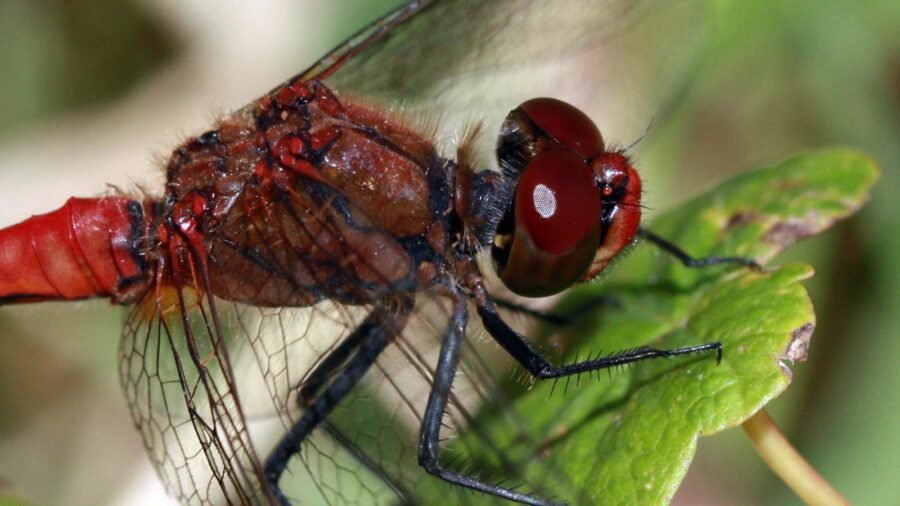
If you’ve ever had a close encounter with a dragonfly, you probably noticed one thing right away: those enormous eyes. They take up most of the insect’s head, and for good reason: when it comes to vision, dragonflies are in a league of their own.
But why exactly are their eyes so big? The answer comes down to survival, and some truly incredible evolutionary design.
One of the most impressive things about dragonflies is that they can see in almost every direction at once. Their huge, rounded eyes give them nearly 360 degrees of vision, meaning they can spot prey, predators, or potential mates from almost any angle.
Story continues below.
Subscribe to see fewer ads.
According to the Natural History Museum in London, their eyes wrap so far around their heads that it’s like living inside a globe of glass. For a flying insect that hunts on the move, this kind of vision is a massive advantage.
Those big eyes aren’t just oversized versions of ours. Dragonflies have compound eyes, made up of thousands of tiny lenses called ommatidia. Each ommatidium functions like a tiny eye, capturing light and movement from a specific angle.
 In addition to their giant compound eyes, dragonflies have three simple eyes called ocelli.
Some dragonflies have up to 30,000 ommatidia in a single eye, according to Encyclopaedia Britannica. This setup allows them to detect even the smallest movement—fast—which is why they’re such precise hunters.
Humans, by comparison, have just one lens in each eye and can’t even come close to the frame rate dragonflies process. They’re able to track movements at around 200 frames per second, while we max out around 60.
Story continues below this ad
Here’s where it gets even more amazing: dragonflies don’t just have great vision, they also have complex colour perception. While humans have three types of colour receptors (red, green, and blue), dragonflies have up to 30 different visual opsins, some of which detect ultraviolet and polarised light.
This ability helps them spot other dragonflies, water surfaces, or prey, even in confusing environments. Their world looks nothing like ours, it’s more vivid, more layered, and probably more beautiful.
In addition to their giant compound eyes, dragonflies have three simple eyes called ocelli. These don’t give a detailed image like the compound eyes do, but they’re great at detecting quick changes in light, like the flicker of a shadow or a shift in brightness.
That may not sound like much, but when you’re flying at high speeds and dodging obstacles, it can mean the difference between survival and a crash.
Story continues below this ad
With this powerful visual toolkit—wraparound vision, extreme motion detection, color perception beyond human capability, and fast reflexes—it’s no surprise that dragonflies are some of the most skilled predators in the insect world.
In fact, studies have shown they have a 95–97% success rate when it comes to catching prey mid-air. That makes them more accurate than most birds or even big cats, according to the Smithsonian Magazine.
Explore more captivating stories about pets and animals here, and make us your daily stop for the latest from the animal kingdom.

Bats first originated in Europe 65 million years ago, scientists say
By Sohail Khan · 25 Sep
BrainyBotz STEM Challenge 2026: Young innovators to design cooler homes
By Sohail Khan · 25 Sep
How Iran’s 7-day plan to end war with US mirrors June memorandum
By Sohail Khan · 25 Sep
Leave a Reply