Germany ready to sign submarine deal with India tomorrow, German envoy says
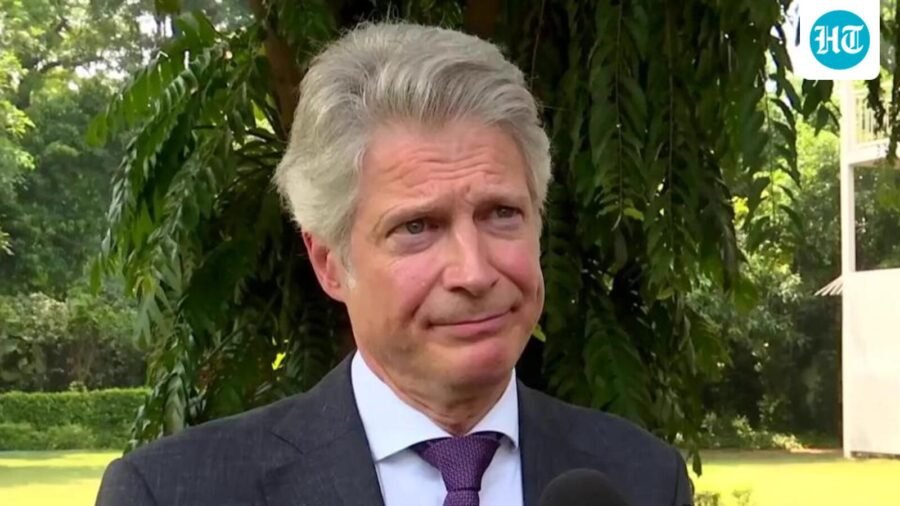
Germany has cleared the government-to-government agreement for India’s ₹70,000-crore Project 75I submarine deal, but awaits final approval from New Delhi, envoy Jasper Wieck said.
Published on: Sep 23, 2026, 18:52:18 IST
Prefer HTon Google
Share via
Copy link
Germany has completed its internal processes for concluding a deal worth almost $7.5 billion to build submarines in India and is awaiting the final go-ahead from New Delhi, German envoy Jasper Wieck said on Wednesday against the backdrop of the two countries deepening their security ties.
The German side has signed off on a government-to-government agreement that is “very forward-leaning” in meeting India’s requests, and the deal can pave the way for enhanced cooperation on other defence systems, Wieck told a media briefing.
Noting that everything has been cleared on the German side, Wieck said: “The government has agreed to all the documents that have been worked on, in particular, the inter-governmental agreement which is very ambitious and very forward-leaning with regard to Indian requests.
“From the German side, we could sign tomorrow. So, it is up to the Indian side, I think it’s the Cabinet Committee on Security that has to give its final approval and this is still awaited.”
Germany’s Thyssenkrupp Marine Systems (TKMS) and India’s state-owned Mazagon Dock Shipbuilders will join hands to build six submarines in India, marking the first big-ticket defence deal between the two countries in several decades. Recent years have seen Germany ease its restrictions on the export of lethal defence equipment to benefit India as part of steps by the two sides to ramp up defence and security cooperation.
The ₹70,000-crore (almost $7.5 billion) Project 75I for building six next-generation conventional submarines is aimed at sharpening the Indian Navy’s underwater capabilities. The first submarine is expected to be delivered seven years after the contract is signed, with the rest coming at the rate of one a year.
The submarines, a variant of HDW Class 214 vessels, will be equipped with air-independent propulsion (AIP) systems, which allow a submarine to remain underwater longer without surfacing and reduce the risk of detection. As part of the contract, TKMS will transfer design and technology to India, bolstering self-reliance in defence manufacturing.
Wieck described the defence and security partnership as one of three priorities for Germany’s ties with India, the others being the India-European Union (EU) free trade agreement and labour mobility and student exchanges. He noted that both countries are spending more to bolster their armed forces because of an “unfriendly geostrategic environment”.
The security of Germany and Europe was impacted by Russia’s invasion of Ukraine, while China’s “revisionist” and increasingly assertive approach is causing challenges for India, Wieck said. “We are both operating under very strange circumstances and on top of this, the US, our most important and trusted partner for decades, is constantly changing the rules of the games, which makes it a bit difficult to cooperate,” he said.
Wieck listed unmanned systems such as drones, cybersecurity, and missile and sensor technologies as other areas where the two countries can be a “perfect match” for developing and producing equipment. Germany and India are already developing their own unmanned systems, and there is “huge potential to work together”, he said.
In an era of unpredictability, great-power competition and lack of trust, the Indo-German partnership stands out in “stark contrast” as it is built on trust, predictability and confidence, Wieck said. “Because of that, this strategic partnership is of such importance for both our countries to succeed in this world that we are dealing with today,” he said.
The bilateral defence and security partnership has grown in recent years with port visits by German warships, the participation of German armed forces in military exercises in India, and the posting of a German liaison officer at the Indian Navy’s Information Fusion Centre for the Indian Ocean Region.
The two countries also finalised a defence industrial roadmap in April, and Germany has made a “180-degree shift” by becoming forward-leaning with regard to export licences and technology transfers for India, he said.
See Less
Jaishankar meets Rubio, conveys India’s concerns on Sanctioning Russia and Iran Act
By Sohail Khan · 23 Sep
Scan, pay, collect: Kanaka Durga temple installs Andhra Pradesh’s first ‘laddu ATM’
By Sohail Khan · 23 Sep
Right to Public Service Act in varsities to be implemented in a phased manner: Minister
By Sohail Khan · 23 Sep
Leave a Reply