Explained: The coal factor in Punjab’s ongoing power crisis
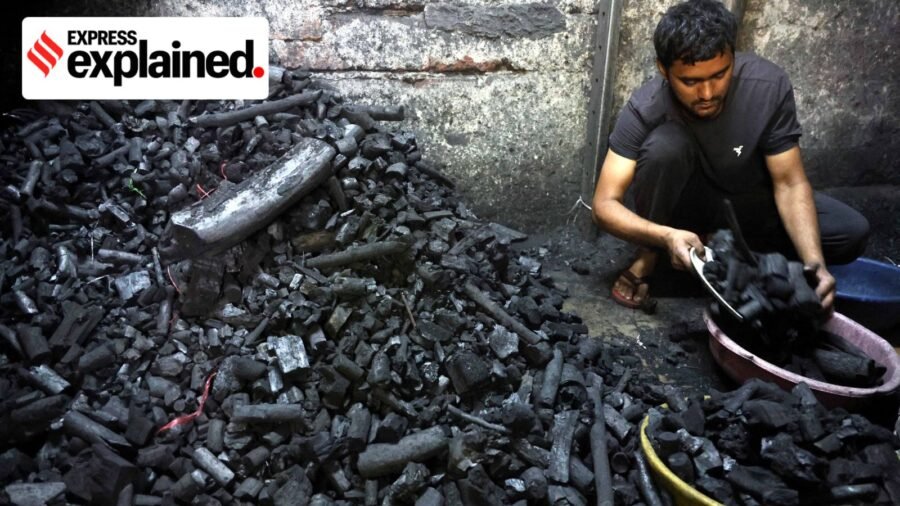
Punjab is facing a power shortage that has led to a war of words between the state government and the Centre. The state government has blamed the shortage mainly on disruption in coal supplies, while the Centre has said that adequate coal has been made available to Punjab’s power plants.
The situation has worsened amid high demand owing to the paddy season and the lingering summer heat.
Power department data shows that generation from state-owned thermal plants was also lower than expected during the peak summer months. Here is what to know.
How serious is the current power shortage?
Story continues below.
Subscribe to see fewer ads.
During the peak summer months between June and August, the two state-owned thermal plants, Guru Gobind Singh Super Thermal Power Plant (GGSSTP), Ropar, and Guru Hargobind Thermal Power Plant (GHTP), Lehra Mohabbat, generated much less power than their available capacity.
The plants were also operating at low capacity on several days in early September. Some units were shut while others were running at reduced load.
The situation at Punjab’s two private Independent Power Producers (IPPs), including Nabha Power Limited at Rajpura and Talwandi Sabo Power Limited, was relatively better until August, but their coal stocks have since fallen sharply. By September 13, Nabha Power had around seven days of coal and Talwandi Sabo around four days.
The result has been restrictions on industrial supply, load-shedding in some areas and reduced power availability for agriculture at a time when demand is high, touching 17,000 megawatts (MW). Overall, Punjab’s total thermal generation capacity stands at around 5,680 MW.
Why did the state’s plants generate less power?
Story continues below this ad
Coal availability is only one of the several factors responsible.
In general, coal allocation is done when a thermal plant is set up, and the Union Ministry of Coal makes an allotment from India’s various coalfields. Punjab’s state-owned plants get coal from the Pachhwara mine in Jharkhand. The two private plants used to get imported coal till 2022, when the Pachhwara mine was not operational, while the state plants used coal allotted by Coal India Limited.
After supplies started coming in from Pachhwara, the coal allotted for the state’s own thermal plants came to be diverted to private thermal plants. They are advised to keep stocks for 21 days, but owing to high peak demand, the stocks fell short.
This time, operations at the Pachhwara mine were affected by heavy rains. Parts of the mine were filled with water, affecting mining and transportation. The government also could not fully draw coal because loaders and unloaders were unavailable. Meanwhile, in Punjab, contractual employees at the state’s thermal plants remained on strike for about a month, affecting operations.
Story continues below this ad
Despite these problems, coal stocks at the two state-owned plants were still relatively comfortable by early to mid-September, but their utilisation remained low.
What about the private thermal plants?
Nabha Power Limited and Talwandi Sabo Power Limited together account for around 3,380 MW of generation capacity. Both plants maintained relatively good generation through August, but their coal stocks have since declined rapidly.
The Central Electricity Authority sets norms for maintaining coal stocks at thermal plants. For thermal plants located more than 1,500 km from their coal source, the prescribed stock level is three weeks. The private plants, therefore, need a sizeable coal buffer before the peak demand period.
Punjab also has an institutional mechanism to deal with coal-related issues. In 2014, the Punjab State Electricity Regulatory Commission constituted a Standing Committee comprising the Secretary, Power, CMD Punjab State Power Corporation Limited (PSPCL) and the concerned plant CEO to deal with issues related to the Nabha project, including alternate or imported coal.
Story continues below this ad
The present situation has brought coal planning for private plants into focus, particularly the need to monitor stocks and consumption well before demand peaks.
What about Punjab’s hydro power?
Hydropower could have provided some relief to the state during high demand. Hydropower is generally a low-cost source and can also provide flexibility when thermal generation fluctuates.
However, some hydro capacity has remained underutilised. The Upper Bari Doab Canal (UBDC) system is one example. A problem in its feeding canal in August 2025 affected the plant, which has continued to operate at around half its capacity. The dip in hydro generation has added to the pressure on the state’s thermal plants, leading to a need for power purchases.
What has the impact been like?
The impact has been felt by all three major categories of consumers, including industry, households and agriculture.
Story continues below this ad
Industry has faced restrictions in power supply, affecting production and adding to costs. Consumers have faced unscheduled power cuts. Agriculture feeders have also seen restrictions when paddy needs the last few rounds of irrigation.
For PSPCL, lower generation from its own plants has also meant greater dependence on short-term power purchases. Power bought from the market has cost around Rs 6 per unit, compared with an estimated variable cost of around Rs 3.85 per unit for its own generation. Based on available estimates, this has meant an additional burden of around Rs 389 crore over three months.
What has the Chief Minister said?
Chief Minister Bhagwant Mann has denied the extent of the problem and said that the shortage of coal at thermal plants is easing. “The flooding at coal mines in Jharkhand had caused a temporary shortage. I had spoken to Jharkhand Chief Minister Hemant Soren and will visit Ranchi in the next two to four days to thank him,” he told the media on Monday (September 14).
Mann added that coal from the Pachhwara coal mine could earlier be used only by the state’s thermal plants and not the two private plants. Coal India has now agreed to their private use following the government’s request, Mann said. Soren had also granted the local approval required from the Jharkhand government.

Woman manifests 30-pound weight loss on birthday, reveals results one year later
By Sohail Khan · 15 Sep
The simple movement you shouldn’t give up as you get older: ‘Asian squat’
By Sohail Khan · 15 Sep
Expert Explains | What the BRICS 2026 summit achieved — and what challenges remain
By Sohail Khan · 15 Sep
Leave a Reply