Experts Explain | How the European Union’s carbon tax works, and why BRICS pushed back against it
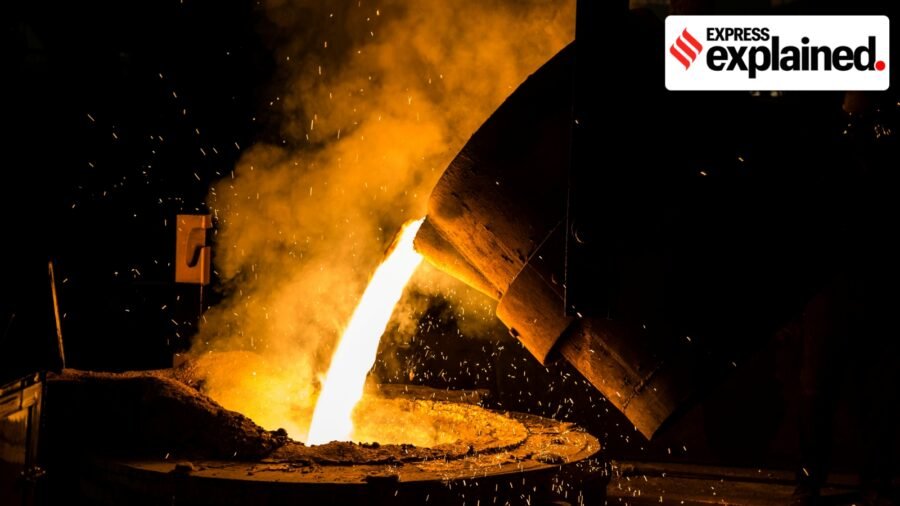
When an Indian mill sells any of these to Europe, the European buyer must buy certificates for the carbon dioxide released in making them. The certificates track Europe’s own carbon market and cost a little over €75 (per tonne) each in the first two quarters of this year. Each certificate covers a tonne of carbon dioxide, not a tonne of the product.
Making a tonne of steel in India releases 2.54 tonnes of carbon dioxide, against a world average of 1.9 tonnes. So, a tonne of Indian steel carries carbon roughly worth €190 on paper. The charge will climb each year as Europe withdraws the free permits it gives its own mills.
Importers do not have to pay this yet, as mentioned above: they will start purchasing these certificates from February 2027, covering goods shipped during 2026.
Story continues below this ad
India’s exposure is narrow, yet deep. Of the $6.3 billion of CBAM-covered goods India sold to the EU in 2024, iron and steel accounted for $5.4 billion.
Therefore, India’s CBAM bill is, in effect, a steel bill. ICRIER estimates that the tax could cut India’s steel exports to the EU by 24%. Commerce Ministry figures already show a 13% fall in iron and steel shipments to the bloc in the first four months of the new regime.
BRICS countries have called CBAM protectionist and discriminatory. How true are these claims?
ICRIER finds that emissions from the world’s steel industry would fall by about 1%, while the EU’s own emissions would rise by 0.29%. European mills would simply make more steel to fill the gap. Production would shift from India to Europe, and the atmosphere is left where it was.
Story continues below this ad
The money does a great deal for European industry, however. European steel, cement and aluminium plants still receive free permits for their own emissions, which are meant to be withdrawn between 2026 and 2034. The European Commission has also proposed a €100-billion Industrial Decarbonisation Bank for European factories. Brussels wants 75% of CBAM revenue, about €1.4 billion a year, to go to the EU budget.
The countries being charged CBAM have done the least to cause the problem. India has produced about 3.6% of all the carbon dioxide emitted since 1751, and the EU’s member states almost a fifth. Paragraph 110 of the New Delhi Declaration says developed countries shall give developing ones money to adapt. But this tax sends it the other way altogether.
What is the EU’s stance?
Europe’s concerns are valid. Its own factories pay for their carbon, and the EU does not want them undercut by imports that pay nothing for theirs. Brussels would also point out that the BRICS declaration expects fossil fuels to keep playing an important role in the energy mix of developing economies. And whatever a summit says, it cannot repeal a European law. Collection will begin in February 2027 either way.
Can India reduce the impending bill?
There is a line in the existing European law India can use. Article 9 of the CBAM regulation deals with carbon prices already paid at home.
Story continues below this ad
If India charges a domestic mill for carbon, the European importer can subtract the amount from the bill at the border. So, India can decide whether this carbon payment happens at home or in Europe.
But, so far, India has left it to Brussels, and the reason is the way its carbon market is built. Unlike the EU model, the Carbon Credit Trading Scheme does not charge a factory for every tonne it emits. Rather, it sets every plant a limit on emissions per unit of output. A plant that crosses this limit must buy certificates to cover the excess.
A mill that stays within its limit would, therefore, pay nothing domestically. But with nothing paid at home, there is nothing for the European importer to subtract, so the mill will have to pay the full bill in Europe. A mill that emits more than allowed does pay in India, and that is the payment Article 9 recognises, so its European bill will come down on the tonnes it overshot.
The result, therefore, is that plants following India’s rules would end up paying Brussels in full while plants that break these would get a discount.
Story continues below this ad
Europe, therefore, needs to recognise the Indian scheme — which it has not. The UK, meanwhile, has moved faster: on September 8, its treasury put the Indian scheme on its list of qualifying carbon pricing schemes for its own border tax starting in January 2027.
What can India do to offset negative impacts before February 2027, when CBAM collection begins?
Three things are in India’s hands before the bills arrive.
First: Address steel, which carries nearly all of the exposure and is the last big sector being brought into the scheme. The Environment Ministry issued draft targets for 255 iron and steel plants only on June 26, skipping the 2025-26 compliance year, with a median cut in emissions per tonne of about 5.5%. Finalising those targets, and putting a clear price per tonne on any shortfall, would give exporters a payment to show at the border.
Story continues below this ad
Second: Leverage the trade agreement which India closed with the EU in January, which is a ready channel to press India’s case. In the agreement, both sides agreed to work on recognising each other’s carbon prices, and the EU promised India any flexibility it grants another country.
Third: Turn up in Brussels. When the Commission asked for comments on those draft rules, India sent three responses, all of them from private firms. Brazil sent 12, two filed jointly by federal ministries. The Bureau of Energy Efficiency and the commerce, steel and environment ministries should be filing these responses.
Beyond that, paragraph 109 of the declaration supports a BRICS Carbon Markets Partnership. Common standards among members would make it harder for Brussels to decide alone whose price counts. Europe will start collecting regardless. How much of that money leaves India depends on rules written in Delhi this year.
Singh is Director, Science, Gateway Research Foundation, and Agarwal is Senior Fellow at the Institute for Governance & Sustainable Development.

4 scenic train journeys in India you should take at least once
By Sohail Khan · 30 Sep


Leave a Reply