Apple Pay comes to India after 12 years: How it works, what users need to know
Story continues below.
Subscribe to see fewer ads.
The potential market size is significant. India had 124.05 million credit cards outstanding in August, while credit-card spending stood at about Rs 2.02 lakh crore during the month, according to RBI data.
Commenting on the launch, Axis Bank Chief Executive Officer (CEO) and Managing Director (MD) Amitabh Chaudhry said, “As payments become increasingly embedded in customers’ everyday digital lives, our focus is on bringing together innovation and trust, while making every interaction more intuitive and relevant.”
Moreover, fintech platform PayU also brought Apple Pay under its merchant network. This will allow merchants to offer customers a secure, contactless and seamless payment experience online, in-app and in-store.
Nikhil Mehta, Senior Vice President, Partnerships & Business Head, Growth Initiatives at PayU said that beyond the introduction of the service, PayU will also help merchants navigate technical integration and compliance processes. “Through PayU’s unified checkout, merchants can offer their consumers the flexibility of faster, safe, and more convenient payment option, thereby boosting conversion rates and driving business growth,” he said.
Story continues below this ad
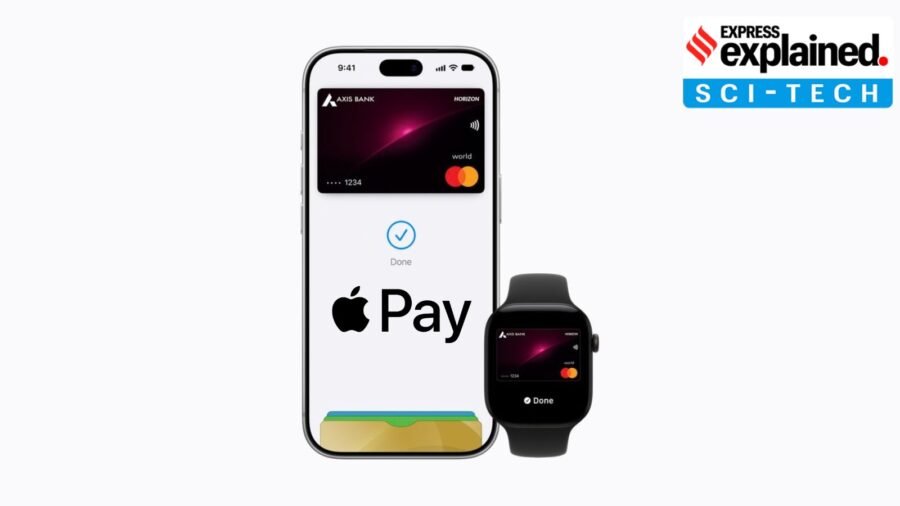
Apple Pay, meanwhile, is available at launch on iPhone, iPad and Apple Watch, while support for Mac is coming soon.
As of now, due to Apple Pay’s support of Axis Bank cards, the addressable market for the service is likely to be limited. However the base can grow as the tech giant finalises more partnerships across the financial sector.
Samsung, Google & WhatsApp Pay
Contactless card payments are not new to India. The mechanism used is Near Field Communication (NFC), a short-range wireless technology that lets two devices exchange data when held in close proximity. In payments, it allows a phone, smartwatch or card to communicate with a compatible point-of-sale terminal without inserting or swiping the card.
Samsung launched Samsung Pay in India in March 2017, two years after its global launch. It allowed Samsung users to make payments by tapping registered debit or credit cards at merchant terminals. Its launch partners included Visa, Mastercard and several major banks, including Axis Bank, HDFC Bank, ICICI Bank and SBI Cards.
Story continues below this ad
In September 2017, Google Pay launched in India, then known as Tez. In 2020, the platform followed with NFC-based, tokenised card payments, initially rolling out the feature to Axis and SBI Card users. The service allows users with supported cards and NFC-enabled Android phones to make contactless payments at compatible terminals.
After almost two years of regulatory delay, Meta’s WhatsApp Pay entered the digital payments ecosystem in 2020 after gaining approval from the National Payments Corporation of India (NPCI) — with a restriction of just one million users. Eventually, NPCI pushed the limit to 100 million by 2022. From market concentration to data privacy concerns, its growth took a hit, while other competitors such as Google Pay, PhonePe and Paytm raced ahead.
In 2025, when most of its rivals had already gained much ground, the NPCI allowed Meta to extend its Unified Payments Interface (UPI) services to its entire user base of over 500 million in India. Effectively, the decision removed the previous cap of 100 million users.
Apple Pay’s appeal
When it comes to Apple Pay, the appeal for a user is mostly related to the integration of their payments into the wider Apple ecosystem. It allows them to make contactless payments through the iPhone and Apple Watch, and also supports payments in apps and on the web through Apple devices.
Story continues below this ad
On Reddit, one Indian user who activated the service described the setup as “smooth” and posted images showing an iPhone 16 Pro and Apple Watch Series 8. Others also questioned what was new about Apple’s offering, with comparisons to existing Google Pay and Samsung Pay tap-to-pay functionality.
Some users argue that Apple’s appeal lies in how the payment service is integrated into its devices and in-app and web checkout experience.
Reuters had previously reported that Apple was also in discussions with other large banks, including HDFC Bank and ICICI Bank. However, no agreements were finalised.


What does it mean if your heart function is only 15%?
By Sohail Khan · 30 Sep

Leave a Reply