Expert Explains: Why US-Denmark pact on Greenland matters for Arctic security
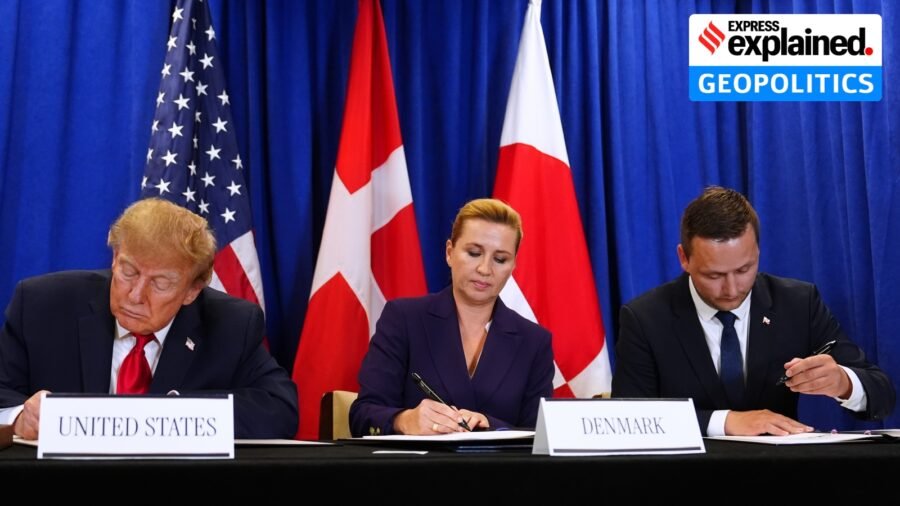
The US-Denmark-Greenland security agreement announced on Friday (September 18) marked a major turning point, with far-reaching strategic ramifications. US President Donald Trump’s repeated demand for US control of Greenland — and even threatening to annex it — had created a serious challenge for NATO. The negotiated security arrangement, however, should not be mistaken as settlement of the Greenland question itself.
Geopolitical significance
Greenland, the world’s largest island, covers an area of around 2.16 million sq km, with approximately 81% covered by a massive permanent ice sheet. Its population — less than 57,000 — makes it one of the least densely populated areas globally, and nearly half of it lives in the capital city of Nuuk. Roughly, 88% of the population is Inuit or of mixed Inuit Danish heritage.
Story continues below.
Subscribe to see fewer ads.
Greenland is an autonomous, self-governing country, within the Kingdom of Denmark. Copenhagen, however, retains the responsibility of foreign policy, national defence, security, and monetary policy.
Located between North America, Europe, and the Arctic Ocean, Greenland has immense strategic significance as it dominates sea lanes and air routes. In fact, it controls the access between the Arctic and Atlantic Oceans, which covers the Greenland-Iceland-United Kingdom gap: a vital choke point.
It is home to the US-Pituffik Space Base (formerly the Thule Air Base), which is crucial for ballistic missile early warning and Arctic defence. The island also has vast reserves of rare earth minerals. With the melting ice caps, accessibility to its untapped resources has increased.
US-Denmark pact on Greenland
The pact entails US permanent basing, overflight, and the ability to do what is necessary to defend Greenland, paving the way for an increased US military presence. It bans non-NATO nations from building bases or making sensitive investments without US approval. The agreement remains valid, even if Greenland makes transition to full independence from Denmark. This can potentially set a new precedent.
Story continues below this ad
Denmark and Greenland have clarified that the arrangement recognises the sovereignty and territorial integrity of Denmark and Nuuk’s right to self-determination. There is an important distinction between sovereignty and strategic control, as the agreement does not transfer Greenland to be under US control.
The emerging framework probably indicates closer strategic primacy without formal territorial acquisition. Any perception that Washington has simply replaced the Danish authority could lead to political tensions, defeating the very rationale of the agreement.
Strategic ramifications
The Arctic, given its geographic location, is set to become a theatre of strategic contest. With the warming of the Arctic, Russia is expanding its military infrastructure and China is seeking a larger economic, scientific, and diplomatic footprint.
Washington’s concern is not just confined to Greenland per se — it seeks to obviate any strategic competition, be it military or by way of dual-use infrastructure. This explains a provision in the agreement debarring US adversaries from having any presence on the island. Both Copenhagen and Nuuk are also averse to hostile powers establishing a foothold in Greenland.
Story continues below this ad
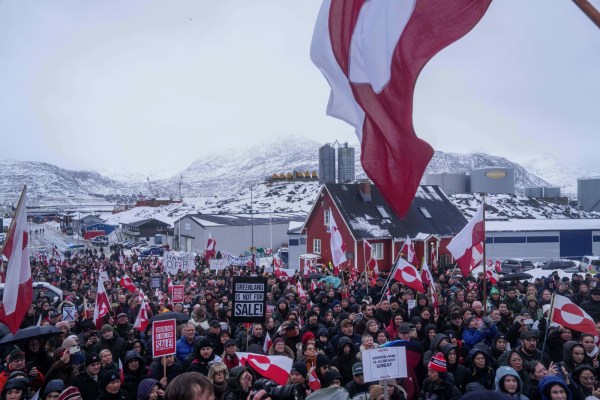 People protest against US President Donald Trump’s policy towards Greenland in front of the US consulate in Nuuk, Greenland, on January 17, 2026. Photo: AP/Evgeniy Maloletka/File
Today, with economic and security dimensions becoming increasingly interwound, there is a considerable overlap between geoeconomic and geostrategic interests. For the US, the diversification of critical mineral supply chains has emerged as a national security imperative, given China’s domination of the global rare earth ecosystem. Interestingly, minerals have not been mentioned prominently in the agreement, the focus being primarily on security.
Possibly, there could be a separate arrangement to cover the economic and investment dimensions, which would create greater space for US commercial involvement and resources management. It will also be in Greenland’s interest that enhanced security also brings greater economic opportunities and developmental avenues.
The Greenland issue had created an extraordinary situation within NATO, as the US was coercing fellow members to gain control over the territory. The new arrangement offers a reconciliatory alternative to resolve the dilemma. NATO has welcomed the agreement, as it contributes to security and stability of the Arctic region. Denmark has insisted that Arctic security should remain the shared responsibility of NATO, rather than exclusively a US preserve. This pact will integrate US capabilities into the NATO framework, thus strengthening collective deterrence.
The Greenland framework symbolises a marked conceptual shift. The US gets access to a long-term guaranteed security arrangement without formal acquisition or legal and geopolitical repercussions. Denmark retains territorial integrity, besides securing American commitment for Arctic security. For Greenland, the pact provides opportunity to leverage its strategic significance for greater politico-economic gains, while navigating the competing external interests.
Story continues below this ad
During his address to the United Nations General Assembly (UNGA) on Tuesday (September 22), Trump dwelt on the Greenland pact. In his speech, he stated that the US will be setting up two major military bases in Greenland and extending its footprint in the Arctic and North Atlantic, which will protect Europe and America besides enhancing NATO capabilities.
What next
The agreement was signed on the sidelines of the UNGA after Trump’s address the same evening. The pact requires formal ratification by the parliaments of Denmark and Greenland, before taking full legal effect. The Danish and Greenlandic leaders have emphasised that the framework respects local self-determination and territorial integrity.
The Greenland deal opens a new chapter for the great power strategic competition in the Arctic region. How NATO cohesion, Greenland’s sovereignty and a rules-based order in the Arctic play out will determine the pact’s durability.
The author is a war veteran, former Assistant Chief, and served as Defence Attache in China, North Korea and Mongolia. He is currently professor at Lal Bahadur Shastri Institute of Management.



Apple Pay comes to India after 12 years: How it works, what users need to know
By Sohail Khan · 30 Sep
Leave a Reply