Double standards in US sanctions law: No Russian oil for others, exception for its own uranium imports
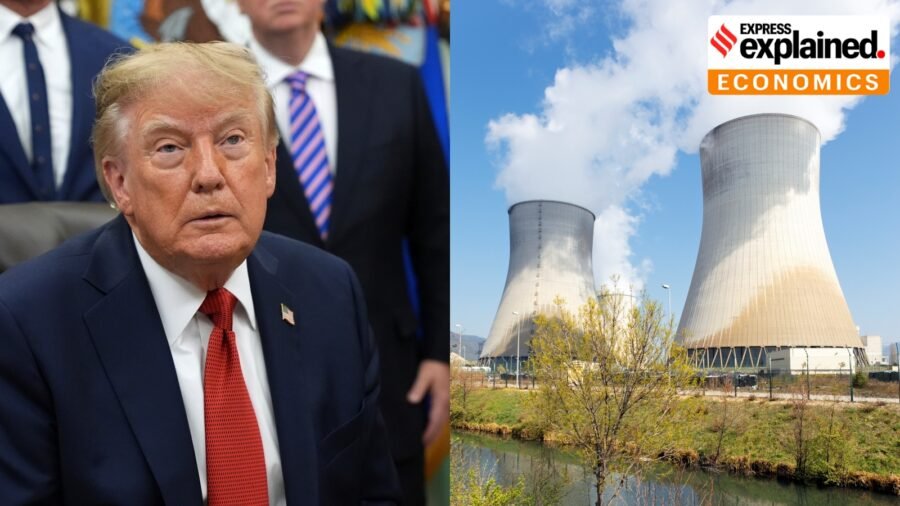
US President Donald Trump Friday signed into law the ‘Lindsey O. Graham Sanctioning Russia and Iran Act of 2026’, giving himself the authority to impose tariffs of up to 100% on top importers of Russian oil and gas, such as China and India.
The law is designed to squeeze Russia’s energy revenues amid its war in Ukraine. But it also creates an exception to ensure that the US can continue to import from Russia a material that is crucial for its nuclear power industry — uranium.
“Exception for certain imports of low enriched uranium for nuclear reactors – this title shall not apply with respect to imports into the United States of low-enriched uranium described in paragraph ..” the law says.
Story continues below.
Subscribe to see fewer ads.
This lays bare the central contradiction at the heart of the US’s words and actions against Russia. As Washington forces developing countries to move away from Russian oil, it is also steadily increasing its uranium imports from Russia — even after the Ukraine war.
Russia is one of the US’s biggest sources of enriched uranium. In 2025, the US imported enriched uranium worth $1.02 billion from Russia, or 23.42% of its total enriched uranium imports for that period, according to data from US International Trade Commission (USITC).
Since the Russia-Ukraine war began, US imports increased by 23.75%, from $829.75 million in 2022 to $1.02 billion in 2025.
Apart from Russia, other countries from which the US imported enriched uranium in 2025 include UK at $1,352.72 million, France at $886.47 million, the Netherlands at $648.68 million, Germany at $307.65 million, China at $118.48 million, Japan at $30.59 million and Belgium at $12.61 million.
What does enriched uranium mean?
Story continues below this ad
Uranium found in nature consists largely of two isotopes — U-235 and U-238. Natural uranium contains 0.7% of the U-235 isotope, while the remaining 99.3% is mostly the U-238 isotope, which does not contribute directly to the fission process.
Energy production in nuclear reactors comes from the “fission”, or splitting, of U-235 atoms, which releases energy in the form of heat. Since natural uranium contains only 0.7% U-235, LWRs require uranium to be “enriched” — which means raising the concentration of U-235 relative to U-238 to sustain a fission chain reaction.
US dependence on Russian uranium
According to the US Energy Information Administration, the existing US commercial fleet of 96 large light water reactors requires about 2,000 metric tonnes of uranium (MTU) of low-enriched uranium per year, representing approximately 15 million Separative Work Units — the standard unit of measurement that represents the amount of effort or work needed to separate uranium isotopes during the uranium enrichment process.
This is because nuclear reactors in the US are based on light water reactor (LWR) technology, which uses light water, or ordinary water, to cool and moderate the reactor. These LWRs require low-enriched uranium in its fuel, in which uranium is enriched from 0.7% to 3-5% U-235. This is mainly because light water absorbs some neutrons that would otherwise sustain fission.
Story continues below this ad
But the US itself has very limited enrichment capacity and depends heavily on imports to run its 98 gigawatt-electric nuclear fleet comprising 96 LWR reactors.
With respect to LEU supply, in 2024 the US imported about 81% of the LEU needed to meet commercial nuclear power demands according to the US Energy Information Administration, and about 20% of total U.S. LEU demand was sourced from Russia that year. Global uranium enrichment capacity is also highly concentrated. According to the International Energy Agency, 99% of the global enrichment capacity is concentrated in four suppliers, with Russia accounting for 40% of global enrichment capacity.
Others include China National Nuclear Corporation at 15%, Urenco, a British-German-Dutch consortium, at 33%; and France’s Orano at 12%.
India’s purchase of Russian oil
The Ministry of External Affairs (MEA) said on Thursday that the government remains committed to ensuring the nation’s energy security “through diversified sourcing and based on evolving market dynamics”. It said in a statement that the proposed legislation’s implications for the India-US relationship as well as the global energy market have been flagged in discussions with US representatives.
Story continues below this ad
Experts said that for New Delhi, meaningfully reducing Russian oil imports is just not an option in the prevailing circumstances of global energy supply tightness amid the West Asia crisis. Even for Washington, taking away millions of barrels of Russian oil from the global market when energy flows from West Asia remain highly constrained wouldn’t be prudent.
According to vessel tracking data from commodity market analytics firm Kpler, India imported 2.08 million barrels per day (bpd) of Russian oil in August, accounting for 45% of the country’s total oil imports. The share was even higher, at over 50%, in the preceding two months.

Six Indian animals that spend most of their lives underground
By Sohail Khan · 19 Sep
As Trump gets 100% tariff power, why India will find it tough to cut Russian oil imports
By Sohail Khan · 19 Sep
How are noisy celebrations and DJs affecting the hearing of humans?
By Sohail Khan · 19 Sep
Leave a Reply