As Trump gets 100% tariff power, why India will find it tough to cut Russian oil imports
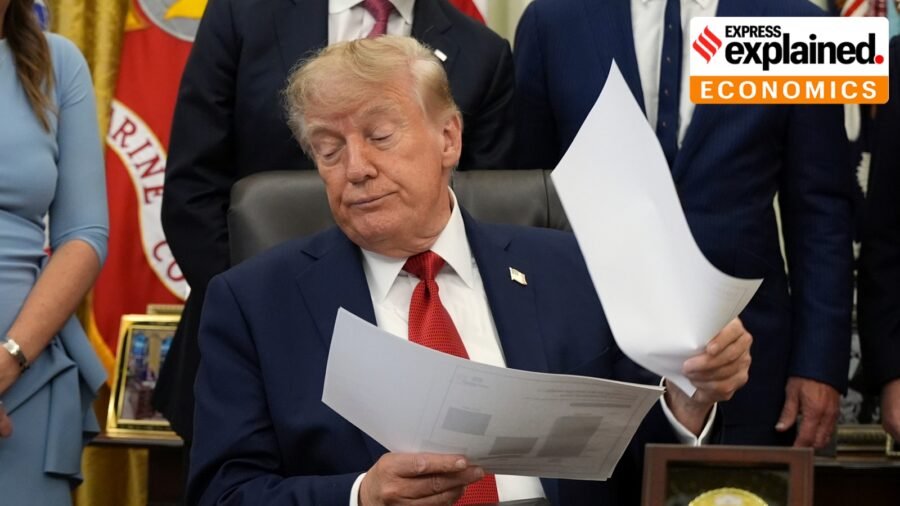
US President Donald Trump Friday signed into law the ‘Lindsey O. Graham Sanctioning Russia and Iran Act of 2026’, that gives him the authority to slap tariffs of up to 100% on countries, including India and China, that are buying Russian oil and gas.
For India, the development is significant. The country depends on imports to meet over 88% of its crude oil needs, and Russia currently accounts for nearly half of these imports. It remains to be seen how the Trump administration implements the legislation’s provisions, given the prevailing energy market crisis amid the West Asia conflict, which has now expanded to Bab el-Mandeb from the Strait of Hormuz.
The legislation allows imposing tariffs of up to 100% on top five buyers of Russian oil and natural gas, against the blanket proposal of a 500% tariff on buyers of Russian energy in the original bill that was floated last year. While this reduction in proposed tariffs appears meaningful on paper, the cap is still too high for India, which is also working to finalise a trade deal with the US.
A precarious energy market
Story continues below.
Subscribe to see fewer ads.
Importantly from New Delhi’s point of view, the new bill does give powers to the US president to waive the application of its provisions. India would almost certainly push for waivers, and it would make sense for the US to agree as a friendly concession, especially given how serious the situation is for New Delhi, according to analysts and experts. Meaningfully reducing Russian oil imports is just not an option for New Delhi amid the West Asia crisis that has squeezed global oil supplies. Even for Washington, taking away millions of barrels of Russian oil from the global market at a time like this wouldn’t be prudent.
Notably, Trump called on Ukraine earlier this week to halt strikes on Russian refineries, given the runaway oil and petroleum product prices amid stifled supplies in the global market. So will he now risk taking more Russian oil off the market by imposing punitive tariffs on countries buying Russian crude in large quantities? At least till the West Asia crisis persists, Trump might want to exercise restraint and caution in implementing the proposed legislation in full force.
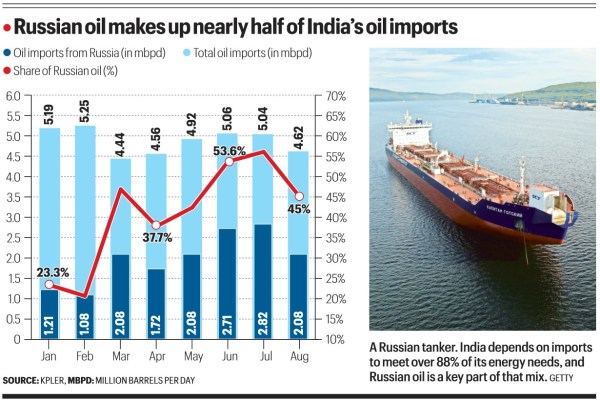 Russian oil makes up nearly half of India’s oil imports.
Doing the opposite would worsen an already worrying supply situation and send oil and fuel prices soaring even higher, something that the Trump administration wouldn’t want ahead of the midterm polls in the US. On its part, India would most certainly move to communicate its energy concerns to Washington, something that was done last year as well when the original draft of the Bill was mooted.
India has been in touch with US authorities over the legislation. A statement by the Ministry of External Affairs on Thursday said: “This issue has been discussed at high levels in recent months with various US interlocutors. Its potential implications for not just the bilateral relationship but also the international energy market have been very clearly articulated by the Indian side.”
Story continues below this ad
“The Indian side has also made clear its determination to take all necessary measures to protect its trade and economic interests. Government will work closely with Indian trade and industry bodies to deal with the implications of these developments,” the MEA added.
Russian crude and India’s oil import slate
With much of the West shunning Russian crude following the country’s February 2022 invasion of Ukraine, Russia began offering discounts on its oil to willing buyers. Indian refiners were quick to avail the opportunity, leading to Russia—earlier a peripheral supplier of oil to India—emerging as India’s biggest source of crude, displacing the traditional West Asian suppliers.
Russian oil proved to be a strong energy security hedge amid the West Asia crisis, as oil flows from the Gulf dried up. About 40% of India’s crude imports usually came through the Strait of Hormuz before the war, and a large chunk of that supply has effectively been offline due to the highly constrained energy flow through the waterway.
Analysts say that despite the threat of sanctions, Russian crude remains the most practical and competitive source of supply for Indian refiners and is extremely difficult to replace in the current market. According to vessel tracking data from commodity market analytics firm Kpler, India imported 2.08 million barrels per day (bpd) of Russian oil in August, accounting for 45% of the country’s total oil imports. The share was even higher, at over 50%, in the preceding two months.
Story continues below this ad
In the months preceding the West Asia war, oil imports from Russia had reduced notably as the US imposed sanctions on Russian oil majors Rosneft and Lukoil, and amid trade pact negotiations between New Delhi and Washington. The US made a meaningful reduction in Russian oil imports a prerequisite for scrapping its 25% additional penal tariff on India. In February, Indian refiners had imported just over 1 million bpd of Russian crude, almost half of the 2025 peak of over 2 million bpd. Even with the significant reduction in volumes, Russia was India’s largest source of crude in February, accounting for about fifth of its total oil imports.
But as supplies from West Asia dwindled due to the effective closure of the Strait of Hormuz, Russian oil came to India’s aid and volumes surged to historic highs. The US itself issued sanctions waivers on purchase of Russian crude amid the West Asia conflict.
India’s crude import strategy has shifted sharply since March 2026 as Strait of Hormuz disruptions tightened West Asian oil flows and increased freight risks. While Russian crude remains the backbone of India’s import slate, refiners have diversified aggressively towards African, North American, and South American barrels to offset the drop in supplies from the Gulf. Interestingly, oil imports from Venezuela in August jumped 60.2% over July to 350,000 bpd, the Kpler data shows.


Six Indian animals that spend most of their lives underground
By Sohail Khan · 19 Sep
How are noisy celebrations and DJs affecting the hearing of humans?
By Sohail Khan · 19 Sep
Leave a Reply