Dis/Agree | In Satya Niketan, a tragedy but not an anomaly

The collapse of a building in Delhi’s Satya Niketan has brought to the forefront the failure of planning and regulation by development authorities and landowners. While the loss of lives and the apathy of those responsible is rightfully receiving attention, little of it is diverted to preventing similar occurrences in urban villages and unauthorised colonies, which are the only source of supply of “accessible” small-format housing in the Delhi-NCR.
Small-format housing is a shared accommodation and can range from a studio, a one RK (room and kitchen) unit, a one-BHK unit, small two-BHK units, or assisted units. For students, young professionals, nuclear families, senior citizens (either living alone or only with a spouse) and even persons with disabilities, from lower to upper-middle income brackets, such units are practical, thus in high demand for both ownership and rental. These are the backbone of a developed economy (look at the role of social housing in the Netherlands). But where are they?
Advertisement
Let’s understand the predicament of the most vulnerable groups, in dire need of small-format housing. Students without allocated hostels need accommodation close to their educational institute to avert the inconvenience and cost of travel. Young graduates need affordable accommodation near offices and may pay a cost marginally higher than students pay for the same conveniences. For women, security considerations override all other conveniences, and securing housing is tougher (and expensive), irrespective of their willingness to pay. Nuclear families and senior citizens prefer to stay close to their desired school and healthcare facility. They pay a higher price ranging from Rs 25,000 to Rs 75,000 per unit of similar housing typology. They may get accommodation in planned parts of Delhi. Any less is always in unregulated areas. The hardships of securing respectable shelter for people with disabilities, foreign visitors, and minorities deserve a separate chapter.
The Master Plan for Delhi (MPD-2047) is responsible for ensuring supply, regulating circle rates, and ensuring sustainable development through public or private developers. The MPD-2047 says, “Nearly 85 per cent of the city’s population belongs to low and mid-income segments. The high cost of land in the city has resulted in unaffordable housing which has led to proliferation of unauthorised colonies (UCs), slums, and densification of urban villages. Around 28.4 per cent of the households live in rental accommodation (Census, 2011). 32.3 per cent of the population are migrants (Socio-Economic Survey of Delhi, GNCTD, 2018-19) who prefer rental housing due to low entry and exit costs. Most of this rental housing demand is being catered by unplanned settlements.” The document also highlights the huge deficit in the provision of different housing formats, especially the small-format affordable ones.
But let’s look at the regulations for small-format housing in the MPD-2047. Such formats will get a maximum floor area ratio (FAR) of 300, ground coverage of 40, minimum plot area of 2000 sqm and a minimum right of way of 12m. On the one hand, the ground coverage and FAR make development of small-format housing unviable and on the other, identifying a land parcel of 2000 sqm or even undertaking land pooling, where required, is a Herculean task. This encourages illegal developments like Satya Niketan to thrive.
Advertisement
The MPD-2047 discusses involvement of the private sector through proposed redevelopment, land pooling and other provisions at length. The private sector has been eager to venture into this category of housing in Delhi. In theory, by increasing the variety of products, the private sector should have attracted a larger pool of end-users while boosting business.
The private sector, like in any other city, has been voicing the need for suitable regulations, location and fiscal tools to provide for the increasing demand for small format housing. For example, apart from allocation of land at suitable locations for such units, the development regulations need to allow higher ground coverages, ease of amalgamation/sub-division of land, ease of mixed-use, change of use, fiscal incentives in duties, and charges to ensure that the asset classes developed remain affordable for the actual end users.
The erstwhile Master Plan did allow plot amalgamation for group housing to improve housing stock and increase affordable units. So, the city got a King’s Court and Queen’s Court, “affordable” at Rs 25 cr per unit; or the Godrej housing in Okhla, with 2-5 BHK units starting at Rs 5.51 cr. The private sector cannot be blamed for this alone. The high cost of land development, the high Equivalent Car Space norms, the low Ground Coverage and the high “unforeseen” expenses make only a 3-BHK “sustainable” and even a small 2-BHK priced at a premium. Furthermore, the density regulations of plotted development disallow multiple-tenant housing per floor, forcing small developers to supply a 3-BHK and above.
Satya Niketan’s failure, therefore, is not a one-off case. It is a collective failure of planning and implementation.
The writer is a practising urban designer


40 years ago September 18, 1986: 177 killed in South African mine
By Sohail Khan · 18 Sep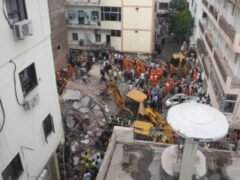

Leave a Reply