Diljit Dosanjh has made Punjabiness a global expression of pride
For years, the quickest, and perhaps the most fraught, way for Sikh men to make themselves less visibly Sikh in the Western world was to take off their turban and cut off their hair: A process of tucking away parts of themselves that marked them out. How Sikh could you be before someone began to stare? Or before that staring led to a slur or a racial stereotype? There was often a heightened awareness of how conspicuous they were. Thus, the aim, almost always, was to fit in.
Back home, giving up the turban was far more consequential than a change in one’s look. It was often understood as rejection of faith, of family and one’s history. The dastar and unshorn hair are sacred parts of the Sikh identity and are among the most visible expressions of the faith. They carry cultural, religious and, for many, emotional significance. It is not uncommon to hear stories about how such a decision leads to years of silence from families, causing much hurt.
Advertisement
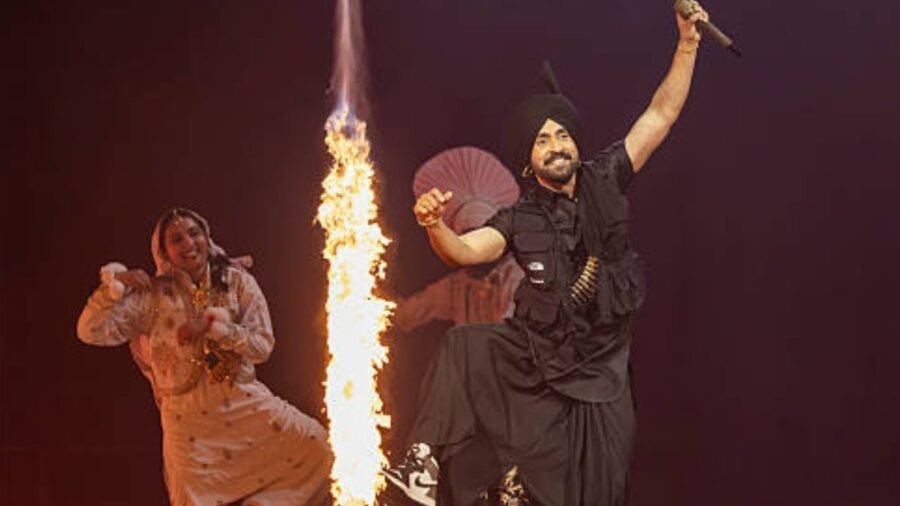
Then came Diljit Dosanjh in his turban, beard, kurta-chadra-kanthi (the traditional folk outfit), pairing it all with luxury sneakers and sparkling bullet belts or bandoliers representing traditional martial and warrior aesthetics, proudly crooning in Punjabi, speaking in Punjabi and making his Sikh identity inseparable from his image as a global star. It made people realise that he does not have to speak or sing in English to be a global popstar — that he can still command the biggest global stages, speak at the Recording Academy and attend the MET gala.
For many, what had once been a source of self-consciousness and baggage, was suddenly part of the charm of a unique identity. With Diljit’s rise, the story is changing. Now you can be stylish and Sikh. This is “wakhra swag” and it has the world pounding its limbs and singing along in turbans.
Which is why the spectacle at London’s Wembley Stadium last week, where Dosanjh performed, was a sight to behold, with so many people wearing the ‘Turlay wali pag’ (a turban) with a fan-shaped crest) now associated with him. Diljit — the first Punjabi artist to headline Wembley Stadium — had a “turban camp” at Wembley, where anyone and everyone, regardless of gender, nationality or ethnicity, could have a turban tied around their heads free of cost and become Punjabi for the night. There were people from India, Pakistan, Afghanistan and Bangladesh, among others, getting turbans tied. There were many from the Western world too, who happily stepped into this Punjabi-ness for the night to become a part of the celebration. Differences suddenly seemed to recede as swathes of cloth were folded and wound patiently around their heads.
Advertisement
What Diljit has done, then, goes beyond taking Punjabi music and culture to a wider audience. When he comes on stage and says, “Punjabi aa gaye oye”, as he did under the Wembley arch as well, it isn’t just a gleeful declaration to whip up a crowd; he’s talking about how the community has arrived on a global platform. It is to do with so many who may have spent years negotiating what it meant to be visibly Punjabi or Sikh. He has placed the refrain in the historical context too, while speaking of the Komagata Maru incident of 1914 when 376 Indian passengers were denied entry into Canada. They had to stay on the ship for nearly two months, even though they were desperate for food, water, and medical attention, before being sent back to India. Dosanjh spoke about this around the time he performed a sold-out show at Vancouver’s BC Place stadium. “You didn’t allow us to come, now we are here,” he had said on The Tonight Show with Jimmy Fallon.
There is a sense of saanjha Punjab (a shared Punjab) in that line, a Punjab whose shared heritage predates the Radcliffe Line, and whose songs have continued to travel without any visa. That connection came through powerfully at Wembley when Dosanjh sang ‘Saanso ki mala’ by Nusrat Fateh Ali Khan — the Pakistani singer’s paean to Krishna, penned by the 20th century Urdu poet Tufail Hoshiarpuri. Diljit, performing it in London — a melting pot of communities from the Subcontinent — was showcasing Punjab’s shared inheritance. He had reached into the repertoire of a Punjabi icon and was treating that music as part of the same cultural universe. He also sang ‘Laung gawacha’, a folk song both sides still sing. Many Pakistanis — Pashtuns and Punjabis, some in those turbans — heard and sang along, enchanted. His effort was not going to erase the borders that exist, but in that space, the hard lines were less important than the shared music.
There is a remarkable confidence in how Dosanjh has made his Punjabi identity inseparable from his music. What he has done with the turban — metres of cloth folded into a distinct entity — is also what he has done with Punjabi identity. He has taken its many strands and carried them to places where they were unfamiliar and ridiculed, and turned Punjabiness into something that others want to step into. That may well be one of his most enduring acts.
The writer is deputy associate editor, . suanshu.khurana@expressindia.com

104 and walking again: What made this centenarian a candidate for double knee replacement
By Sohail Khan · 19 Sep
At Asiad, all that glitters isn’t gold
By Sohail Khan · 19 Sep
Leave a Reply