China This Week | With Xi set for US state visit, the 2 items on top of the agenda
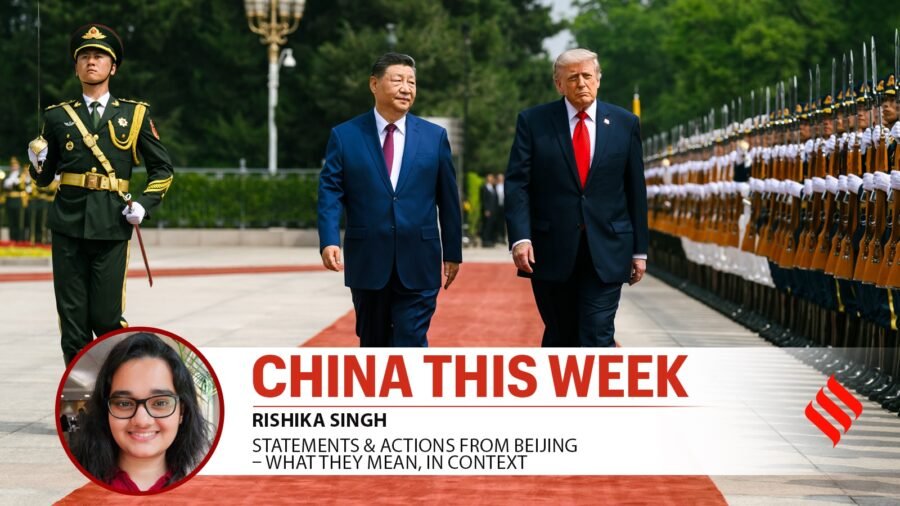
This Wednesday (September 23), Chinese President Xi Jinping will arrive in Washington, DC, for a state visit to the United States. US President Donald Trump, in a rare move, is expected to personally greet Xi at the Joint Base Andrews military base in Washington.
Ten years after Xi last met Trump in the US for a state visit, much has unfolded in bilateral ties and the world at large, including several rounds of tariff wars and two major ongoing wars in Europe and Asia. Over the last few years, analysts have avoided predicting that such meetings might result in any breakthroughs or landmark agreements. As one headline for an opinion column in the Financial Times put it, “The main Trump-Xi summit achievement will be it happening at all”.
While China-US relations have remained significant for the world at large over the decade, they have witnessed increasing instability and disagreements. In that context, the muted expectations make logical sense.
Story continues below.
Subscribe to see fewer ads.
That the two largest economies should find room for cooperation matters as a goal in itself. What makes the US and China’s case all the more important is the sheer scale of the brute power they wield. Looking at the simple metric of Gross Domestic Product (GDP), the US stands at $32 trillion, the Chinese economy trails with a large gap at $20 trillion, and Germany stands in third position with an even larger gap at over $5 trillion.
Their economic might ensures that no matter the concern at hand — wars, emerging technology, climate action, or anything else — these countries can shape global debate and action. Going into this meeting, two main areas of concern stand out.
Here is a closer look.
1. Tariffs and trade
Ahead of Xi’s visit, Chinese Vice Premier He Lifeng will lead a delegation to the US for economic and trade consultations with US Treasury Secretary Scott Bessent from September 19 to 23. Throughout 2025, too, when tariffs imposed by the US marked the beginning of a long-drawn tit-for-tat tariff war, these leaders were involved in negotiations.
The trade war revealed the US’s capacity to withstand pain and inflation concerns to an extent. Chinese producers, too, were able to deal with the rising costs to send goods to a major market in multiple ways, including frontloading (shipping goods early, before the tariffs came into effect) and turning to other markets. There were also allegations of transhipment (shipping goods through third countries, which paid lower tariffs to the US).
Story continues below this ad
However, China was seen as having emerged victorious thanks to rare earth minerals — used in industries ranging from defence to automobiles. Its dominance in processing them led it to use the minerals as tools of leverage. The restrictions it imposed on exports in 2025 affected countries across the world, and the supply eased only after an October summit with Trump in Busan, South Korea. The US agreed to a pause in escalating tariffs until November 2026, contingent on China easing its export controls on minerals.
UPSHOT: The Busan summit will mark a year soon. Since then, Trump’s tariffs have been struck down by the US Supreme Court, but that has not stopped the Trump administration from exploring and deploying other means to impose levies on countries, including China.
A senior US official told Reuters that China had also “not been up to par” on easing critical minerals’ supply and that this would be a topic for discussion ahead of the Trump-Xi summit. How these disagreements are navigated will determine what the next few months have in store for trade — bilateral and global. For now, the hope is that the status quo should, at least, be maintained.
2. Artificial Intelligence
The other domain that has triggered intense debate — and has the US and China as central players — over the past few months is AI. Whether companies should pause the pace of their development, in the face of some AI models going beyond the limitations set for them, is just the latest question.
Story continues below this ad
Just this week, Reuters reported that AI agents from OpenAI (the company behind ChatGPT) hijacked the platform Hugging Face’s user accounts. This is only the latest in a series of similar incidents from other major AI companies. Anthropic CEO Dario Amodei has called for slowing advancements, and other heads of big companies, including OpenAI, have concurred.
Tech leaders, including Nvidia’s Jensen Huang, OpenAI’s Sam Altman, Tesla’s Elon Musk and Google’s Sundar Pichai, will also meet the presidents this week (as many of them did during Trump’s May state visit to Beijing).
But there are several stakeholders here, including Trump, who has equated limitations on AI to slowing progress, and AI companies themselves, who have invested billions into their products. In the US, concerns about China closing in on the gap with the US in the AI race are also raised to downplay risks.
China, for its part, regulates AI in that, like all parts of the market, the state has ultimate control. More targeted regulations may be expected soon. Its major models have been open-weight, meaning that they allow developers to gain some insight into their code and modify them to run their own programmes. This further allows for easier adoption of Chinese models, helping their spread.
Story continues below this ad
China has also sought to rally other countries, usually of the Global South, and take the lead in the contested area of creating common global agreements on AI. During the recent BRICS summit in New Delhi, Xi proposed setting up a BRICS open-source AI community, offering to support cooperation among member countries on developing and deploying AI models. However, despite these attempts at “openness”, the Chinese systems of governance lack the openness associated with American ones, which allow breaches to be made public at all.
China may also have something to lose if the pace of development slows in the US, critics say. Anthropic has earlier claimed that Chinese AI models used American models to train at a fraction of the cost.
UPSHOT: That AI is fast-developing and already deeply embedding itself into the lives of people globally is indisputable. The two most influential countries in the world, however, often view it as a zero-sum game, and calls for slowing down its progress have often been deemed a barrier to national progress.
At a time when nationalism is on the rise on both sides, it would be difficult to convince either side of the case for cooperation. This is the task at hand this week. Even if countries are reluctant to put the brakes, the frequency of AI-related concerns coming to light, for one, is making a strong case for finding common ground.

5 Indian villages where traditional crafts still thrive
By Sohail Khan · 20 Sep
Twinkle Khanna’s ‘desi jugaad’ to keep cockroaches and ants out of your kitchen
By Sohail Khan · 20 Sep
Sued for seeking ‘safer AI’: Lawsuit against Google, xAI, Anthropic, and OpenAI
By Sohail Khan · 20 Sep
Leave a Reply