BRICS New Delhi Declaration: Key takeaways on tariffs, terrorism, West Asia war, and more
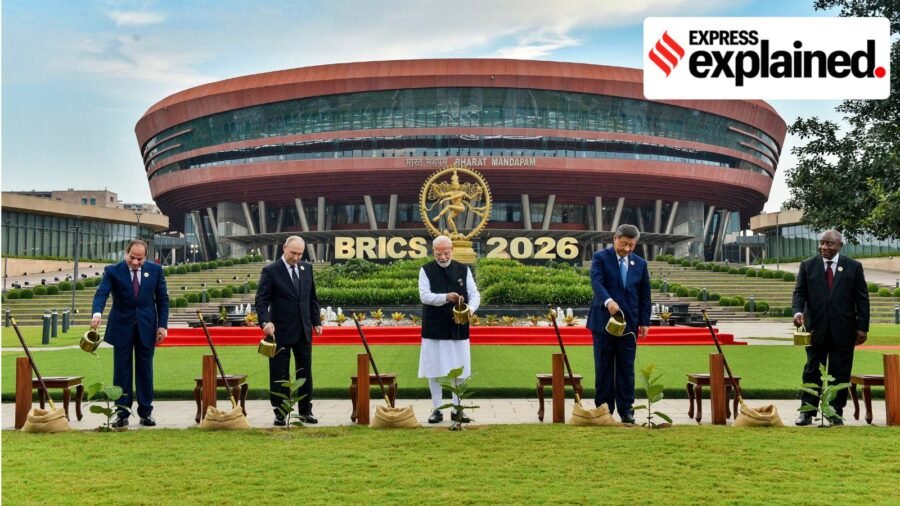
The BRICS grouping on Saturday (September 12) adopted the New Delhi Declaration, laying out common positions on issues ranging from trade and terrorism to artificial intelligence and institutional reform.
Set against the backdrop of tariffs, trade tensions, and geopolitical fragmentation, the grouping expressed its opposition to unilateral trade restrictions amid efforts to ease cross-border payments and investments across BRICS countries.
The declaration also contained several India-specific outcomes, from harsher language on cross-border terrorism to new cooperation mechanisms spanning digital public infrastructure, health and finance.
Story continues below.
Subscribe to see fewer ads.
Reaching consensus was itself significant. BRICS foreign ministers had failed to issue a joint statement in May amid differences between Iran and the UAE, and diplomats had spent the run-up to the summit trying to find language on the conflict that both countries could accept. The final declaration reflects that balancing act, addressing the wars and tensions across West Asia without directly assigning responsibility to individual countries.
Here are the key takeaways.
1 – Pushback against unilateral tariffs and restrictive trade measures
Since early 2025, United States President Donald Trump has announced a series of escalating tariffs against several US trading partners to extract concessions from them and correct a perceived imbalance — and “return” money — to the US.
The declaration expresses its condemnation of “unilateral coercive measures” which are contrary to international law and the United Nations Charter, and calls for their elimination.
While the BRICS declaration does not name the US president — who has famously attacked the grouping and called it “anti-American” — the grouping acknowledges its role as a collective affected by such “unjustified unilateral protectionist measures”. This language positions BRICS as a collective counterweight to the growing use of trade and financial restrictions by major Western economies.
Story continues below this ad
“We acknowledge that BRICS members represent a broad diversity of societies and civilisations that are affected differently by unjustified unilateral protectionist measures inconsistent with WTO rules, and that BRICS should focus on promoting a just and fair, stable and predictable environment for mutually beneficial sustainable development,” the statement said.
The language also stops short of announcing a retaliatory trade mechanism.
The declaration also addresses climate-linked trade policy, explicitly opposing carbon border adjustment mechanisms when they are unilateral, punitive, discriminatory or protectionist.
2 – Strong condemnation of terrorism, especially Pahalgam attack
The declaration expresses its commitment to combating terrorism in “all its forms and manifestations”.
Story continues below this ad
In a significant diplomatic victory for India, the declaration specifically condemns in the “strongest terms” the April 2025 terrorist attack in Pahalgam in Jammu and Kashmir, in which 26 people were killed, and several others were injured.
The declaration also singles out the cross-border movement of terrorists, terrorism financing and safe havens, while expressing zero tolerance for terrorism and rejecting double standards in countering terrorism.
India has long sought international recognition of cross-border terrorism as a distinct security challenge. This language is particularly notable because BRICS operates by consensus and includes China, whose position on Pakistan-based terrorists at the UN has at times differed from India’s.
The declaration also reiterated that terrorism is not to be associated with any specific religion, nationality, civilisation, or ethnic group, and called for closer international counter-terrorism cooperation. In this light, it acknowledged the cooperation among member nations as part of the BRICS Counter-Terrorism Working Group (CTWG), the BRICS mechanism for coordinating counter-terrorism cooperation.
Story continues below this ad
It identified extremism and radicalisation among the younger generations as a specific issue that needed to be addressed.
3 – Common ground on the war in West Asia
The presence of Iran and the United Arab Emirates, two sides that have found themselves on competing sides of the war in West Asia, raised concerns about finding a consensus.
Against this backdrop, the declaration expresses “deep concern” over the escalation of tensions across West Asia and calls for maximum restraint and the resolution of disputes through dialogue and diplomacy. Without assigning responsibility to individual countries, it condemns attacks on civilian infrastructure and safeguarded nuclear facilities, while stressing the importance of maintaining uninterrupted trade, supply chains and energy flows.
The declaration also expressed grave concern over the humanitarian situation in Gaza and the Occupied Palestinian Territory. It calls for maintaining the Gaza ceasefire and unhindered humanitarian access, and opposes forced displacement of Palestinians. It condemns all such violations of international human rights law, including the use of starvation as a method of warfare, attacks targeting civilians and civilian objects, including healthcare facilities and other civilian infrastructure, and the unlawful obstruction of humanitarian access.
Story continues below this ad
The declaration affirmed its support for UNRWA and noted the International Court of Justice’s provisional measures in South Africa’s case against Israel, which reaffirmed Israel’s legal obligation to ensure the provision of humanitarian aid in Gaza.
The declaration also reiterated the group’s support for a two-state solution, with a Palestinian state within the 1967 borders, with East Jerusalem as its capital.
The declaration also called on Israel to adhere to the Lebanon ceasefire and for Israeli withdrawal from remaining Lebanese territory, as well as an inclusive political transition in Syria.

‘I get drunk messages between 2 and 4 am’: Bhuvan Bam on how his comedy helps people cope
By Sohail Khan · 12 Sep
The story of the iconic 1,212-pillar temple corridor that framed the Modi-Xi handshake
By Sohail Khan · 12 Sep

Leave a Reply