Acharya Nagarjuna University has emerged as a leader in innovation and entrepreneurship, says Andhra Pradesh Governor
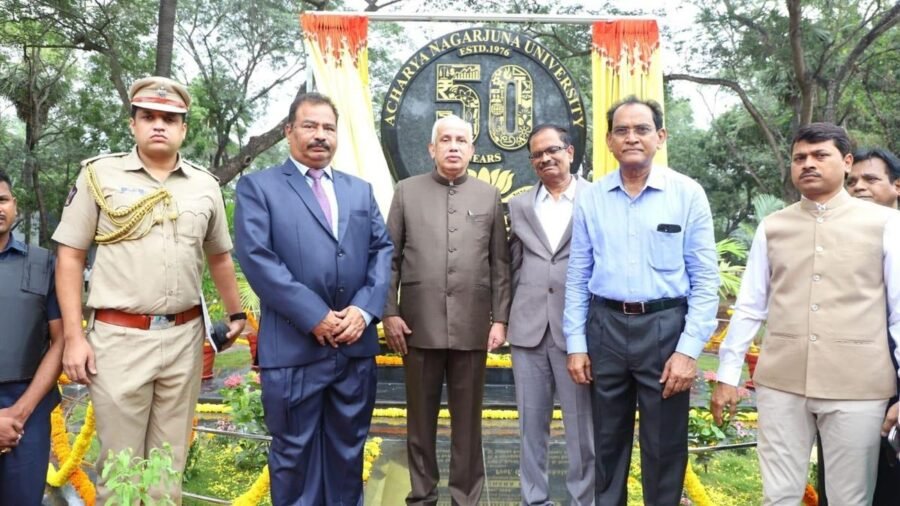
Acharya Nagarjuna University has been providing quality higher education to students of coastal Andhra Pradesh for the past five decades, Andhra Pradesh Governor and Chancellor S. Abdul Nazeer said on Friday.
Addressing the ANU Golden Jubilee celebrations on the university campus, Mr. Nazeer said the institution, which began as an Andhra University Postgraduate Centre in 1967, came to be known as Nagarjuna University on September 11, 1976. Envisioned as a meeting point between India’s traditional knowledge and modern scientific disciplines, the university was set up under Act No. 43 of 1976 of the Andhra Pradesh Legislative Assembly. It was named after Buddhist philosopher Acharya Nagarjuna, he said.
“Since its inception, the university has grown substantially in teaching, research and infrastructure through the efforts of successive administrators. Teaching and research are the university’s two eyes. The university has emerged as a leader in innovation, skill development and entrepreneurship too,” the Governor said.
Appreciating the university’s rankings and accreditation, he said curriculum changes in line with industry requirements would help students.
Andhra Pradesh State Council of Higher Education interim Chairman Acharya Vijaya Bhaskar and Vice-Chairperson Acharya K. Ratna Sheela Mani appreciated the university’s progress.
Vice-Chancellor Acharya K. Gangadhara Rao presented a report on the university’s five-decade journey. Rector Acharya Siva Ram Prasad also spoke on this occasion.
The Governor unveiled the Golden Jubilee memorial and a souvenir documenting the university’s achievements. The Vice-Chancellor felicitated him. Registrar Acharya Simhachalam, governing body members, faculty, staff, researchers and students attended the programme.
ANU former Joint Registrar Vasa Manikyala Rao told that the demand for a university in the region gained momentum in the 1950s, when students from Guntur and Krishna districts faced difficulties travelling far to other universities in united Andhra Pradesh. “Kala Prapurna Vavilala Gopalakrishnaiah had proposed a postgraduate centre in Guntur during the Andhra University Senate meeting in 1956,” he said.
The foundation stone for Arts Block-I was laid by Acharya Vuppalapati Balaiah, the first Vice-Chancellor of Acharya Nagarjuna University, on October 15, 1976.
Special Arrangement
Later, an Andhra University postgraduate centre was set up at NBTS Polytechnic College, Nallapadu, with nine PG courses. The courses were conducted there for nine years, along with an academic block at AC College, Guntur, Mr. Manikyala Rao said.
Later, 300 acres were acquired at Kaja-Nambur due to its proximity to Vijayawada, Guntur and Tenali. Infrastructure development followed. Mr. Manikyala Rao said the PG centre received autonomous status in 1976 on the recommendations of Prof. Santappa Committee, with Prof. Vuppalapati Balaiah serving as the director.
The name Nagarjuna University was changed to Acharya Nagarjuna University through an Ordinance in 2004.
From 1991, the university undertook reforms, established new departments and strengthened existing ones. Its jurisdiction has now expanded to over 400 colleges offering courses in arts, science, commerce, management, education, law, engineering and professional disciplines. Two PG centres were set up at Ongole and Nuziveedu.
The university promotes research and innovation, receiving support under UGC, RUSA, DST, ICSSR and CSIR. Its Central Library has been modernised with books, journals, research publications, e-resources and electronic databases.
Greater autonomy subsequently enabled curriculum redesign, innovative courses and modern evaluation systems, attracting students from 16 countries.
ANU has received A+ accreditation from NAAC and, secured 20th position nationally and second position in Andhra Pradesh in the NIRF rankings. As it enters its Golden Jubilee year, the university remains committed to excellence, research, skill development, ethical values and social responsibility.

Nadda highlights need for a resilient healthcare system
By Sohail Khan · 12 Sep
Noted theatre personality Chidambararao Jambe passes away
By Sohail Khan · 12 Sep
Leave a Reply