BKC’s pod taxi ‘economically inefficient’: 129 architects register opposition
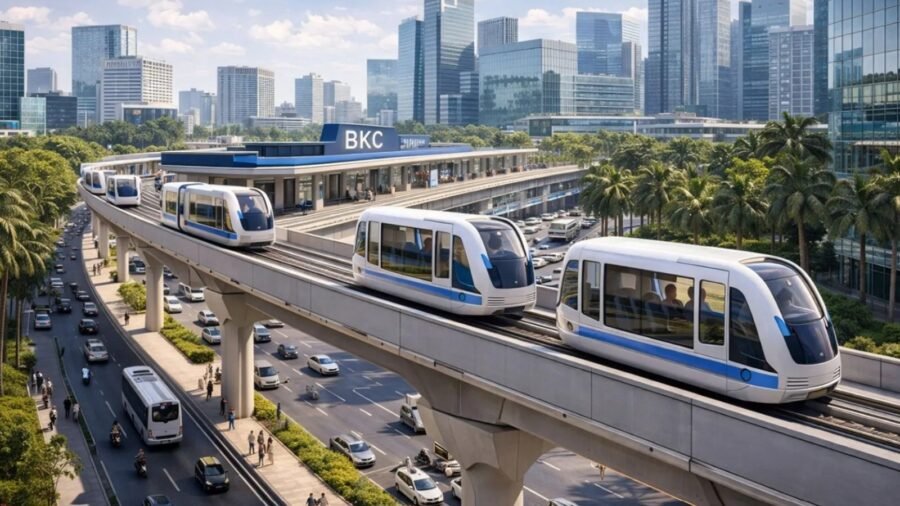
As work continues on the Bandra Kurla Complex’s (BKC) pod taxi, connecting Bandra to Kurla, prominent architects recently wrote to metropolitan commissioner Sanjay Mukherjee to reconsider the Rs 1,016 crore project, calling it “economically inefficient” due to its “low capacity”.
Signed by several prominent architects, including Brinda Somaya, Rahul Kadri, PK Das, Vivek Pai, Vikas Dilawari, Abraham John, and Nondita Correa Mehrotra, it says, “At a projected fare of approximately Rs 21 per kilometre, the Personal Rapid Transit System operates as an exclusive, high-cost transit mode rather than an inclusive mass transit solution.”
“Spending over 1,016 crore on a low-capacity system (4-6 passengers per pod) that caters primarily to a limited demographic is economically inefficient. Also, this decreases the carrying capacity of the roads below,” the architects under the Mumbai Architects Collective wrote.
Story continues below.
Subscribe to see fewer ads.
Requesting a meeting to discuss the pod taxi project, the Collective detailed several construction-related environmental concerns, including dumping debris in Bandra East’s Urban Plaza and City Park and damaging tree cover along road medians and through mangroves.
Construction of the first phase of BKC’s pod taxi started in May, with around 140 piers underway. The first phase will cover 3.36 km, with two disconnected arms from Bandra East and Kurla, each covering four stations.
These include Bandra East, Kalanagar, MMRDA Old Building, Excise Department from Bandra East, and Bharat Diamond Bourse Gate 11, MMRDA Pay & Park, LBS Marg, and Kurla, due by the end of 2027.
Work on the ground has only begun in Bandra East due to monsoon and traffic complications.
Story continues below this ad
Residents have flagged that the Urban Plaza and City Park, a public open space, has been barricaded and is being used like a “civil dump yard and equipment staging area” for the construction; and that the project stands to affect 499 trees along the road medians.
Additionally, 041 hectares of mangroves may also be cut for the project.
The architects wrote, “Excavations along road medians threaten local trees and fail to mitigate localized microclimate disruptions, loss of canopy coverage, and ‘Urban Heat Island’ escalation in BKC,” questioning the need for the low-capacity pod taxi.
Mumbai’s prime business district, BKC, sees footfall of four to six lakh people every day – and it is expected to grow with the start of the bullet train.
Story continues below this ad
The MMRDA estimates that the pod taxi will carry 1.09 lakh passengers by 2031. Now, urban planners and transport experts have pointed out that high ridership would not solve the traffic problem in BKC.

Trump’s Big Move Amid 100% Tariff Bill: Why Is The US Buying Uranium From A Country At War?
By Sohail Khan · 18 Sep
Asian Games 2026: Manu Bhaker, Tajinderpal Toor Named Flag-Bearers For Opening Ceremony
By Sohail Khan · 18 Sep
Leave a Reply