AI can create a work, but can it be its author? Why the Copyright Office drew the line
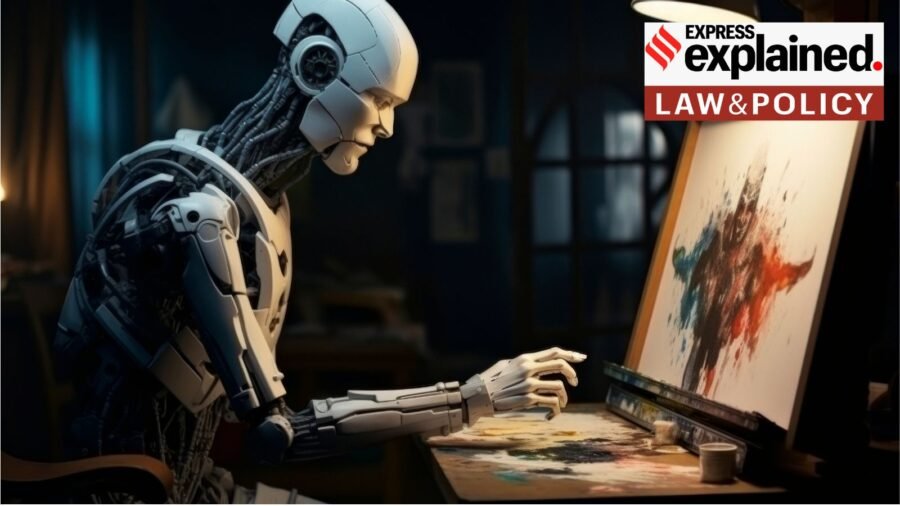
Can AI companies use copyrighted material to build their systems? And can something an AI creates be copyrighted in turn?
The Copyright Office answered the second question on August 31, rejecting an application filed by American computer scientist Stephen Thaler seeking copyright registration for an artwork generated by his AI system, DABUS.
The Office found the artwork original because nothing on record showed it was copied from any specific existing work, not because AI-made works are inherently original. And the human-authorship requirement doesn’t disappear either. Even if a work is original, someone still has to be identifiable as the person who “caused” it to be created.
Story continues below this ad
It said that the person who creates something “refers to the person who brings about, or is responsible for, the coming into existence of the work. The emphasis is upon responsibility for the work’s origination, rather than upon the instrument, mechanism or tool through which its final expression is generated.”
The order is among the first decisions in India to address a question that is becoming increasingly important: if an AI system generates a work, who, if anyone, is its author?
What was the case about?
The case pertained to an artwork titled “A Recent Entrance to Paradise.” In 2022, Thaler applied to register copyright in the work. According to him, the artwork had been generated autonomously by DABUS, or “Device for the Autonomous Bootstrapping of Unified Sentience”, an AI system that he had developed.
The application identified DABUS as the author and Thaler as the owner of the copyright.
Story continues below this ad
The Copyright Office objected to the application. Over several rounds of correspondence and hearings, it asked whether an AI system could legally be recognised as an author under the Copyright Act. It also asked who should be treated as the author if the work was indeed generated using AI.
During the proceedings, the Office allowed Thaler to amend the application and identify himself as the author. He declined and continued to insist that DABUS should be recognised as the author of the work.
What the law says
The Copyright Act answers three separate questions – whether a work is original, who its author is, and who owns the copyright.
The first question comes from Section 13 of the Act, which protects original literary, dramatic, musical and artistic works. Since the Act does not define “originality”, the copyright office interprets it from the Supreme Court decision in Eastern Book Company v D.B. Modak. In that case, the Supreme Court held that a work does not have to be novel or groundbreaking to receive copyright protection. However, it must show at least a minimum degree of creativity and cannot merely be copied or mechanically reproduced.
Story continues below this ad
On the question of authorship, Section 2(d)(vi) identifies an author of computer-generated works as “the person who causes the work to be created.”
In the present case, the dispute was over the meaning of that phrase. Thaler argued that DABUS itself generated the artwork and should therefore be recognised as its author. The Copyright Office had to decide whether the provision refers to the machine that produces the final output or the person responsible for creating and operating that system.
Section 17 states that the author is generally the first owner of the copyright, whereas Sections 18 and 19 allow copyright to be assigned or transferred through legally recognised agreements. “Where the person claiming ownership differs from the person identified as the author, the claimant must either establish that the case falls within one of the express exceptions to Section 17, or demonstrate a valid assignment satisfying Sections 18 and 19,” the order said.
The Office noted that these provisions are built around legal persons who can hold rights, transfer them and enforce them. That became an important consideration in deciding whether an AI system could be treated as an author.
What did the Copyright Office decide?
Story continues below this ad
On originality, the office ruled in Thaler’s favour. It found that the image generated by the AI was original enough to qualify for copyright protection.
It says that “the work must not be copied from another existing work and must contain an exercise of skill and judgement that is not so trivial as to be purely mechanical” and that “the expression must reflect some non-trivial creative character and must not be the product of an entirely mechanical or purely routine exercise.”
On authorship, the Office said that the Copyright Act treats authorship as a legal status that carries rights and responsibilities. An AI system, however sophisticated, does not presently possess such legal recognition under Indian law.
It said that “the fact that a computer or AI system generates the final output does not place an editor, publisher, printer, camera, framing expert or rendering software at a higher pedestal and make them as author merely because each plays an indispensable role in the ultimate production of the work.”
Story continues below this ad
To interpret who “causes” a computer-generated work to be created, the Copyright Office looked into American copyright cases that distinguished between a tool and the person handling it. In Burrow-Giles and later Aalmuhammed v Lee, US courts held that authorship does not necessarily belong to whoever performs the final act of creation, but to the person exercising overall creative control, or the “mastermind” behind the work.
Applying that reasoning, the office said that although DABUS generated the final image, it did so within a system designed and set in motion by Thaler. He created the system, determined how it would function and initiated the process that produced the artwork. DABUS was treated as a tool through which the work was generated, while Thaler was the person who legally “caused” it to be created.
It said that, when an Act refers to a “person”, it often refers to a natural person or a juristic person, like a company, that has a legal personality. Such entities are capable of owning property, entering into contracts, etc, and since DABUS is not a recognised juristic person, Stephen L. Thaler was “the legally recognised person who caused the particular work to be created and is therefore the person capable of being identified as its statutory author.”
Since DABUS could not be recognised as an author, the application identifying DABUS as the author and Thaler as the owner did not meet the criteria under the Copyright Act.
Story continues below this ad
The Office also rejected a fallback request to simply record DABUS as the technological generator of the artwork. It held that the register could not be used to indirectly confer legal status on an AI system and that no proper application seeking such an entry had been made.
The order leaves open the possibility of a future application that identifies the author under the Copyright Act. It also states that any broader change in the law would have to come from Parliament. “Whether legal personhood or authorship should ever be extended to autonomous artificial intelligence remains a policy decision strictly reserved for Parliament, and cannot be introduced via administrative reinterpretation,” it said.


Don’t buy a lab-grown diamond before checking these 7 things
By Sohail Khan · 29 Sep
Towards a gender just Uniform Civil Code
By Sohail Khan · 29 Sep