Ahead of Durga Puja, two ideas of faith, a party’s two faces
Dear Express reader,
Ahead of Durga Puja, Dhirendra Krishna Shastri, the godman who runs Bageshwar Dham, has raked up a controversy by calling on Bengali Hindus to abstain from eating non-vegetarian food during the festival, branding those who do as “pakhandis”. In much of India, vegetarianism, especially around Navratri or Sawan, has become a litmus test of devotion. But in West Bengal, the line between a bhakta (true devotee) and a bhanda (hypocrite) has never rested on dietary choices.
Advertisement
The community pujos make this clear — the queues for the bhog (the offering to the goddess) are matched by those outside the plentiful non-vegetarian food stalls that dot the perimeter of the pujo pandals. The Shakta tradition in Bengal — the worship of Shakti, the divine feminine to which both Durga and Kali belong — has historically accommodated meat, fish and animal sacrifice. Vegetarianism happens to be one of the many paths to the goddess, not a necessary precondition.
What Shastri’s remark brings into focus, then, are two very different ideas of what religious faith should look like. One treats food and abstinence as markers of purity. The other sees faith as something that can accommodate different practices and forms of devotion. Interestingly, his remark was followed by a revealing sequence of responses. BJP state president Samik Bhattacharya distanced the party from it. Chief minister Suvendu Adhikari partook in the bhog at the Kalighat temple, eating fish and basanti pulao on camera, even as the VHP issued “guidelines” for Durga Puja organisers to keep the sale and consumption of non-vegetarian food away from pandals to preserve the festival’s “sanctity”. A Congress leader who had filed a police complaint against Shastri over his remarks was arrested in Kolkata. Within a single week, the ruling party and its affiliates came to be the proponent of a purity campaign and its most conspicuous violator.
This apparent anomaly can be understood when placed in context of the BJP’s victory in the state in May this year. For a decade, the party had fought the “outsider” charge in Bengal — the Trinamool Congress’s “Bengali asmita” campaign, which painted the BJP as a Hindi-belt import — bohiragato — with no understanding of what being Bengali entailed. The party’s 2026 victory required it to shed that label, and in the run-up to the elections, its campaign focused on leaders eating fish and assuring the electorate that it was attuned to its diet and culture. And so, ahead of the state’s biggest festival, the vegetarian-purity code that plays as content for a north Indian godman’s YouTube audience is one a state government must publicly breach to prove it belongs to the region it now governs. What looks like the party’s own moral messaging failing when it comes in contact with Bengal is two tracks of the same movement: A portable, telegenic orthodoxy for national branding, and a vernacular, accommodative face in the state.
Advertisement
Behind the electoral calculus, however, what remains is a simpler truth about how people practise faith: What Vivekananda’s teacher, the Bengali mystic Ramakrishna Paramahamsa, called nana mat, nana path — as many faiths, so many paths.
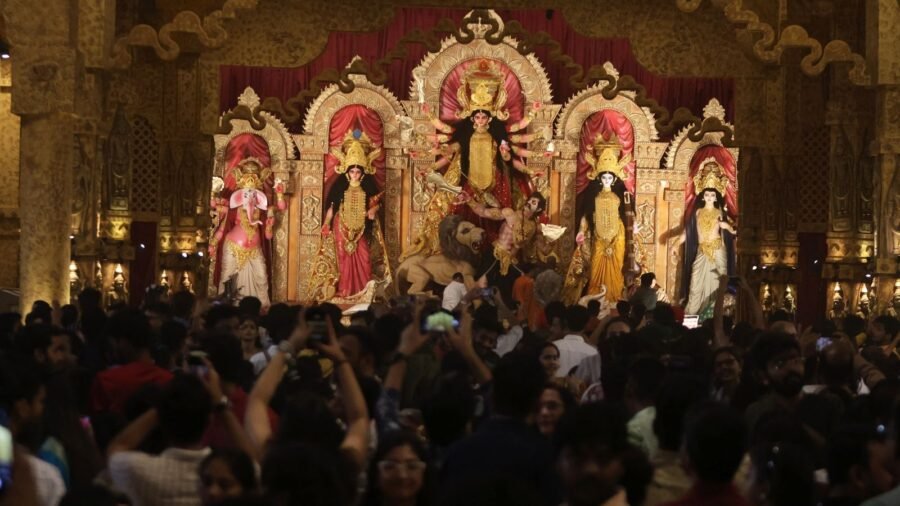
The Durga Puja celebration in the state offers a way to understand this. It has always been less about enforcing sameness than about making room — for different rituals, different forms of devotion, and even different reasons for showing up. It has allowed the religious tradition to remain alive by placing it within a larger shared world, where participation does not need a rigid checklist of dos and don’ts. The pandal is simultaneously a sacred space, a work of art and a meeting place. Thousands participate in its rituals; many others partake of its atmosphere, its aesthetics and its communal life. Some come for the pushpanjali, some for the food stalls, and some simply because this is when Bengal comes together. The festival’s rare quality is its capacity to accommodate different degrees and forms of participation.
That may be the essence of the state’s sharodotshob — not that everyone worships in the same way, but that, for a few days every autumn, multitudes can find themselves as part of the same celebration.
Stay well,
Paromita
Recommended Readings:
Kanti Bajpai writes: India and China are at a Nash equilibrium. Will it hold?
Kaushik Das Gupta writes: What has made Delhi so indifferent to the humanity of Dilliwallahs?
Devdutt writes: Not just a target, Manusmriti can be a weapon
Sayu Bhojwani writes: From 9/11 to Zohran Mamdani: From the ashes, a new South Asian political compact

Letters to The Editor — September 14, 2026
By Sohail Khan · 13 Sep
Pakistan’s westward turn — strategic depth or overstretch
By Sohail Khan · 13 Sep

Leave a Reply