78 years ago, how Hyderabad acceded to India: One year of talks, 3 days of military action
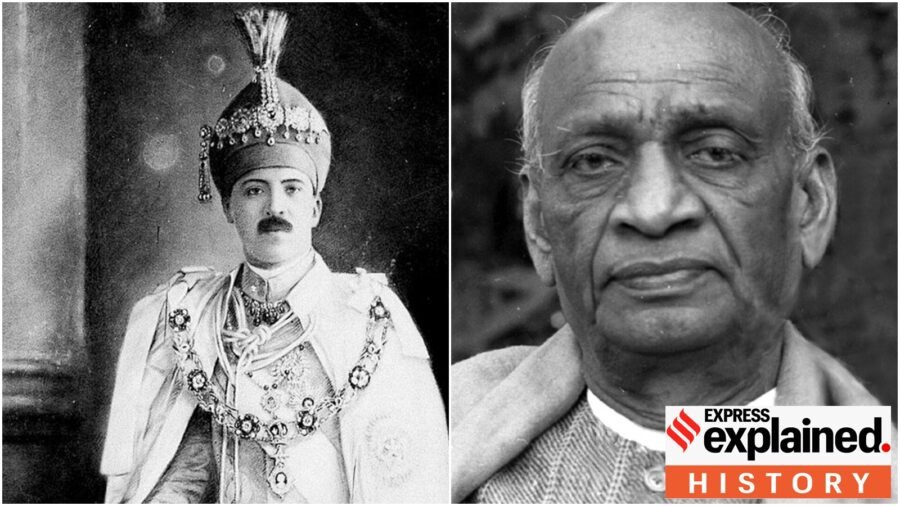
September 17 marks the anniversary of the accession of Hyderabad to independent India. This day in 1948 brought to a close a year-long saga that threatened to make the rich Deccan province a “cancer in the belly of India”, in the words of Sardar Vallabhbhai Patel.
Why did Hyderabad’s Nizam not join India in August 1947, like most other princely states? What made Hyderabad so significant that Patel dealt with it cautiously? What was the role of razakars, and why were peasant movements active against the Nizam? Here’s a brief history.
August 1947: The Nizam’s decision
As the British prepared to leave India, liberating — and dividing — the land they had ruled for close to 200 years, the question of the 500-odd princely states so far under British control arose. The provinces were given the option of joining either India or Pakistan, or remaining independent. While most provinces on the Indian side of the border acceded, some harboured dreams of independence. Most significant among these were Jammu and Kashmir in the North, and Hyderabad in the south.
Story continues below.
Subscribe to see fewer ads.
Founded in 1713, Hyderabad in 1947 was a very large province, comprising present-day Telangana and parts of Karnataka and Maharashtra. Its ruler, Mir Usman Ali or Nizam Asaf Jah VII, was then among the richest men on the planet.
In the opposite situation from Jammu and Kashmir, where a Hindu ruled over a Muslim-majority province, Mir Usman Ali was the Muslim ruler of a Hindu-majority state — but not just any Muslim ruler. His personal wealth and the prestige of his province made him an important figure in the Muslim world. The Nizam’s sons were married to the daughter and niece of the deposed Caliph of Ottoman, Abdulmejid II, who even wanted his daughter’s heir to succeed him as the Caliph.
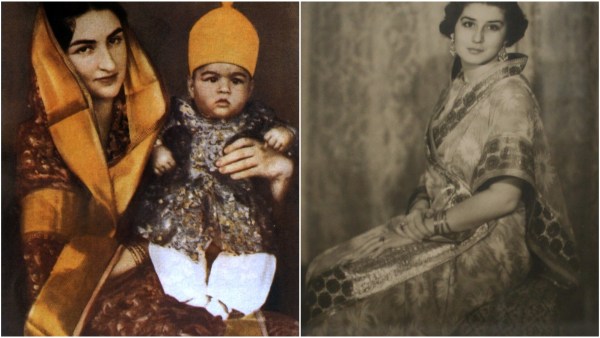 The Ottoman princesses Durrusehvar and Niloufer, the Nizam’s daughters-in-law. In Durrusehvar’s lap is Asaf Jah VIII, the Nizam’s heir. (Photos: Wikimedia Commons)
Mir Usman Ali had also contributed generously to the British coffers during the World Wars, and he believed he could persuade the English crown to recognise and support his state as an independent entity.
To plead his case, he employed a prominent English lawyer, Sir Walter Monckton, a friend of the last viceroy of India, Lord Louis Mountbatten. Monckton told Mountbatten that if India pushed Hyderabad too much, the Nizam would join Pakistan. Historian Ramchandra Guha writes in his book India After Gandhi that from Pakistan’s side, Muhammad Ali Jinnah “had gone so far as to tell Lord Mountbatten — erroneously — that if the Congress ‘attempted to exert any pressure on Hyderabad, every Muslim throughout the whole of India, yes, all the hundred million Muslims, would rise as one man to defend the oldest Muslim dynasty in India’.”
Story continues below this ad
Sardar Patel moved patiently with Hyderabad. In November 1947, India and Hyderabad signed a stand-still agreement, which meant ties between India and the state would continue as they had under the British. Meanwhile, negotiations continued.
In April 1948, Prime Minister Jawaharlal Nehru said at a Congress session in Mumbai that while the government “will not be hustled into any course of action which might militate against the prestige of the Government”, “I agree with Sardar Patel that nothing short of a satisfactory and honourable solution would be acceptable to the Government of India. There need be no apprehension that the Government of India will give away any of India’s basic interests on this issue.”
Revolt and Razakars
While the state actors — KM Munshi from India’s side and dewan Mir Laik Ali from Hyderabad — were negotiating, a revolt against the Nizam’s rule had been brewing within the province. As early as on August 7, 1947, as Bipan Chandra and others write in the book India Since Independence, the Hyderabad State Congress had launched a satyagraha for democracy in the province. In the rural areas, a Communist-led peasant movement, against large landholdings, forced labour and excessive tax collection, was gaining strength.
In the midst of this, an outfit meant to cement the Nizam’s position was getting more violent.
Story continues below this ad
The Ittehad-ul-Muslimeen had started off as a political outfit to demand greater say for Muslims, but after Qasim Razvi, a close aide of the Nizam, took over, it gained a communal and extremist tinge. Razvi also set up, with state support, a paramilitary called ‘razakars’, who began brutally attacking opponents of the Nizam.
Sardar Patel was fast losing patience. In June 1948, he wrote to Nehru: “I feel very strongly that a stage has come when we should tell them quite frankly that nothing short of unqualified acceptance of accession and of introduction of undiluted responsible government would be acceptable to us.”
The government still tried to make the accession happen peacefully through talks. Meanwhile, more and more arms were being brought into Hyderabad.
Operation Polo
Eventually, on September 13, 1948, the Indian Army was sent to Hyderabad under Operation Polo. In three days, the Nizam’s forces surrendered. On the night of September 17, the Nizam made a public address on the radio, banning the razakars. Six days later, he made another address, in which Guha quotes him as saying that Razvi and his men had taken “possession of the state through Hitlerite methods while he had been “anxious to come to an honourable settlement with India”.
Story continues below this ad
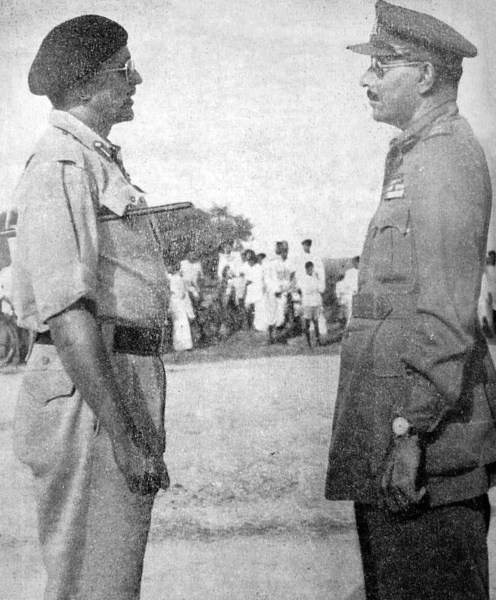 Major General El Edroos (right) offers surrender of the Hyderabad State Forces to Major General (later General and Army Chief) Jayanto Nath Chaudhuri at Secunderabad.
For India, the accession of Hyderabad was not just a huge problem solved, but also a triumph of the secularism the Indian state stood for. Indian Muslims had backed the government fully, and the picture Jinnah had painted had not even come close to materialising. Sardar Patel shared this view.
Bipan Chandra and others quote Patel as writing, “On the question of Hyderabad, the Indian Union Muslims have come out in the open on our side and that has certainly created a good impression in the country.”



Leave a Reply