Why flights are cancelled during rain: it is not just visibility
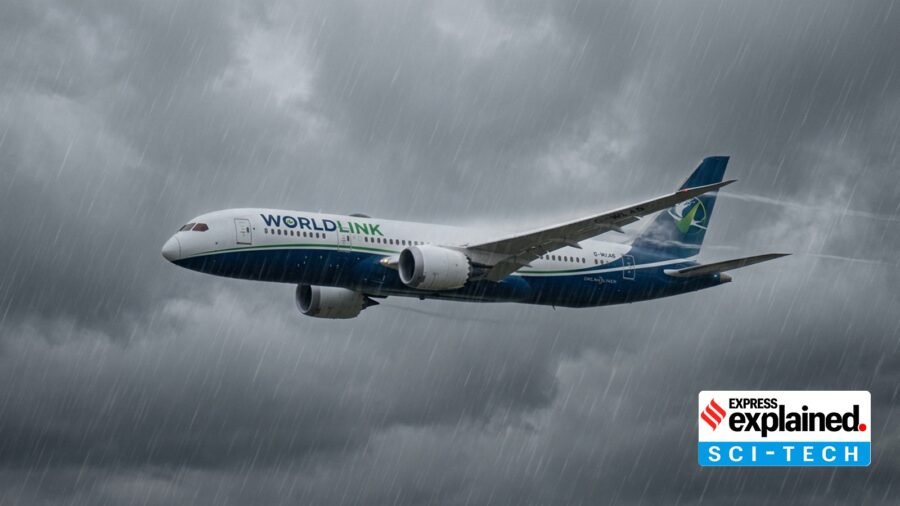
Heavy rain and thunderstorms disrupted flight operations in Delhi on Monday, with 26 flights cancelled and 15 diverted.
Modern commercial aircraft are built to operate in poor weather, and pilots and airports are equipped with adequate technology to operate in sub-optimal conditions. So why does heavy rain still disrupt flight operations?
What happens to a flight during heavy rain?
Rain can reduce the pilot’s visibility, but that is not the main problem. In fact, commercial airlines pilots are trained in instrument flying, which means that they can fly guided by the instruments in the cockpit, rather than what they can see outside the plane. Thus, when the aircraft is high up enough, rain is not a major problem.
Story continues below this ad
It is a much bigger impediment in taking-off and landing. Heavy showers can produce spray from the runway, while rain and low cloud can reduce the distance at which pilots can see lights, markings, and even obstacles on the runway.
Pilots do not simply decide whether they can see enough. They work with defined operating conditions, including runway visual range (RVR), the distance over which a pilot positioned over the runway can see markings or lights.
It is on the runway that the plane has the risk of sliding off, hitting a ground vehicle or even another plane, because a wet runway can affect braking and directional control.
Aircraft tyres need friction with the runway to slow down after landing. Water reduces that friction, and heavy rain can create standing water, increasing the risk of reduced braking performance or hydroplaning. The American government’s Federal Aviation Administration (FAA) specifically advises pilots to monitor runway-condition reports and warns that braking conditions can deteriorate rapidly on wet runways.
Story continues below this ad
Thus, many of the flight delays and diversions is because runway clearance is slower.
Rain doesn’t always come alone
Rain can often be accompanied by thunderstorms and strong winds.
Thunderstorms can produce strong and rapidly changing winds, wind shear, downbursts, turbulence, hail and lightning. The FAA advises pilots not to take off or land in the face of an approaching thunderstorm because a sudden gust can create dangerous wind changes.
For aircraft, crosswinds are more dangerous. As Minneapolis’ Metropolitan Aircrafts Commission explains, “Runways are built to align with historical wind patterns specific to each airport because aircraft land and take off into the wind.” Strong winds blowing across an airplane’s path can make landing and take-off difficult, as pilots have to angle the plane’s path in relation to the wind.
Aircraft are built to survive rough weather
Story continues below this ad
However, none of this means flights are inherently dangerous in rough weather.
Commercial aircraft are designed to withstand severe weather conditions.
Aircraft have systems to remove rain from the windscreen and to protect against icing, while their engines are certified to operate in precipitation. Their structures and systems are also designed to deal with lightning strikes.
As the US government’s National Weather Service says, “Commercial transport passenger planes are hit by lightning an average of one or two times a year. They are designed and built to have conducting paths through the plane to take the lightning strike and conduct the currents.”
This basically means that the body of the aircraft provides a conductive path that allows the electrical current to travel around the structure and exit elsewhere, leaving the inside safe.
Story continues below this ad
How do pilots land when they cannot see the runway?
This is where the Instrument Landing System (ILS) and the CAT system come in.
ILS uses radio signals from ground equipment to provide an aircraft with precise lateral and vertical guidance towards the runway. Airports and aircraft can be approved for different categories of low-visibility operations.
In India, the Airports Authority of India defines CAT I operations as approaches with a decision height of at least 200 ft and specified visibility/RVR minima. CAT II allows lower decision heights and lower RVR, while CAT III operations permit approaches in much poorer visibility. CAT III is further divided into IIIA, IIIB and IIIC depending on the permitted decision height and RVR.
Story continues below this ad
Apart from technology, pilots, crew, and ground personnel are all highly trained to ensure safe flight operations in poor weather.

‘What’s for lunch when your restaurant is travelling at 28,000 km/h?’
By Sohail Khan · 28 Sep
How South Africa’s new exchangeable pitches could shape the 2027 Cricket World Cup
By Sohail Khan · 28 Sep
The mindset shift Virat Kohli is talking about: ‘Promised myself…to play more freely’
By Sohail Khan · 28 Sep